Designing the 'Human × AI' innovation engine.
Artificial Intelligence is rapidly moving from experimental pilot projects into the operational core of organizations.
Yet the true shift is not about adopting new tools. It is about redesigning workflows, redefining roles, and rethinking how innovation itself is structured. In a world where data can be processed instantly, patterns can be detected at scale, and ideas can be generated in seconds, the competitive advantage no longer lies in access to technology. It lies in how deliberately and responsibly that technology is integrated into the way teams actually work.
This chapter argues that integrating AI into innovation workflows is no longer optional. It is essential. Markets are accelerating, customer expectations are evolving, and complexity is increasing across industries. Teams that rely solely on traditional, manual processes will struggle to keep pace. At the same time, organizations that rush to automate without structure risk creating confusion, ethical blind spots, and diluted accountability. The challenge is not whether to use AI, but how to embed it into existing Jobs-to-be-done in a way that strengthens clarity, ownership, and impact.
Innovation is rarely the result of isolated brilliance. It emerges from a repeatable process that guides teams from discovery to definition to delivery. When this process remains implicit, the introduction of AI often becomes chaotic. Tools are layered onto unclear workflows, responsibilities blur, and decisions lack traceability. By contrast, when the innovation process is decomposed into clear stages and actionable tasks, AI can be applied with precision. Each job within the workflow can be evaluated: Where does AI accelerate analysis? Where does it enhance ideation? Where must human judgment remain central?
This chapter provides a guiding framework to make that integration intentional. It begins by mapping the innovation journey into distinct stages, such as Discover, Define, and Deliver, and then further into concrete tasks that can be observed, measured, and improved. For each task, the framework asks three essential questions. First, can AI meaningfully augment or automate this activity? Second, what ethical considerations must be addressed before doing so? Third, who remains accountable for the final outcome?
Ethical integration requires more than compliance. It demands transparency in how models are used, clarity about data sources, awareness of bias, and explicit human oversight. When AI contributes to research synthesis, scenario modeling, or concept generation, teams must understand the limitations of those outputs.
When AI supports decision making, a human must remain responsible for interpreting recommendations and weighing broader implications. Responsibility cannot be delegated to an algorithm. It must always reside with a person who is empowered and prepared to stand behind the result.
This shift also invites a deeper reflection on what humans uniquely contribute. As AI assumes technical, repetitive, and data-intensive tasks, space is created for distinctly 'Human Superpowers'; to become more visible and more valuable. Creativity allows us to connect disparate insights into coherent narratives. Empathy enables us to understand unarticulated customer tensions. Ethical judgment helps us evaluate not only what can be built, but what should be built. Strategic intuition guides direction in moments where data is incomplete or ambiguous.
When organizations clarify these roles, collaboration between humans and AI becomes complementary rather than competitive. AI can expand the range of options considered, accelerate experimentation, and surface hidden patterns. Humans can interpret meaning, define purpose, and make principled decisions. Together, they can move faster without sacrificing depth, and scale innovation without eroding accountability.
The framework presented in this chapter is therefore not merely a technical blueprint. It is an operating model for 'Human × AI' collaboration. It outlines what must be in place before AI is embedded into workflows, including defined processes, explicit responsibilities, ethical guardrails, and leadership commitment to clarity. It demonstrates how decomposing work into Jobs-to-be-done enables both scalability and learning, while ensuring that final responsibility remains unmistakably human.
Integrating AI into innovation workflows is not about replacing people. It is about elevating the system in which they operate. When done thoughtfully, it allows organizations to increase efficiency, deepen insight, and unlock higher-order creativity. Most importantly, it ensures that as technology advances, human intention and accountability remain at the center of progress.
The new superpowers: Essential abilities of humans and generative AI.
We've seen that in the age of AI, the human element in innovation is more crucial than ever. But what does it truly mean to collaborate with AI effectively? In a world where AI invades the creative process, where can humans add the most value? This chapter digs into your role as a human. What are the mindsets, skills, and tools that will make you even more indispensable, and how can you continue to add value in a landscape transformed by AI?
By exploring 'Human Superpowers' like creativity, empathy, and ethical judgment, we'll show how your unique strengths bring purpose, insight, and vision to every AI-driven process. While AI might handle the how, only humans can provide the why. With qualities like empathy to steer user-centered insights, creativity to break new ground, and ethical oversight to maintain integrity, humans ensure that innovation remains both meaningful and impactful.
This chapter is both a roadmap and a call to action, encouraging you to leverage AI as a tool while doubling down on what makes us distinctively human. Whether you're a product manager, designer, or strategist, understanding what to focus on when working with AI will be key to thriving, and innovating, within this new landscape.
To become more innovation-ready and improve the success rate of our innovation process we can use the Discover, Define, and Deliver framework combined with (generative) AI. However, offloading more and more tasks rooted in today's complex and manual innovation process to AI will have a big impact on us, the human innovators. As said before, the future is about 'Human × AI' collaboration, as AI and humans have complementary powers that can work together.
To understand what that means and how we can position ourselves for success in the future, let's compare what AI and humans can do first.
Some (gen) AI superpowers today:
| Analysis | Prediction | Generation | Automation |
|---|---|---|---|
| Data processing and analysis | Predictive analytics | Content generation | Instruction following |
| Natural language processing | Agents | ||
| Classification |
Generative AI can help us reinvent and evolve how we are tackling the challenges in specific Jobs-to-be-done in innovation in 3 ways:
Speed up cycles: AI can speed up the process, allowing for more experiments and iterations.
Improve the quality of hypotheses: AI can help to incorporate more data and do more research, improving the quality of the problem description and the solutions developed.
Increase efficiency: AI makes it possible to access a wide range of skills without a need for an expert for every task.
While this is all true, we need to understand what should be the focus of the humans, what AI can do, and how we can better amplify the strength of the human and the power of AI to reinvent innovation process and make it more efficient on the one hand, and more collaborative and playful on the other.
At its core, the human role in AI-driven product management is about guiding AI systems toward human-centric goals. AI, despite its computational power, lacks purpose, empathy, and ethical boundaries. Humans bring the essential qualities, our 'Human Superpowers', to AI-driven processes that make innovation not just functional but meaningful.
'Human Superpowers' are the cognitive, emotional, and interpersonal abilities that uniquely position us (as opposed to AI agents) to drive the innovation process forward.
Each superpower plays a key role in navigating the complexity and uncertainty inherent in innovation, fostering creativity, problem-solving, and resilience.
These human qualities are particularly relevant as we navigate a world where AI can generate content, make decisions, and even simulate human-like interactions. Our value lies not in competing with AI but in elevating it. By focusing on empathetic understanding, creative thinking, critical evaluation, and ethical direction, we guide AI toward outcomes that resonate with human needs and values. This section explores how we can embrace these 'Human Superpowers' and apply them in our personal and professional lives.
The 'Human Superpowers'.
'Social Superpowers' Empathy and diversity
Humans, particularly in leadership roles like product management, have an innate ability to connect deeply with other humans, something AI cannot replicate. A product manager serves as the voice of the customer, ensuring that AI-generated solutions resonate with human experiences, addressing pain points and desires that data alone may not capture. While AI can predict behavior patterns, it cannot feel human emotion, nor does it bring diverse perspectives and experiences to its analysis. By prioritizing empathy and diversity, humans guide AI outputs toward solutions that truly align with and enhance the human experience.
Collaboration
Product managers play a crucial role in bridging the divide between human teams and AI systems, fostering collaboration that leverages the strengths of both. This requires clear communication and collaboration within multidisciplinary teams, ensuring that AI functions as an integrated partner rather than an isolated tool. The product manager facilitates the collaboration necessary for innovation, coordinating input from designers, developers, users, and AI systems to create products that are truly holistic.
'Intuitive Superpowers' Creativity
AI is fundamentally an optimization tool; it works within predefined frameworks and data constraints. True creativity: The ability to envision entirely new possibilities and reframe problems, remains a distinctly human trait. Product managers spark innovation by imagining products and experiences that do not yet exist, using AI to bring novel ideas to life. While AI can iterate based on past data, it lacks the ability to fundamentally reshape the context of a problem or envision new solutions, tasks that require human creativity and lateral thinking.
Curiosity
In an ever-evolving AI landscape, a product manager's curiosity drives continuous improvement and adaptation. This lifelong learning mindset ensures that humans stay at the frontier of what AI can achieve, constantly pushing boundaries, learning from past experiments, and exploring new opportunities. This curiosity fuels innovation, ensuring that the human spirit of discovery remains central in an AI-augmented world.
'Analytical Superpowers' Critical thinking
Product managers excel in critical thinking, bringing judgment and strategic oversight to keep AI outputs aligned with long-term goals. While AI can analyze vast amounts of data, it is the human who interprets, questions, and contextualizes this data to uncover deeper insights. Humans are uniquely equipped to recognize when data fails to tell the full story, applying critical thinking to sense gaps, inconsistencies, or opportunities that AI might overlook.
Attention to detail
While AI excels at identifying patterns, product managers apply attention to detail to refine these insights and ensure they meet high standards of quality and user relevance. This meticulous oversight ensures that AI-driven products are carefully tuned to user needs and aligned with the broader objectives of the project. A human touch ensures that AI outputs are polished, functional, and reflective of the nuanced world of human experiences.
'Moral Superpowers' Ethical judgment
One of the most profound roles humans play in AI-driven innovation is as ethical stewards. AI operates based on data and rules, often mirroring the biases or blind spots present in its inputs. product managers bring ethical judgment to ensure that AI systems operate with respect for human dignity, fairness, and transparency. They recognize potential harms and make decisions based on values, balancing the drive for innovation with responsibility, and prioritizing the greater human good over mere efficiency.
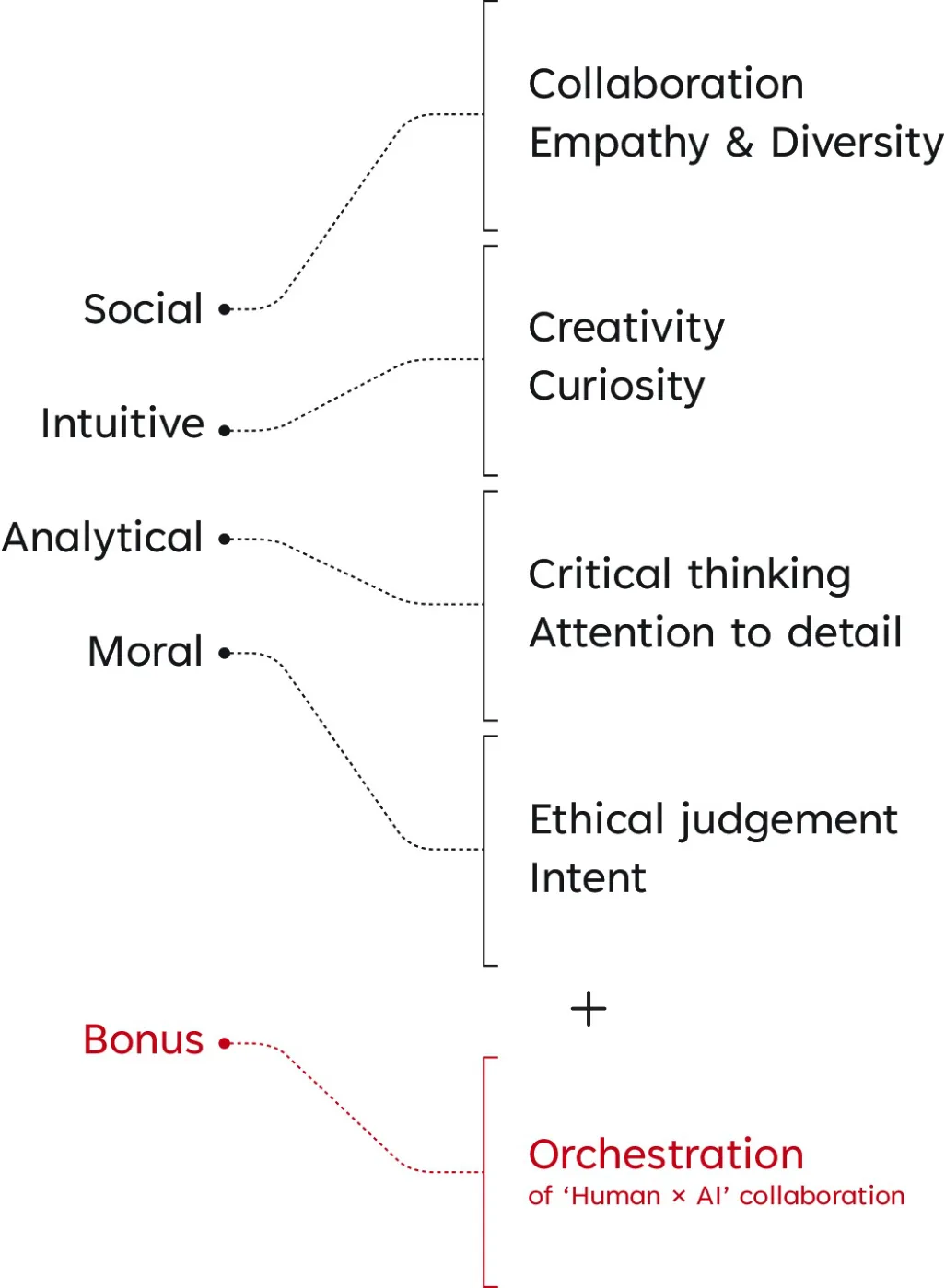
Intent
AI lacks intrinsic intent; it does not know “why” it does what it does. Product managers, on the other hand, bring intentionality to AI systems, guiding them with purpose and meaning. This role involves setting the moral compass for AI projects, ensuring they serve not only functional goals but also align with values that uplift humanity. The product manager's intent shapes AI's direction, ensuring its applications reflect ethical considerations and societal needs.
Orchestration of human-AI collaboration
(Bonus superpower) In the Discover, Define, and Deliver stages, product managers act as conductors, orchestrating a seamless collaboration between AI and human teams. They determine when to delegate routine tasks to AI, when to partner with AI to augment decision-making, and when to lead by applying uniquely human insights. This orchestration requires an understanding of both AI's capabilities and limitations, enabling the product manager to meaningfully integrate AI into workflows.
The human role is not simply to use AI but to curate and direct its application, selectively deploying AI where it enhances creativity and innovation while consciously overriding it when ethical or strategic judgment is required.
Tool
'Complexity/Ambiguity' map.
- PERSONAL
- map your insights
- ± 90 MIN
- session
- 2-6
- people per group
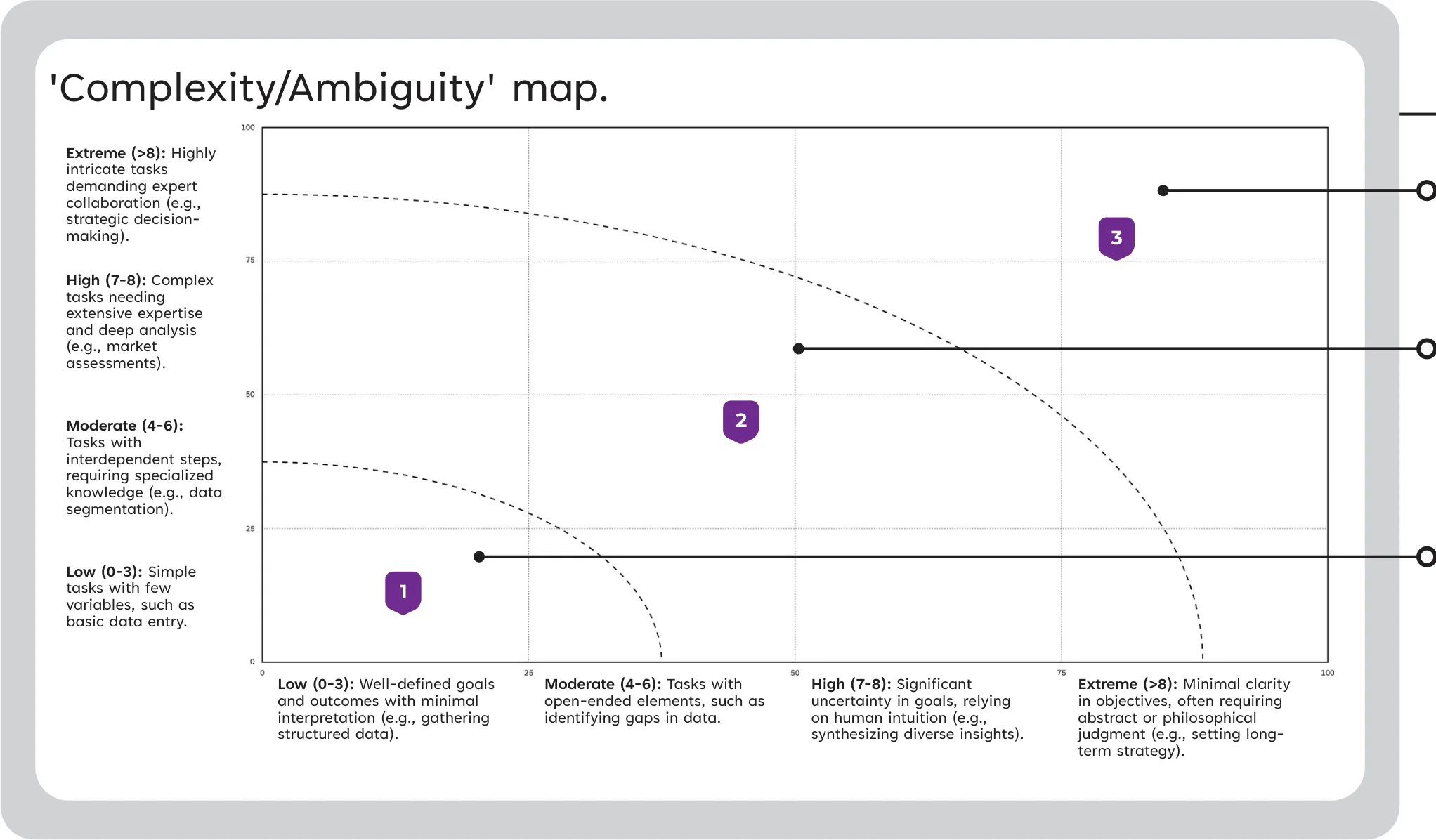
To optimize 'Human × AI' collaboration, selecting the appropriate mode (Delegate, Partner, or Lead) is essential. Each mode aligns differently with tasks based on their complexity and ambiguity. This approach allows individuals and teams to maximize efficiency and effectiveness by leveraging AI's strengths where they make the most impact.
We can use the ''Complexity/Ambiguity'' diagram to categorize tasks. Here, complexity is the intricacy and required expertise of a task, while ambiguity reflects the clarity of objectives and outcomes. Each task can be positioned within this diagram, helping determine the best collaboration mode.
Complexity (here: y-axis) assesses how multifaceted a task is in terms of dependencies, expertise, and number of variables:
- Low (0-3): The task is straightforward, with few variables or steps, and requires little expertise. It can be handled with minimal thought or effort (e.g. simple data entry).
- Moderate (4-6): The task has multiple steps or variables, requires some specialized knowledge, and involves moderate interdependencies or coordination (e.g. organizing segmented data).
- High (7-8): The task involves many interconnected parts, multiple areas of expertise, and significant dependencies. It requires deep analysis and problem-solving (e.g. assessing market opportunities).
- Extreme (>8): The task is deeply intricate, involving highly specialized knowledge, numerous dependencies, and a vast amount of information to manage. It may require teams of experts to collaborate (e.g. finalizing insights that impact strategic decisions).
Ambiguity (here: x-axis) gauges how defined a task's goals or outcomes are, measuring the need for interpretation:
- Low (0-3): The task has clearly defined goals, criteria, and outcomes, with little to no room for interpretation (e.g. gathering raw data with set parameters).
- Moderate (4-6): The task has some open-ended elements, requiring interpretation or judgement, but the overall objectives and process are mostly defined (e.g. reviewing gaps and refocusing research).
- High (7-8): The task involves significant uncertainty, with unclear objectives or criteria for success. It requires human intuition and multiple interpretations to proceed (e.g. synthesizing data or identifying gaps in complex datasets).
- Extreme (>8): The task is highly ambiguous with minimal clarity on goals or outcomes. It may involve abstract reasoning or philosophical judgement, where no single "right" answer exists (e.g. defining strategic objectives in rapidly shifting environments).
How to use the 'Complexity/Ambiguity' map Step 1
Score the different tasks from your upcoming workflow in terms of complexity and ambiguity on a scale of 1-10.
Step 2
Place them into the map below, based on the ratings. Map out all tasks to have the full picture of what's ahead.
Step 3 Assign a 'Human × AI' collaboration mode to each task based on what zone they landed in:
Zone 1 = Delegate mode
Zone 2 = Partner mode
Zone 3 = Lead mode
Examples: Defining objectives typically involves high ambiguity and many variables and is most suitable for Lead mode.
Evaluating and synthesizing data or concepts involves moderate complexity and moderate ambiguity and is most suitable for the Partner mode.
Data collection typically is a well-defined task, with well-defined parameters. This can be delegated.
How to apply Human × AI collaboration to your role.
Incorporating AI into your role means re-dividing the work between you and the intelligence now available, not handing your job to a machine. Test every task on two dimensions: ambiguity, how well-defined the task is, and stakes, what a wrong output costs. Low ambiguity and low stakes point to Delegate; high ambiguity with recoverable stakes points to Partner, where AI drafts and you shape; high stakes always point to Lead. The pattern is the same everywhere: delegate the routine, partner on the creative, lead on judgment; what changes per role is where the lines fall.
**Product manager × AI** *Strategy, vision and execution*
Much of the PM workload is information logistics, exactly what AI does well. The model tells you what is happening; only you decide what it means.
Data-driven insights: AI synthesizes market trends, customer feedback and competitor analysis; you start with the picture assembled. → Delegate mode
Delegate routine tasks: reports, stakeholder updates, workflow tracking; the hour-long status update becomes a ten-minute review. → Delegate mode
AI-assisted roadmapping: have AI forecast scenarios, argue for three roadmaps and against your favorite; you still choose the road. → Partner mode
Ethical judgment and vision alignment: guiding direction in line with user needs and company values, the part of the job that grows as the rest shrinks. → Lead mode
Key Human Superpowers: Vision and strategic thinking (Intuitive), Ethical judgment (Moral), Orchestration (Bonus)
Developer × AI Code, efficiency and experimentation
The visible gain is keyboard time; the invisible one is attention. When a function draft costs seconds, trying an idea becomes cheaper than debating it, and the scarce skill moves from writing code to specifying, reviewing and integrating it.
AI for coding assistance: code generation and auto-completion for repetitive tasks; treat output as a junior colleague's draft, reviewed before it ships. → Delegate/Partner mode
Automated testing: AI runs routine tests and finds errors; luxury coverage becomes the default. → Delegate mode
Prototype and experiment: AI builds prototypes fast for early proofs of concept where the goal is learning. → Partner mode
Focus on creative problem-solving: you tackle the challenges needing human intuition, new algorithms, system optimization, user needs. → Lead mode
Key Human Superpowers: Problem-solving creativity (Intuitive), Critical thinking (Analytical), Attention to detail (Analytical)
Designer (UX/UI) × AI Creativity, empathy and user-centered design
AI can generate a hundred layouts; it cannot feel which one will make a user trust the screen. First drafts are nearly free, so explore ten directions and spend the recovered hours where quality is decided: details, transitions, real users.
Speed up design iterations: AI-powered wireframes, layout suggestions and rapid prototyping cut initial draft time. → Delegate mode
Enhance research: AI synthesizes feedback and predicts preferences; patterns buried in hundreds of tickets surface in minutes. → Delegate/Partner mode
Accessibility and usability: AI checks compliance, usability and predicted emotional response before a test group sees it. → Partner mode
Stay focused on user empathy: the tools produce options; your taste decides what deserves to exist. → Lead mode
Key Human Superpowers: Empathy (Social), Creativity (Intuitive), Aesthetic judgment (Intuitive)
Researcher × AI Insight, synthesis and experimentation
The bottleneck was never curiosity but the collecting and cleaning before thinking begins; a three-week literature review now takes an afternoon. Easy evidence raises the stakes on rigor: an AI synthesis can be fluent and wrong, so your value moves from producing findings to guaranteeing they can be trusted.
Automate data collection: literature reviews, trend analysis, survey gathering in hours instead of weeks. → Delegate mode
Synthesize and visualize: AI finds patterns and presents datasets visually, strengthening your recommendations. → Lead mode
Rapid hypothesis testing: simulate scenarios cheaply, saving real studies for the most promising ideas. → Partner mode
Drive insight and strategy: your attention shifts to critical thinking, ethical evaluation and guiding AI toward human-centered outcomes. → Lead mode
Key Human Superpowers: Curiosity (Intuitive), Critical thinking (Analytical), Ethical judgment (Moral)
Make it concrete: audit your own role
The four profiles are starting points. List your ten most time-consuming recurring tasks, using your calendar rather than memory, and classify each with the two-question test; usually three or four sit squarely in Delegate territory while the Lead-mode work you were hired for gets the leftover hours. Start with one task: run human and AI in parallel for two weeks, compare outputs, then hand it over with a review step matching the stakes.
Two rules keep this safe: accountability never transfers, your name is on what ships, so review AI output like a new colleague's; and reclassify quarterly, because tasks migrate between modes as tools improve. Then run the audit as a team: the same Delegate task on four lists is one shared workflow worth automating once, and imbalances surface, a list of all Delegate work signals a role needing redesign, all Lead work signals a bottleneck.
Finally, measure the shift. Reclaimed time evaporates into meetings unless reassigned: when you hand a task to AI, decide what the freed hours are for, and check your calendar against that intention three months later. The success metric is not how many tasks you delegated but whether the work only you can do finally gets the hours it deserves.
Futureproof your workflows.
This process serves as a guide for moving from an initial idea to a tangible, market-ready outcome.
It demonstrates how to break down complex projects into distinct stages, assign Jobs-to-be-done for each stage, and decide where and how AI can best support the process. Here's a step-by-step approach to examining and optimizing your own workflow by using 'Human × AI' collaboration effectively.
The following is a guide to decomposing a typical workflow, defining Jobs-to-be-done, and figuring out where to apply AI.
Step1. Define the stages of your workflow
Start by identifying the major phases of your project from concept to completion. Typical stages include:
- Define: Set objectives, clarify scope, and gather initial insights.
- Discover: Conduct research, generate ideas, and shape requirements.
- Planning and design: Develop initial concepts, design wireframes, or draft early prototypes.
- Testing and validation: Gather feedback, run tests, and validate concepts.
- Launch and evaluation: Finalize, launch, and assess the success or areas for improvement.
These stages provide a roadmap that ensures a structured approach and keeps the project aligned with key objectives.
Step 2. Identify Jobs-to-be-done for each stage
Break down each stage into specific tasks or Jobs-to-be-done. For example:
- In the Define stage, you may need to “Establish project goals”, “Identify stakeholders”, and “Create a kickoff document.”
- During testing and validation, you could include “Create test plans”, “Gather user feedback”, and “Analyze test results.”
- Jobs-to-be-done provide clarity on what needs to be achieved in each phase and help determine the role AI can play. Describe each Job-to-be-done in detail.
Step 3. Prioritize tasks for AI collaboration
Evaluate each Job-to-be-done based on its complexity and ambiguity to decide on the Human × AI collaboration mode:
- Delegate: Ideal for repetitive, low-ambiguity tasks, such as data collection, basic analysis, or organizing information.
- Partner: Suitable for tasks requiring creativity and iteration, where AI provides suggestions or drafts that humans refine.
- Lead: Necessary for strategic decisions, ethical considerations, or highly complex tasks where human oversight is critical.
Prioritize AI involvement in areas where it can save time on routine tasks, enhance creativity, or accelerate data processing.
Step 4. Select the right tools for each mode
Identify tools that align with each collaboration mode:
- For Delegate tasks, consider automation tools (e.g., data scrapers, report generators) to handle repetitive work.
- For Partner tasks, look for co-creation tools (e.g., AI-driven content generators, design assistants) to facilitate interactive workflows.
- For Lead tasks, use support tools (e.g., AI-assisted analytics, decision-support software) that provide data insights while allowing humans to drive the final decisions.
Choosing the right tools ensures that AI is effectively integrated into your workflow, optimizing both efficiency and impact.
Step 5. Iterate and optimize
As you implement AI in your workflow, continually assess its effectiveness:
- Conduct regular reviews to determine if the collaboration modes are still effective.
- Gather feedback from team members on AI outputs to adjust prompts, refine tool usage, or shift tasks between Delegate, Partner, and Lead modes.
- Over time, optimize the workflow by expanding AI's role in tasks where it proves valuable and limiting it where human judgment remains essential.
- To learn even more, share (parts of) your approach across teams or even organizations, allowing you to use best practices in your process immediately.
By following these steps, you can systematically introduce AI into your workflow, freeing up time for high-value tasks, enhancing creativity, and ensuring that each project phase is well-supported. This structured approach to 'Human × AI' collaboration empowers you to leverage AI not just as a tool, but as a strategic partner in delivering impactful outcomes.
Benefits include
Efficiency gain: Of course, one of the first things that comes to mind when applying generative AI to the innovation process is that we can gain efficiency. In innovation, there are many time-consuming tasks that used to be processed manually, and that limit the speed and output of a 100%-human innovation team. Adding AI can make research much faster and allow for deeper analysis of customer data. Building your own "algorithms" for time consuming tasks means it is cheaper and faster to carry out these tasks, allowing more, faster, and better-quality output.
Re-use and instant scaling: The great thing is, that once you have created such algorithms, you can then re-use them for free. For instance, once you have taught an AI to help in market research, codifying the best practices of experienced researchers, that AI is instantly scalable. You can re-use that very same method for any new project virtually for free.
Learning and continuous improvement: An innovation process that is decomposed into components (both re-usable AI components and human Jobs-to-be-done), has another benefit. The performance of each part of the process can be looked at independently, and when there appears to be room for improvement, that part of the process can be modified independently. Allowing the organization to tweak and tinker with the process in a structured way. That also means, you can learn from past results, and from other teams or even companies.
Refocusing human effort: That leaves us to the last benefit of restructuring the innovation process; the human side. There will always be parts of the innovation process where the magic happens. The "aha moments", the moments of inspiration. These are the things where human input will remain vital. Off-loading the more routine tasks to AI allows us to focus on where we can add real value as human beings.