 Part I
The Break.
Organizations are not slow because they lack ideas, talent, or effort. They are slow because of how the work is designed to move. This part names that design flaw, counts what it costs, and reframes the way forward from collaboration to augmented collaboration.
 Part II
The Principles.
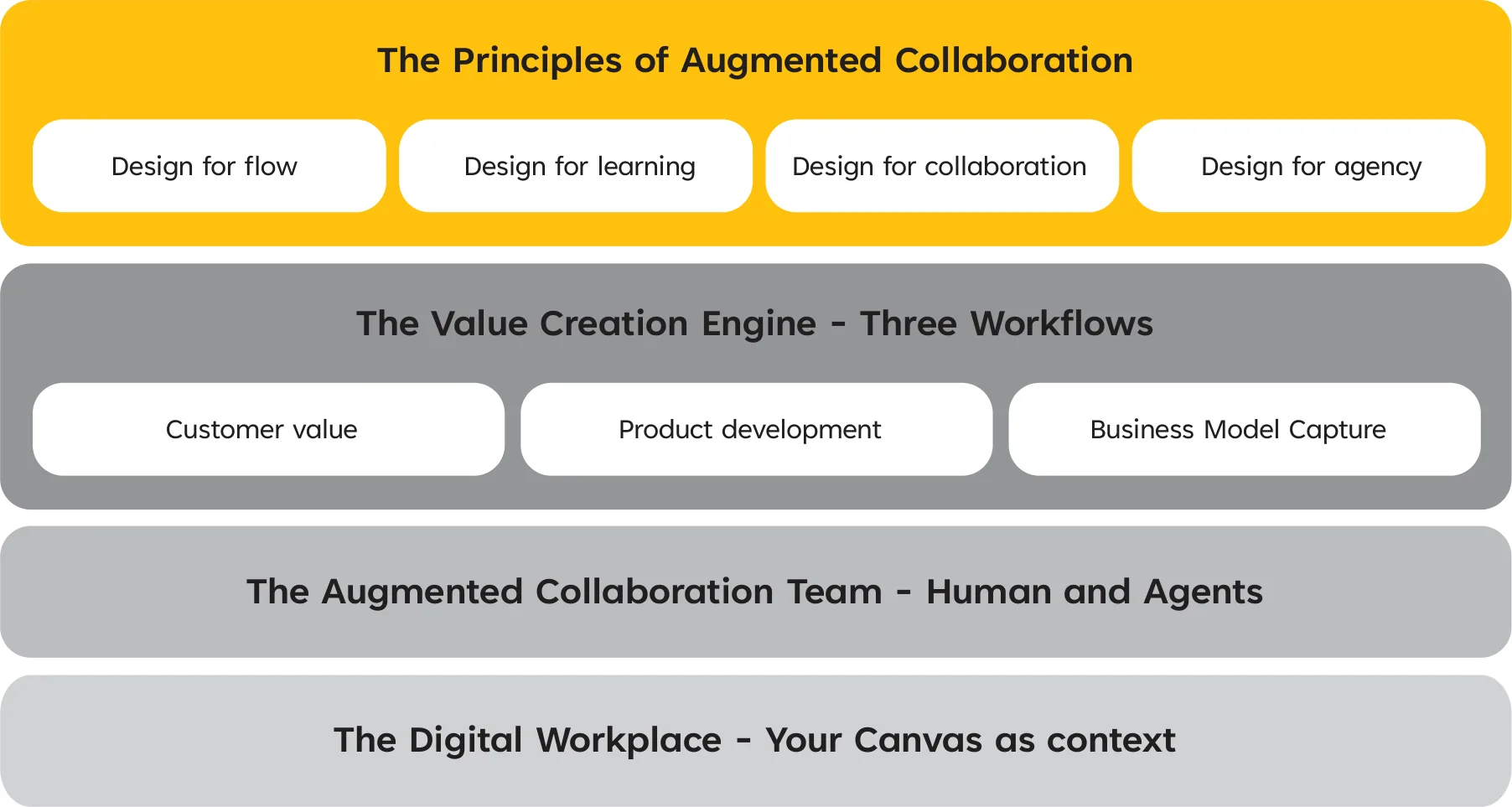
They are not a loose collection of good habits. The principles live inside four design activities that make a Collaborative Operating System work. Design for flow, learning, collaboration, and agency. Together they turn good collaboration from isolated effort into a coordinated capability.
 Part III
The Engine.
This is the heart of the book. Everything before it explains why the old model fails and how a better way of working feels from the inside. Everything from here is the engine itself, the part of an organisation that actually creates value, and the part that has to run differently.
 Part IV
The Team.
AI does not arrive as a replacement, it arrives as an accelerant. The organizations that benefit most are not those that adopt it fastest, but those that embed it most deliberately into how teams think, decide, and deliver. Human judgement sets the direction. AI removes the friction in between.
 Part V
The Organization.
Leadership does not disappear in an augmented organization, it becomes more decisive than ever. The leaders who matter most are not those who decide fastest, but those who make direction so clear that good decisions happen everywhere without them. Clarity sets the direction. Courage keeps it moving.
 Part VI
The Practice.
A Collaborative Operating System only creates impact when it is installed and scaled across the organization. The focus shifts to turning ideas into practice, embedding new ways of working, and expanding them into repeatable, sustainable capabilities.