From an inventory to a position.
Organizations rarely die because one business fails suddenly. They die because the portfolio ages together: every model in the same late phase of its lifecycle, every profit pool mature, and nothing growing up behind them.
The inventory from step 1 makes the businesses visible. Positioning makes the danger visible, because it forces every model to answer two questions at once: how strong are we in this business today, and how much will this market matter tomorrow?
Strength is about the business as it is: market share, margins, customer loyalty, the capabilities behind the model, how defensible the position is. Attractiveness is about the market as it will be: growth, profit pools, technology shifts, regulatory direction, how exposed the space is to disruption. Score each business on both, honestly and with evidence, and resist the urge to average the room's opinions; where scores disagree, that disagreement is information.
Plotted together, the portfolio tells its story in one glance. A cluster in the top right says the organization is riding strong businesses in good markets, and should ask what it is doing for the day those markets mature. A cluster on the left says the future is arriving faster than the capabilities are. And a portfolio spread thinly everywhere says nobody has chosen. The map does not make the choice, but it makes not choosing visible, and that is usually enough to start the real conversation.
The four zones, and what each demands.
- Scale. Strong business, attractive market. These earn the right to more: more investment, more talent, more ambition. The risk here is complacency dressed as prudence, milking a winner instead of extending it.
- Invest. Attractive market, but the business needs capability or capital to win it. These are deliberate bets: fund them properly or do not enter, because a half-funded position in an attractive market is a donation to a competitor.
- Transform. The business matters, the market still wants what it does, but the current model is wearing out: margins compressing, channels aging, the value logic due for reinvention. These need redesign, not just efficiency, and they are where step 3's exploration work usually starts.
- Harvest. Limited future attractiveness, whatever today's numbers say. Manage for cash, wind down with intent, or exit well. Naming this zone out loud is the hardest and most valuable act of the whole session, because every organization has a business it is sentimentally overfunding.
Plotting every model the organization runs or is considering, by how proven it is and how well it fits.
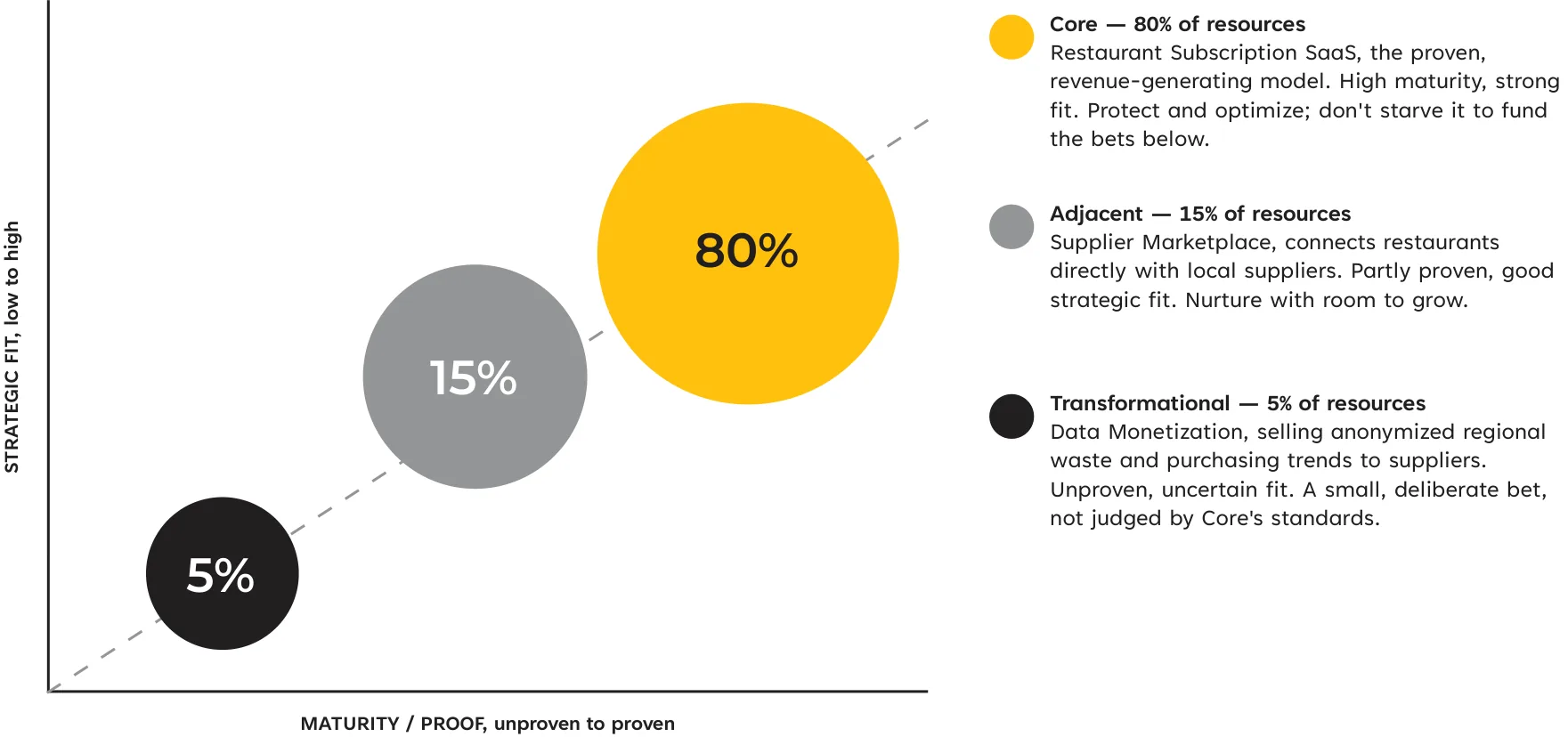
What the canvas is for, and what it is not.
It is worth being precise about the limits of this tool. The portfolio canvas does not decide funding levels, and it does not replace a real financial model or a real strategic debate. What it does is organize that debate so it happens explicitly, with the whole portfolio visible at once, rather than one model at a time in separate conversations where nobody in the room can see the full picture. A leadership team that has never plotted its models this way is often surprised, once they do, by how many resources are quietly flowing to a model nobody had actually agreed was strategic, or how little protection the core business has been getting while attention chases something newer. The canvas does not hand you the answer. It just makes the real question impossible to avoid, and puts it in front of the whole room at the same time, which is often the harder part.
Common ways this step goes wrong.
The most common mistake is judging every model by the core business's metrics, expecting an exploratory bet to show the same margins or growth rate as a mature product within its first year. That reliably kills promising ideas before they have had a fair chance to develop, and it does so invisibly, because a model that never got room to prove itself leaves no evidence of what it might have become. The second is the opposite failure: refusing to ever apply real standards to a pet project, letting it linger in explore indefinitely without ever being asked to prove strategic fit or graduate to real investment. A favored idea can absorb small amounts of money and attention for years this way, never quite failing and never quite succeeding. The third is plotting the portfolio once, at a single planning offsite, and never revisiting it, when a model's position should move as evidence accumulates, and a growth-stage model still managed with explore-stage patience is its own kind of drag. And the fourth is skipping the exercise entirely because the organization believes it only has one business model, when a closer look at where money and attention actually go almost always reveals otherwise. Each of these failures shares a root: a single standard applied to models that have earned very different levels of trust.
What this step hands to the next one.
By the end of this step, the organization has something more useful than a single business model description: an honest map of every model it is actually running or seriously considering, each placed according to how proven it is and how well it fits, with a management approach that matches its position rather than a one-size-fits-all standard applied uniformly. That map is a real achievement, but it is not the end of the work. It shows where each model sits. It does not yet show what each model is quietly betting on.
Because every model on the canvas, proven or not, rests on assumptions, and the map does not say which of those assumptions are most likely to be wrong. The core subscription business assumes renewal rates hold. The marketplace assumes suppliers will show up. The data business assumes anyone will pay for the reports at all. Some of these beliefs are well tested; others have never been checked. Surfacing them, and ranking them so the riskiest ones get tested first, is the job of the step that follows.
That is where Test and Validate picks up. With the portfolio mapped and each model's zone understood, it goes inside each model and asks a sharper question: which specific assumptions is this model actually resting on, and which of them most need testing before further investment follows? Using an Assumption Tracker, it turns a mapped portfolio into a prioritized testing plan, so the organization spends its next round of effort not on the loudest idea or the newest one, but on the single assumption whose answer would change the most.
Tool
Business Model portfolio canvas.
- PERSONAL
- map Business portfolio insights
- ± 90 MIN
- session
- 2-6
- people per group
Mapping out all Business Models within an organization provides the foundation for effective long-term planning.
If a company only has one Business Model their lifecycles are intertwined, once the Business Model reaches its end, so does the company. To prevent such a scenario organizations need to branch out. And ideally not through just one additional Business Model, but multiple. Those being at different stages of maturity, occupying different value spaces, and attracting a different customer segment. And suddenly, managing such a portfolio has become a difficult and messy challenge. That is where the Business Model portfolio canvas comes in.
Most organizations operate several Business Models, not just one. This creates strategic confusion, competing priorities, and governance clashes. Portfolio mapping exposes where different models create and capture value, enabling informed choices. The core purpose is visibility: To see the portfolio, talk about it coherently, and steer it deliberately.
Benefits
- Answers: Where does value come from? Where are dependencies?
- Prevents over-investment in mature models and under-investment in emerging ones.
- Stops forcing incompatible models to share governance.
- Creates shared language via named value spaces.
- Enables intentional, resilient, future-ready portfolio design.
- Surfaces uncomfortable truths about portfolio health.
Limitations and pitfalls
- Don't treat value spaces as markets; they're about value logic.
- Avoid judging new spaces by core metrics.
- Consider geographic differences in viability.
- Keep early iterations simple.
- Revisit regularly; it's a snapshot.
- Involve strategy, finance, operations, and customer-facing teams.
How to use it: The 5-step process: Identify distinct Business Models
- List every model. Don't confuse products, segments, or channels with Business Models.
- Treat offerings with different Value Propositions, revenue logic, or delivery systems as separate models.
Place each in a lifecycle stage
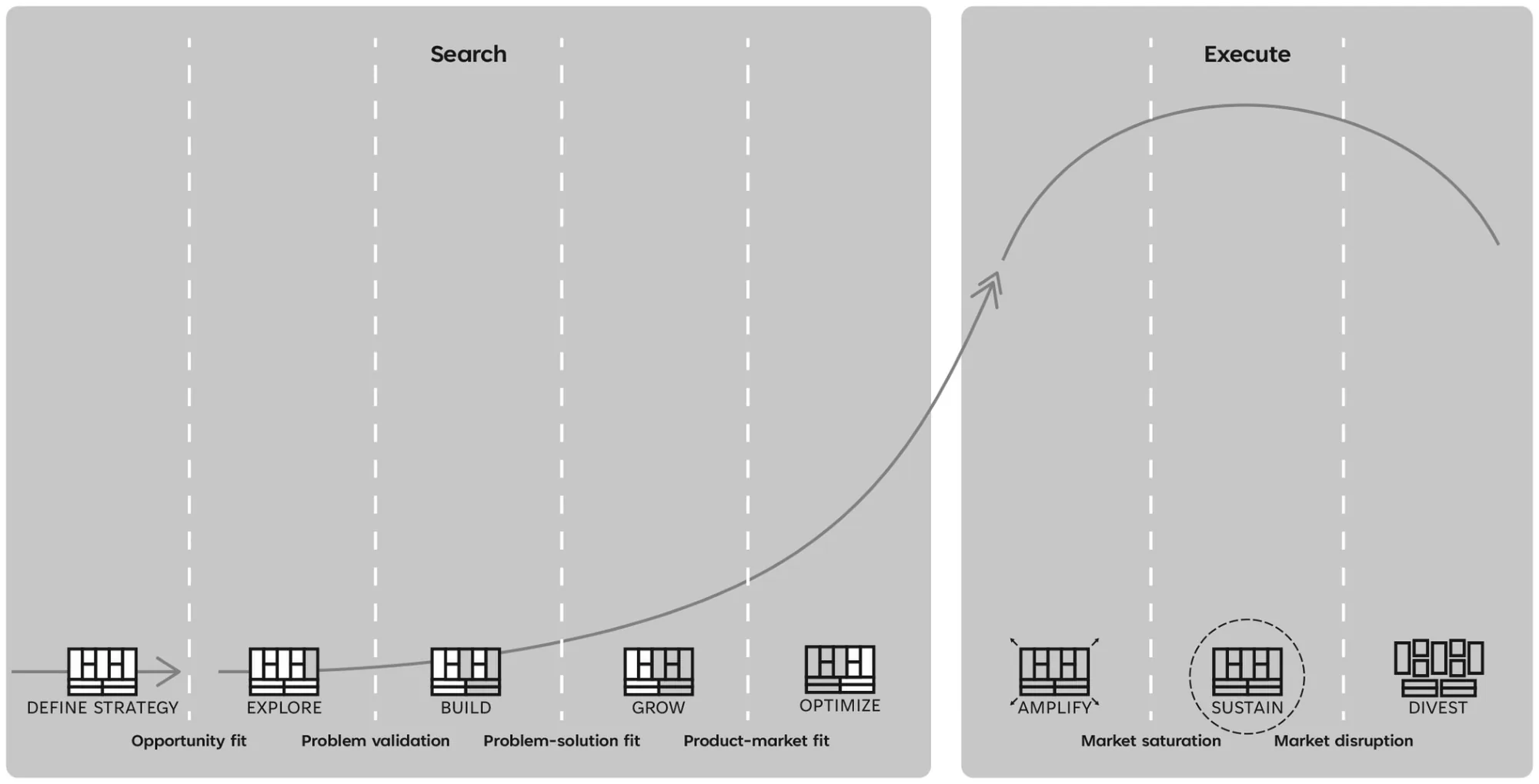
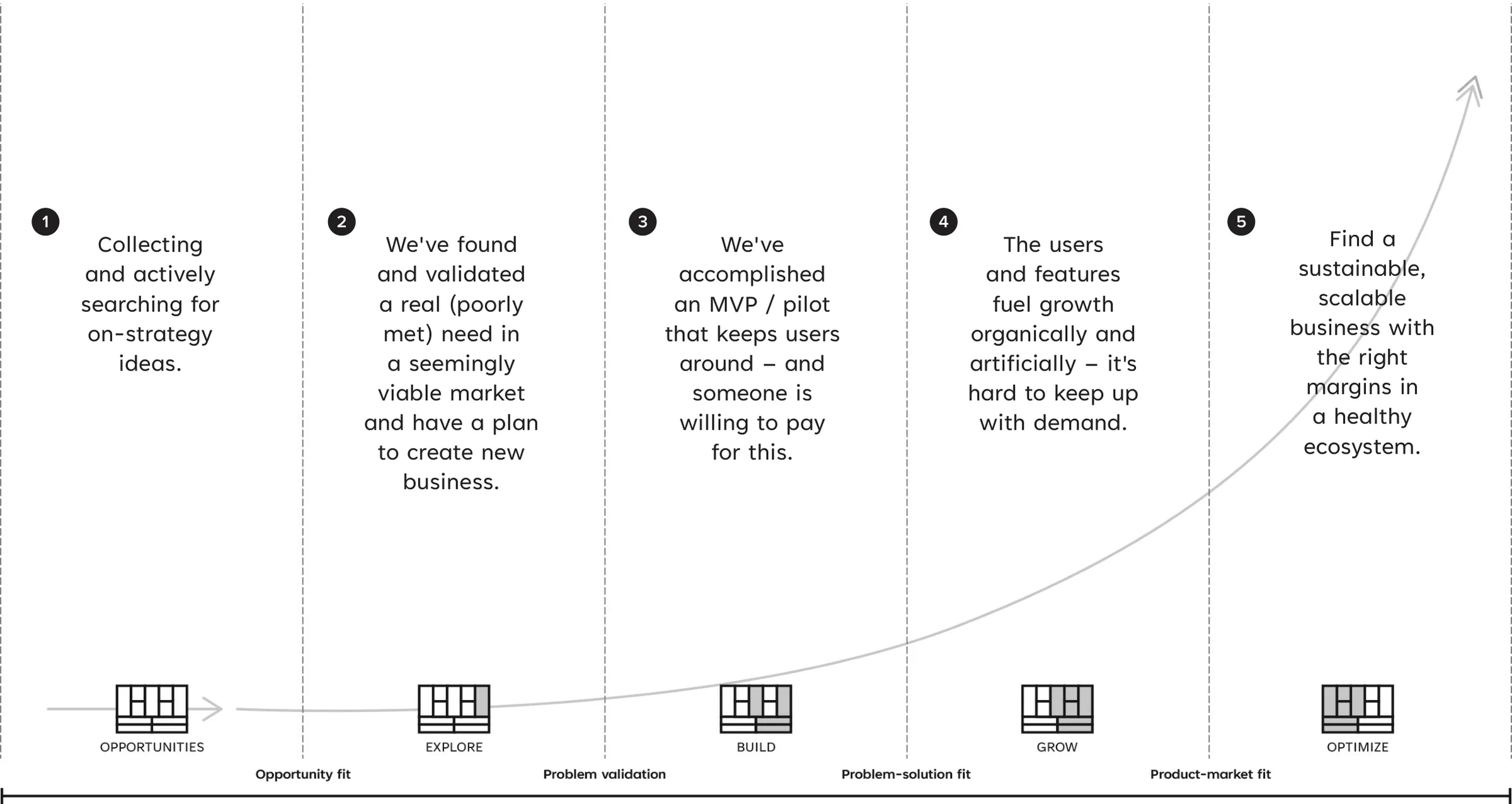
- Ideation; Problem validation; Solution design; Product–market fit; Amplify; Sustain; Divest.
- Use behavioral and structural signals (learning vs. optimizing, assumptions vs. facts, margin trends).
Define value spaces Defined by 5 dimensions:
- Customer type (consumers, SMEs, ...)
- Problem addressed (efficiency, risk reduction, growth, ...)
- Value logic (product sales, platforms, ...)
- Value capture (fees, subscriptions, ...)
- Geography (regions shape feasibility and economics).
Cluster Business Models into value spaces
- Reveal where models compete, where spaces are overexploited, and where promising spaces are unexplored.
- Shift the conversation from “which product?” to “which value spaces and why?”
Assess portfolio balance and risk
- Evaluate lifecycle spread (early to late) and value space coverage (narrow to diversified).
- Healthy portfolios show strong, but not dominant, core spaces. Additionally, emerging activity in adjacencies and exploration, as well as explicit non-pursuits.
Why one Business Model is no longer a strategy.
Most companies don't fail because they do one thing badly. They fail because they do one thing too long. They perfect a Business Model, scale it, squeeze efficiency out of it, build an organization around it, and for a while it works: revenue grows, processes mature, the model becomes "the way we do things around here." Until customers change, technology accelerates, competitors rewrite the rules, and the model becomes a liability. That is why a Business Model portfolio becomes essential: not chasing trends, but acknowledging that no Business Model stays relevant forever. The question isn't if your model will erode, but whether you'll be ready.
Reducing risk by not betting on a single future
Many organizations bet everything on one dominant way of creating value; under pressure, panic follows: cost-cutting, rushed innovation, desperate acquisitions. A portfolio mixes models delivering performance today, models extending what works, and models exploring new value logics. Diversification doesn't dilute focus; it creates strategic optionality and buys time to adapt before disruption becomes decline.
Escaping the trap of short-term optimization
Organizations excel at optimizing the present: KPIs, incentives, and culture serve the core, so the new is judged by the standards of the old. A portfolio forces the questions: what are we optimizing and what not yet, which models deserve efficiency and which learning, where predictability and where exploration? Explicit choices avoid killing tomorrow's business because it doesn't behave like today's.
Turning strategy into a living system
Without a portfolio view strategy stays abstract, pilots disconnected from direction. A portfolio creates coherence, clarifies priorities, and reveals trade-offs; strategy stops being a document and becomes a system of choices guiding decisions across the organization.
Smarter resource allocation, fewer false expectations
A quiet killer of innovation is misapplied measurement: early-stage models expected to deliver mature returns, experiments suffocated by reporting designed for stable businesses. A portfolio legitimizes difference: core models measured on efficiency and profitability, emerging on traction and learning, exploratory on insight and option value. Not lower standards, appropriate ones: the difference between innovation theater and real renewal.
Making innovation intentional, not accidental
Innovation often happens in pockets, driven by enthusiasm, not strategy. A portfolio connects trends, customer shifts, and ambition to concrete choices about value creation and capture. The question stops being "what could we innovate?" and becomes "which Business Models must exist for us to remain relevant?"
Staying aligned with changing customer needs
Customers don't evolve in neat steps; expectations jump suddenly, and one model rarely serves everyone well for long. A portfolio responds with nuance: different models for different segments and moments, pricing, channels, and Value Propositions evolving without one outdated structure forcing everything.
The real point of a Business Model portfolio
The portfolio is leadership maturity, not complexity: accepting that success means managing today's performance, tomorrow's growth, and the day-after-tomorrow's survival at once. Companies that embrace this actively shape the future, and where standing still is the fastest way to fall behind, that may be the most strategic move of all.
Managing a portfolio of Business Models.
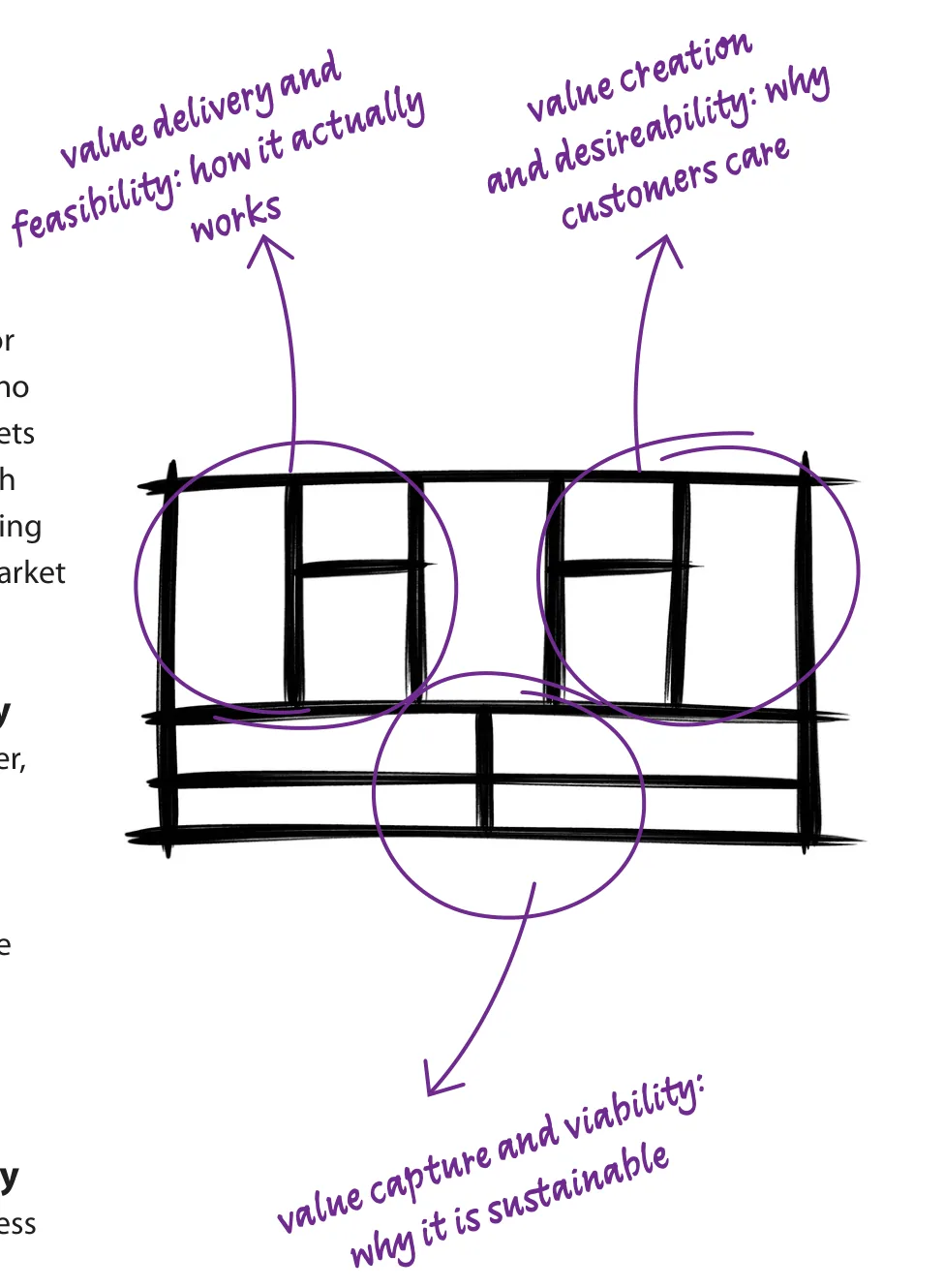
At the heart of every strong Business Model is a solution to a real Customer Problem. The companies that stand the test of time keep a sharp eye on what their customers need, where their pain points are, and what ambitions drive them. In a world where new technologies and competitors constantly emerge, it's no longer enough to lean on a single Business Model. Lasting success requires a portfolio of Business Models, each addressing specific customer challenges and market opportunities, and a deliberate approach to each model's lifecycle keeps organizations agile, growing, and innovating.
Understanding value, Customer Problems, market size, and model structure
Everything begins with a clear grasp of the Customer Problem you're solving. This forms the core of your Value Proposition: what unique benefit do you offer? You also need a realistic view of the market: how big is the opportunity, and is your model really meeting customer needs? Together these insights let you prioritize, invest wisely, and shape a portfolio where every Business Model adds real value and supports sustainable growth.
Lifecycle: The different stages of Business Models
Business Models aren't static; they evolve, from identifying and validating new Customer Problems, to building and scaling solutions, optimizing for efficiency, and eventually retiring models that no longer fit. Knowing where each model stands lets you balance maximizing existing successes with exploring fresh opportunities, and prevents being caught off guard by shifting expectations or market changes.
Multiple models: The power of variety
No single Business Model serves every customer, in every market, forever. Forward-thinking organizations nurture a diverse portfolio, each model targeting a different customer group, problem, or segment. This reduces dependence on any one revenue stream, spreads risk, and encourages ongoing innovation, giving your business more ways to adapt and thrive.
Linking Business Models with strategy
Portfolio management isn't just tracking Business Models; it's making sure they all move the organization in the right strategic direction. Regularly checking whether each model still solves important Customer Problems and fits the long-term strategy maintains focus and alignment, keeping the organization resilient in changing times and sharpening its competitive edge.
Managing today while building tomorrow.
The Business Model portfolio theory by Yves Pigneur, co-developer of the Business Model canvas, is a strategic framework that empowers organizations to manage multiple Business Models simultaneously, much like a financial portfolio.

For more than two decades, Business Model innovation has evolved from a niche concept into a central discipline for organizations navigating uncertainty. Yet one of the most important shifts is still underappreciated: Companies should no longer think in terms of a single Business Model, but in terms of Business Model portfolios. This shift fundamentally changes how organizations design strategy, allocate resources, and govern innovation.
From single models to portfolios
When the Business Model canvas was first introduced, it was primarily a storytelling tool for entrepreneurs, a way to describe and design a future business. But as large organizations adopted it, a new reality emerged.
A large number of companies doesn't operate one Business Model, they operate many. Over time, this led to the concept of a dual portfolio:
- Execution (exploitation) portfolio: Focused on existing Business Models. Here, companies can assess performance using metrics like return and disruption risk. Decisions revolve around improving, scaling, or retiring models.
- Exploration portfolio: Focused on future Business Models that do not yet exist. These are evaluated based on expected return and innovation risk, and require systematic testing and experimentation.
Together, these portfolios represent two fundamentally different time horizons: Today's business and tomorrow's business. Winning businesses don't just protect and optimize their core, they also invest in the future by developing new Value Propositions, testing emerging technologies, and entering adjacent or disruptive markets.
Why every company needs a portfolio mindset
The portfolio approach is not only for large, diversified organizations. Even companies with a single dominant Business Model need it.
There are two key reasons:
- 1. Managing the present: Organizations must understand where their core Business Model sits in its lifecycle and where adjacent projects or Business Models could reinforce it.
- 2. Securing the future: Every company needs a pipeline of new ideas; whether to reinforce, complement, or replace the core business.
This introduces a critical insight: Innovation is not about a single bet, but about managing a funnel.
In practice, only a small fraction of ideas survive. For example, out of hundreds of innovation initiatives, only a handful may reach execution. This implies that a healthy organization must continuously generate, test, and eliminate ideas at scale.
This portfolio-based thinking reduces the risk of stagnation and disruption. It encourages innovation while maintaining operational excellence.
Forexample, a company might maintain a profitable legacy model (exploitation) while simultaneously launching a digital platform (exploration). Overtime, insights from the new model can feed back into the core or even replace it entirely.
Value spaces and Business Model families
As portfolios grow, structure becomes essential. One useful lens is the concept of Business Model families (or what some call value spaces).
Large organizations often operate across distinct domains, each with its own logic. These domains, or “families” cover all Business Models within it that share a similar value logic. It defines how and where an organization creates and captures value, independent of specific products.
Within each “family,” multiple Business Models may coexist. Sometimes reinforcing each other, sometimes competing. Understanding these groupings helps organizations:
- Identify synergies and conflicts
- Allocate resources more effectively
- Decide where to invest, defend, or exit
In exploration, these value spaces guide strategic intent. Leadership may decide where to focus innovation efforts, while teams experiment within those boundaries.
What makes a healthy portfolio?
A strong Business Model portfolio is not defined by success rates, but by balance and throughput. In exploration, a healthy portfolio means:
- A large and diverse funnel of ideas
- A willingness to systematically test and discard weak concepts
- Sufficient volume to ensure that a few strong models emerge over time
Organizations must design for this reality. If only one in ten ideas succeeds, then ten successful Business Models require roughly one hundred serious explorations.
This requires discipline, patience, and a cultural shift: Evidence matters more than opinion, and stopping projects is part of progress.
The governance challenge: Two cultures, one organization
Perhaps the biggest challenge is governance. Execution and exploration require fundamentally different operating models:
| Execution (Exploit) | Exploration (Innovate) |
|---|---|
| Predictability | Uncertainty |
| Efficiency | Experimentation |
| Planning | Learning |
| Low risk tolerance | High risk tolerance |
Trying to manage both with the same structures and metrics is a common mistake and often leads to innovation being deprioritized.
Successful organizations typically:
- Establish dedicated innovation teams
- Give them direct access to top leadership
- Allow different processes, metrics, and culture
- Maintain strong bridges to the core business for scaling
Without this separation, exploration struggles to survive within performance-driven business units.
Beyond products: The Business Model lifecycle
Another key insight is that product innovation is not the same as Business Model innovation. Improving a product may extend its life. But changing a Business Model can redefine the entire game:
- New customer segments
- New revenue mechanisms
- New channels or partnerships
- Entirely new markets
In many industries, product innovation alone is no longer sufficient. External shifts, such as regulation or technological change, can render existing models obsolete, regardless of product quality. This is why organizations must actively manage Business Model lifecycles, not just product lifecycles.
The role of digital tools and AI
As Business Model innovation matures, it is increasingly supported by digital platforms and AI. We are moving toward computer-aided design for Business Models, where tools can:
- Generate and refine ideas
- Track experiments and evidence
- Visualize portfolios in real time
- Support governance and decision-making
AI, in particular, has the potential to:
- Suggest patterns across industries
- Assist in hypothesis generation
- Analyze experimental data
- Recommend portfolio moves
Yet despite these advances, one principle remains unchanged: Tools are only as powerful as the thinking behind them. Conceptual clarity (understanding Business Models, value creation, and experimentation) remains the foundation.
Mastering the dual portfolio
At its core, managing a Business Model portfolio is about resolving a fundamental tension:
- Exploit what works today
- Explore what will work tomorrow
Organizations that master this duality: Balancing discipline with experimentation, efficiency with creativity, are the ones that not only survive disruption, but shape it.
The future belongs to companies that treat innovation not as a side activity, but as a systematically managed portfolio of bets.
Moreover, the Business Model portfolio theory promotes strategic conversations across departments, aligning innovation with business goals and improving strategic foresight. It forces organizations to assess the maturity, profitability, and scalability of each model, encouraging regular review and iteration.
In essence, Pigneur's theory helps businesses build resilience and readiness in uncertain environments. It transforms innovation from a siloed activity into a core strategic capability. By applying this theory, companies increase their chances of sustainable growth, greater customer value, and competitive advantage: Critical ingredients for building a truly winning business in the 21st century.
Mapping your Business Model portfolio.
Once organizations accept that they do not operate a single Business Model but a portfolio of them, a new challenge emerges: How do you make that portfolio visible, discussable, and steerable?
Why portfolio mapping matters
Without a portfolio view, organizations tend to:
- Over-invest in mature Business Models
- Under-invest in emerging ones
- Force incompatible models to share governance
- Confuse optimization with innovation
Mapping your portfolio does not solve these issues automatically, but it creates the clarity required to address them deliberately.
At its core, portfolio mapping helps answer three strategic questions:
- Where does our current value really come from?
- Where are we overly dependent on a single value logic?
- Where are we preparing for future relevance?
Step 1: Identify distinct Business Models
The first step is deceptively simple: List all the Business Models you currently operate.
This is harder than it sounds, because organizations often mistake:
- Products for Business Models
- Customer segments for Business Models
- Channels for Business Models
A good rule of thumb: If two offerings differ meaningfully in Value Proposition, revenue logic, or delivery system, they are different Business Models.
Examples of signals that you have multiple Business Models:
- Different pricing mechanisms (subscription vs. transaction)
- Different customer relationships (self-service vs. managed)
- Different partners or delivery chains
- Different unit economics
At this stage, avoid judging quality or performance. The goal is completeness, not evaluation.
Step 2: Place each Business Model in its lifecycle
For each identified Business Model, determine its current lifecycle stage:
- Ideation
- Problem validation
- Solution design
- Product–market fit
- Amplify
- Sustain
- Divest
This is not about financial size or importance. A small but mature model may sit in sustain, while a large but fragile one may already show signs of decline.
Best practice is to base this assessment on behavioral and structural signals, not optimism:
- Where is most effort spent: Learning or optimizing?
- Are assumptions still being tested or treated as facts?
- Are margins expanding, stable, or under pressure?
Making lifecycle stages explicit often reveals uncomfortable truths, which is precisely why it is valuable.
Step 3: Define your value spaces
Once individual Business Models are visible, the next step is to organize them into value spaces.
What is a value space?
A value space is a category of Business Models that share a similar value logic. It defines how and where an organization creates and captures value, independent of specific products. It is usually defined by five dimensions:
- 1. Type of customers addressed Who is being served (e.g. consumers, SMEs, enterprises, public sector).
- 2. Type of Customer Problem addressed What kind of job, pain, or outcome is being targeted (e.g. efficiency, risk reduction, growth, compliance).
- 3. Value logic or Business Model used How value is created and delivered (e.g. product sales, platform orchestration, outcome-based services).
- 4. Way value is captured How money is made (e.g. transaction fees, subscriptions, licensing).
- 5. Region or country covered Where the model operates, acknowledging that geography often fundamentally shapes feasibility and economics.
Step 4: Cluster Business Models into value spaces
With value spaces defined, cluster your Business Models accordingly.
Some organizations discover they operate almost entirely within a single value space. Others realize they are already spread across several, without acknowledging it.
Important insights often emerge here:
- Where multiple Business Models compete for the same customers with different logics
- Where value spaces are overexploited
- Where promising spaces are unexplored or underdeveloped
This step shifts the conversation from “which product should we build?” to “which value spaces should we be active in, and why?”
Step 5: Assess balance and risk across the portfolio
Now assess your portfolio across two dimensions:
- Lifecycle stage (early to late)
- Value space coverage (narrow to diversified)
Healthy portfolios typically show:
- Strong but not dominant core value spaces
- Emerging activity in adjacent or future value spaces
- Explicit choices about what is not being pursued
Unhealthy portfolios often show:
- Heavy dependence on one mature value space
- Innovation efforts that never leave the core space
- Geographic expansion without Business Model adaptation
Best practice tips
- Make it visual: Use simple maps and clusters, not spreadsheets.
- Involve multiple perspectives: Strategy, finance, operations, and customer-facing teams see different signals.
- Name your value spaces: Naming creates shared language and sharper decisions.
- Revisit regularly: Portfolio maps are snapshots, not truths.
- Link to governance: Different value spaces often require different rules.
Common pitfalls to avoid
- Treating value spaces as markets: They are defined by value logic, not industry labels.
- Forcing everything into the core: New value spaces often fail when judged by core metrics.
- Ignoring geography: A Business Model that works in one region may not translate directly to another.
- Overcomplicating the first map: Clarity beats precision in early iterations.
- Mapping without acting: A portfolio map without decisions is just a poster.
Closing reflection
Mapping your Business Model portfolio is not about control, it is about choice. It allows organizations to see where they are locked in, where they are exposed, and where they still have room to maneuver.
Value spaces provide the language to talk about growth beyond products and markets. Together with lifecycle thinking, they enable leaders to design portfolios that are resilient, intentional, and future-ready.
The real question is not how many Business Models you have, but whether you are consciously managing the spaces in which they live, or simply reacting as they collide.
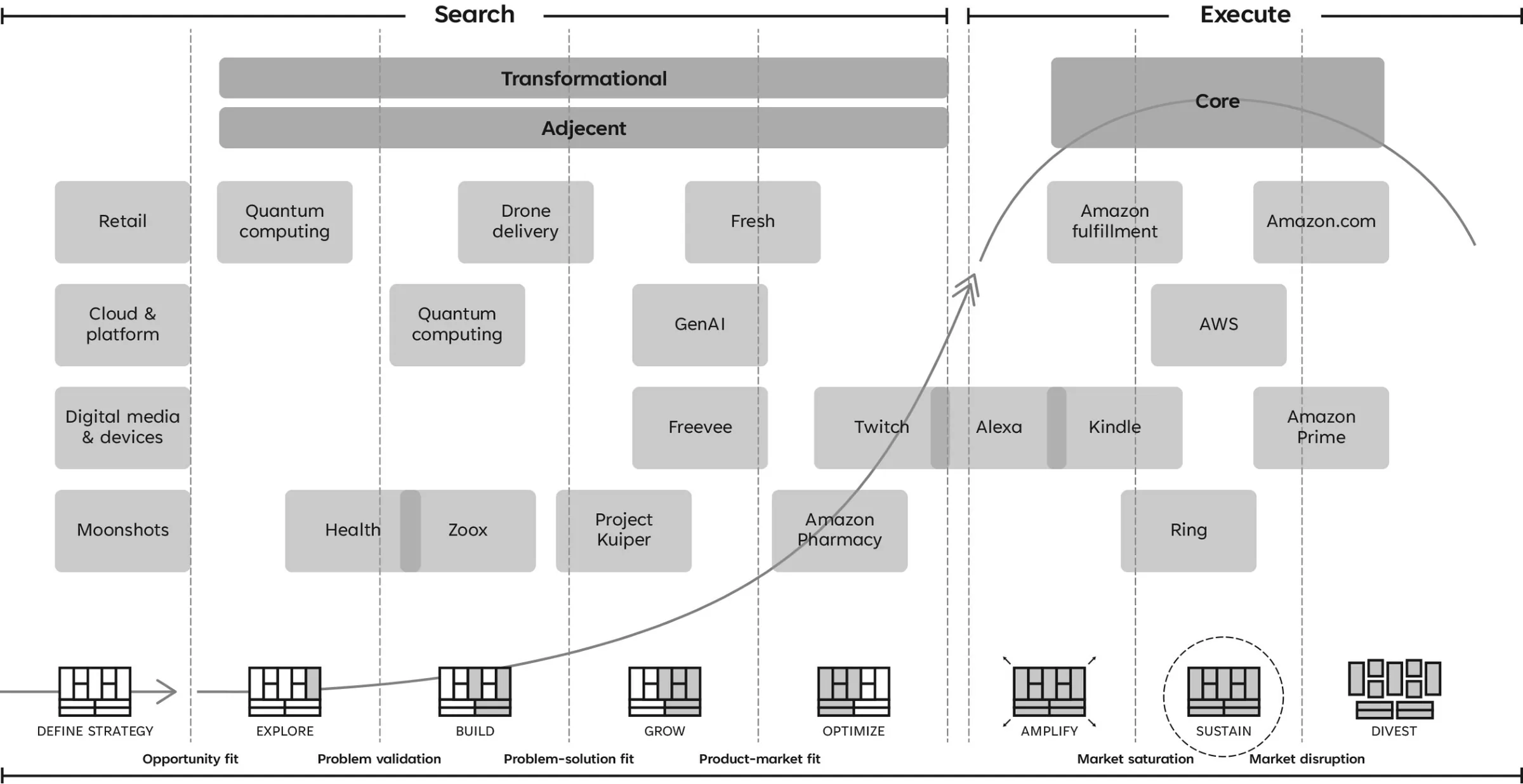
Case study · Amazon
A masterclass in Business Model portfolio thinking.
Amazon is often described as a retailer, a tech company, a logistics giant, or a cloud provider. All of these descriptions are true, and all of them miss the point.
Amazon is not successful because of one dominant Business Model. Amazon is successful because it deliberately operates and orchestrates a Business Model portfolio across multiple value spaces, each with its own logic, lifecycle stage, and strategic role.
What makes Amazon exceptional is not innovation speed, but portfolio discipline.
Amazon's portfolio logic (at a glance)
Amazon's portfolio can be understood as a system of interlocking value spaces, where mature models fund exploratory ones, and where scale in one space reinforces advantage in others.
Crucially, Amazon does not optimize all Business Models for profit. It optimizes the portfolio for long-term strategic power.
Value space 1: Online retail (core, mature)
- Type of customers: Consumers (B2C), increasingly hybrid B2B via Amazon Business
- Customer Problem addressed: Convenience, assortment, price transparency, fast delivery
- Value logic / Business Model: Large-scale marketplace and direct retail combined
- Value capture: Low-margin product sales, marketplace commissions, logistics fees
- Region covered: Global, with strong regional adaptation
Portfolio role
This is Amazon's foundational Business Model but not its profit engine.
The retail model sits largely in the sustain phase of its lifecycle:
- Highly optimized
- Operationally complex
- Margin-constrained
- Capital-intensive
Amazon deliberately keeps margins low here, using retail as:
- A demand engine
- A data generator
- A distribution backbone
Many companies would try to “fix” this Business Model. Amazon treats it as infrastructure.
Value space 2: Marketplace and third-party services (core, cash generative)
- Type of customers: Third-party sellers (SMEs to large brands)
- Customer Problem addressed: Access to demand, logistics, payments, trust, and reach
- Value logic / Business Model: Platform orchestration and enablement
- Value capture: Commissions, fulfillment fees (FBA), advertising, seller services
- Region covered: Global, with strong penetration in North America, Europe, and Asia
Portfolio role
This value space represents a shift from selling products to enabling commerce.
It is in the amplify to sustain phase:
- Scales with ecosystem growth
- Strong margins compared to retail
- Deep lock-in via logistics and data
Importantly, this model feeds on the retail model, but operates under a fundamentally different value logic. Amazon does not confuse the two, even though they share customers and infrastructure.
Value space 3: Amazon Web Services (AWS) (growth → sustain)
- Type of customers: Enterprises, startups, developers, public sector
- Customer Problem addressed: Scalable, reliable, on-demand computing infrastructure
- Value logic / Business Model: Infrastructure-asa-service and platform services
- Value capture: Usage-based pricing, subscriptions, long-term contracts
- Region covered: Global, with region-specific compliance
Portfolio role
AWS is Amazon's most profitable and strategically independent Business Model.
Originally exploratory, AWS moved rapidly through the Business Model lifecycle, reaching its current state: Sustainment.
It operates in a completely different value space from retail. Targeting other customer segments while manoeuvring a different regulatory and competitive landscape.
Most companies would have spun this off. Amazon kept it, but governed it differently.
Value space 4: Advertising (growth, high-margin)
- Type of customers: Brands and sellers
- Customer Problem addressed: Targeted visibility at the point of purchase
- Value logic / Business Model: Data-driven performance advertising
- Value capture: Pay-per-click, sponsored placements
- Region covered: Primarily mature Amazon markets
Portfolio role
Advertising is a value extraction layer built on top of existing ecosystems.
It sits in the growth phase:
- Extremely high margins
- Low incremental cost
- Strong data advantage
Amazon did not start with advertising. It earned the right to it by owning intent-rich Customer Journeys. This is a classic example of value space adjacency.
Value space 5: Subscriptions and ecosystems (Prime, devices, content)
- Type of customers: Consumers and households
- Customer Problem addressed: Convenience, loyalty, entertainment, ecosystem simplicity
- Value logic / Business Model: Bundled subscription and ecosystem lock-in
- Value capture: Recurring subscription fees, cross-subsidization
- Region covered: Selective global markets
Portfolio role Prime is not designed to maximize profit. It is designed to:
- Increase lifetime value
- Reduce churn
- Reinforce all other value spaces
This Business Model is best understood as a portfolio glue rather than a standalone profit engine. It is currently in the amplify to sustain phase.
Value space 6: Exploratory and future options (early-stage)
Examples include:
- Healthcare (Amazon Pharmacy, One Medical)
- Smart home (Alexa, devices)
- Logistics as a service
- AI and foundational models
These operate in:
- New customer domains
- New regulatory contexts
- New value logics
Many will fail. Amazon expects this.
Portfolio role These are future options, deliberately protected from short-term ROI pressure, funded by mature models, and governed with learning as the primary KPI.
What Amazon gets right (best practices)
- Clear separation of value spaces.
- Different models are not forced into one logic; infrastructure is shared while economics stay separated
- Lifecycle awareness
- Mature models fund exploration instead of being endlessly optimized
- Willingness to operate low-margin models
Because portfolio power matters more than individual profitability.
What most companies get wrong when copying Amazon
- Trying to copy AWS instead of copying portfolio thinking
- Expanding into new value spaces without new governance
- Expecting every model to be profitable immediately
Amazon's advantage is not size. It is intentional Business Model portfolio design.
Closing insight
Amazon shows that the question is not: “What is our Business Model?” But: “Which value spaces do we occupy and how do those Business Models reinforce each other across their lifecycles?”
That is the real strategic lesson.