Why we had a #badversion.
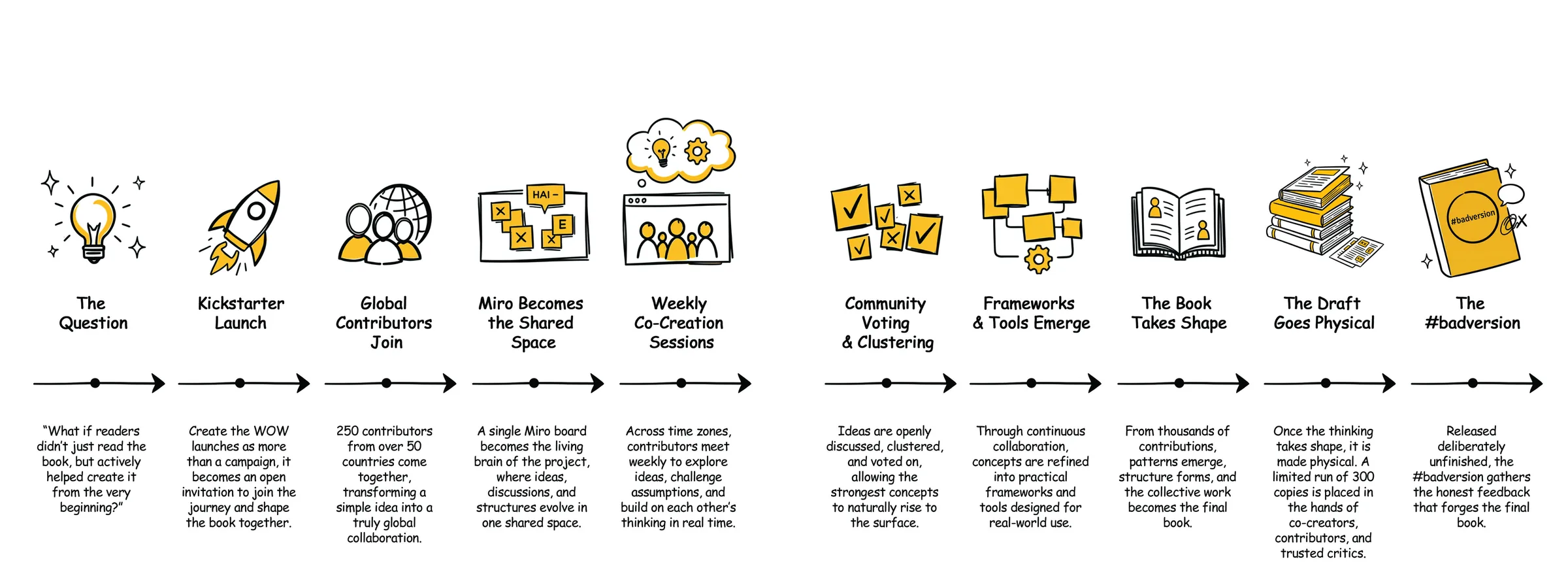
This book is finished, but the version before it will always exist. We printed a limited run of 300 copies for our co-creators, contributors, and trusted critics, not as a locked product but as a working version of ideas still being shaped, tested, and refined. We gave it a name that left no room for confusion: the #badversion.
Why? Because this is a book about a new way of working, and we refused to build it the old way. It was co-created in the open: 250 people from more than 50 countries on one shared Miro board, with AI clustering sticky notes, summarizing sessions, and surfacing patterns no single person could hold in their head. When the thinking took shape, we made it physical, because ideas on paper are easier to challenge. The deeper reason: an unfinished book is not a gesture, it is a test, and tests come back with results. Perfection delays the moment your assumptions meet reality; we wanted that moment early, while we could still act on it. We were not seeking reassurance, but the friction that exposes gaps and forces better decisions. Here is what came back.
The #badversion showed us what was already clear. The diagnosis landed: readers recognized the linear trap, the speed gap, and the AI illusion from their own organizations. The tools and canvases proved themselves in real workshops, and the community pushed one standard relentlessly: if a concept could not be used in real work, simplify it. Chapters people used, we kept; chapters praised but never revisited told a quieter story. Just as clearly, it showed what was missing. One question kept returning: this is convincing, but how does it all run together, day to day? The parts were described well; the engine connecting them was not. Readers understood every instrument. They could not yet hear the orchestra.
That insight became the largest addition to this book: the Value Creation Engine and the chapters showing its workflows at work, from customer value creation to product development, feeding each other continuously with AI at every stage. Not a section we planned; a section 300 readers handed us. The feedback reshaped the architecture too: the failing operating model now opens the book, the principles of augmented collaboration earned a part of their own, and every workflow was rebuilt to one test: could a team pick this up on Monday and use it? Where readers showed us friction, the tools changed, and sections we liked but nobody used were cut, because shelf space is a promise to the reader.
The process sharpened our thinking about AI. It was at its most useful when it could see the whole picture, the canvases, clusters, and conversations, not just a typed question: shared context moved the work forward, isolated prompts produced generic answers. That hardened into one of this book's central arguments: AI creates value inside shared context, not beside it. Weekly sessions gave the collaboration a heartbeat, ideas advanced on merit through open comments and votes with seniority buying nobody a shortcut, and smaller workshops fed the same board, so every insight flowed back into the whole.
We learned to read patterns, not opinions: when five readers from five countries stumbled in the same place, the place was the problem. Praise was pleasant and mostly useless; confusion was uncomfortable and precious. Underneath it all ran a deeper test: this book claims work improves when it is visible, feedback comes early, many minds share one space, and AI amplifies rather than replaces human thinking. Those claims had to survive hundreds of contributors, deadlines, and disagreements, and they produced a better book than we could have written alone. This final version carries the fingerprints of everyone who engaged with the #badversion: their questions sharpened the arguments, their pushback killed ideas we loved and saved better ones we had overlooked. Everything this book asks of your team, we tried ourselves first, in the open, flaws and all. It worked for us. The rest is about making it work for you.
From kickstarter to Miro to #badversion on to publishing.
In the summer of 2025 we started something that felt more like an experiment than a book project. Instead of writing behind closed doors, we asked a different question: "What if readers helped create the book itself? Like we did back in 2009 with 'Business Model Generation'?" We launched a Kickstarter campaign for 'Create the WOW', not only to fund the book but as an invitation to join the creative process from the very beginning. Within a short time, 250 people from more than 50 countries had joined: designers, entrepreneurs, consultants, innovation leaders, students, product managers, and strategists, all curious about the same challenge: how organizations can speed up and collaborate on designing products, services, and experiences with AI.
"The heart of the collaboration became a single shared Miro board."
From the beginning, everything happened in one place: the book's structure, brainstorming, concepts, templates, design direction, feedback, and discussion, instead of being scattered across documents, slides, emails, and chat threads. The board grew into a landscape of ideas, sketches, and clusters, the living brain of the book. Every week we hosted global co-creation sessions where participants from every time zone opened the same board and explored the key questions: what structure the book needed, where readers struggle with Value Propositions and Business Models, which tools and templates make strategy practical. Sticky notes appeared faster than anyone could read them, while Miro AI grouped concepts, challenged assumptions, and built on the thinking.
"One remarkable aspect of the process was how democratic it became."
Instead of a small editorial team deciding what belonged in the book, the community could see, comment on, and vote on ideas directly on the board, and the book slowly emerged from the group's collective intelligence. Within the 250, a core of around 30 co-creators showed up almost every week, refining ideas, improving tools, challenging assumptions, and turning raw brainstorming into structured insight. One recurring discussion focused on readability: strategy books often become too theoretical to use in real work, so the community pushed toward clarity, visual explanation, and practical tools. If a concept could not be easily explained or used in a workshop, it was simplified. The redesigned Value Proposition canvas in this book grew directly from those sessions.
As the weeks passed it became obvious that the project was not just producing ideas for the book; it was demonstrating a new way of working.
This is what a collaborative operating model for innovation can look like: instead of small internal teams, organizations involving employees, partners, customers, and outside experts in one shared visual workspace where ideas evolve collectively. Smaller workshops formed inside the larger collaboration, and because everything stayed on one board, their insights flowed straight back into the whole.
"Looking back, it is difficult to imagine this project happening without Miro."
The board was a single source of truth where brainstorming, decision making, template design, feedback, and workshops happened simultaneously, and from its thousands of ideas, comments, and clusters we distilled the insights, structured the chapters, and shaped the manuscript. Published in May 2026, Augmented Collaboration is the result of a global collaboration shaped by 250 co-creators and energized by 30 committed contributors, proof that open collaboration around a shared challenge produces something richer than any small team could create alone. "In the end, we did not just write a book about creating value. We experienced a new way of innovating together and learned how to 'Create the WOW'."
"What got you here, won't get you there"Marshall Goldsmith
How this book was co-created.