Discover jobs and problems, from market to person.
Why a person isn't yet a problem.
Step 1 ended with a sized opportunity and a specific person inside it: a persona built from real interviews and real data, not a guess wearing a stock photo. That is real progress. But it is easy to overstate how much it actually buys a team. Knowing who someone is, and even having a rich sense of their goals and frustrations, is not the same as knowing precisely what is wrong for them. A team that skips straight from persona to solution is designing against a feeling rather than a fact.
This step exists to close that gap, and it does it in two moves. First, turning the person's situation into a specific, provable problem: precise enough that it could actually be proven wrong. Second, deciding which of the problems and jobs surfaced this way are worth solving first, rather than chasing all of them at once. Skip the first move and the team builds confidently on a guess. Skip the second and the team drowns in a backlog of true but unimportant problems.
What are they trying to get done?
The starting lens is Jobs-to-be-done thinking, and it begins by asking a slightly different question than most teams default to. Instead of asking what a customer might buy, it asks what they are actually trying to get done: the progress they are trying to make in their situation, independent of any particular product. Ask yourself: if our product disappeared tomorrow, what would this customer hire instead to make the same progress? The answer reveals the job, and the job is more stable than any product built to serve it.
A job has a functional dimension, the practical task itself. But it almost always carries social and emotional dimensions too: wanting to look competent in front of a boss, wanting to stop dreading a particular part of the week, wanting to feel in control of something that currently feels chaotic. These layers are not decoration. They are frequently the reason a customer goes looking for a solution at all. A team that only hears the functional layer routinely builds something technically correct that customers still do not adopt, because the thing that actually drove the search for a solution was never in the functional layer to begin with.
It is worth being precise about what a job is not. A job named this way is still not a problem statement. It is the territory a problem lives in. "Keep the kitchen's food costs under control" is a job. It does not yet say what is actually broken, for whom, or why. That precision is the next move, not this one.
Write the problem down properly.
Once the job is named, the Customer Problem Canvas is where the problem itself gets written down properly, before anyone is tempted to jump to a solution. And someone will be tempted. The moment a job is named, solutions start arriving uninvited, because proposing answers feels like progress and examining problems feels like delay. The canvas exists to hold that impulse back for one more page.
In practice this means answering a small number of disciplined questions, together, on one page. Who exactly has this problem? What is the problem, in the customer's own words? Why does it matter to them? How do they cope with it today, without any help? And the question that matters most: how will the team know if it has actually understood the problem correctly rather than just assumed so? The one-page constraint is deliberate. A problem that cannot be stated on a single page is not yet understood.
That last question separates a real problem statement from a plausible-sounding one. A well-written problem statement should be falsifiable: there should be some answer a customer could give, or some behavior they could show, that would prove the team wrong. If nothing a customer could ever say or do would change the team's mind, the problem has not been defined. It has been asserted. And asserted problems have a way of surviving contact with evidence far longer than they should, because nobody ever specified what would count as being wrong.
From a job to a falsifiable problem.
Returning to the independent-restaurant persona from Step 1 makes this concrete. The job in that owner's world might be named as: "keep food costs under control without spending hours on inventory admin." That is a real job, but it is still too broad to design against. It could point toward a dozen different problems, some real and some imagined.
Run through the Customer Problem Canvas, it sharpens considerably:
- Who: an independent restaurant owner who also does the ordering, typically with no dedicated back-office staff.
- What: they routinely over-order perishable ingredients, because they are estimating demand from memory and a paper notebook, not from any actual record of what was used last week.
- Why it matters: spoiled inventory is a direct, recurring loss on already-thin margins, and the anxiety of guessing wrong is a source of ongoing stress, not just a line item.
- How they cope today: rough mental estimates, occasional over-ordering as a safety margin, and accepting the waste as a cost of doing business.
- How the team will know it has understood correctly: if, shown an accurate record of the past four weeks of actual usage, the owner is surprised by the gap between what they assumed and what the data shows.
That surprise is the signal the problem was real and previously invisible, not already known and merely unaddressed. Written this way, the problem can be checked against reality in a specific conversation, rather than debated in the abstract.
One practical note: fill the canvas in as a team, in the customer's words wherever you have them. The quote bank from your interviews is the raw material here. If the team finds itself paraphrasing, inventing, or averaging across customers, that is a signal to go back and listen again before writing anything down. A canvas full of the team's language describes the team's imagination. A canvas full of the customer's language describes the market.
It is also worth keeping the rejected candidates visible. The canvas will surface problems that do not survive the falsifiability test, and there is a temptation to quietly delete them. Keep them on the board instead. Knowing what the problem is not turns out to be almost as valuable as knowing what it is, because every discarded candidate draws a boundary line around the real one.
By the end of this exercise, the board usually holds several problems that survived: real, falsifiable, and written in the customer's own words. That is a strong position to be in, and it immediately creates the next question. Which one deserves the team's next slice of time? Answering that fairly, by evidence rather than by instinct or volume, is exactly what the next step is for.
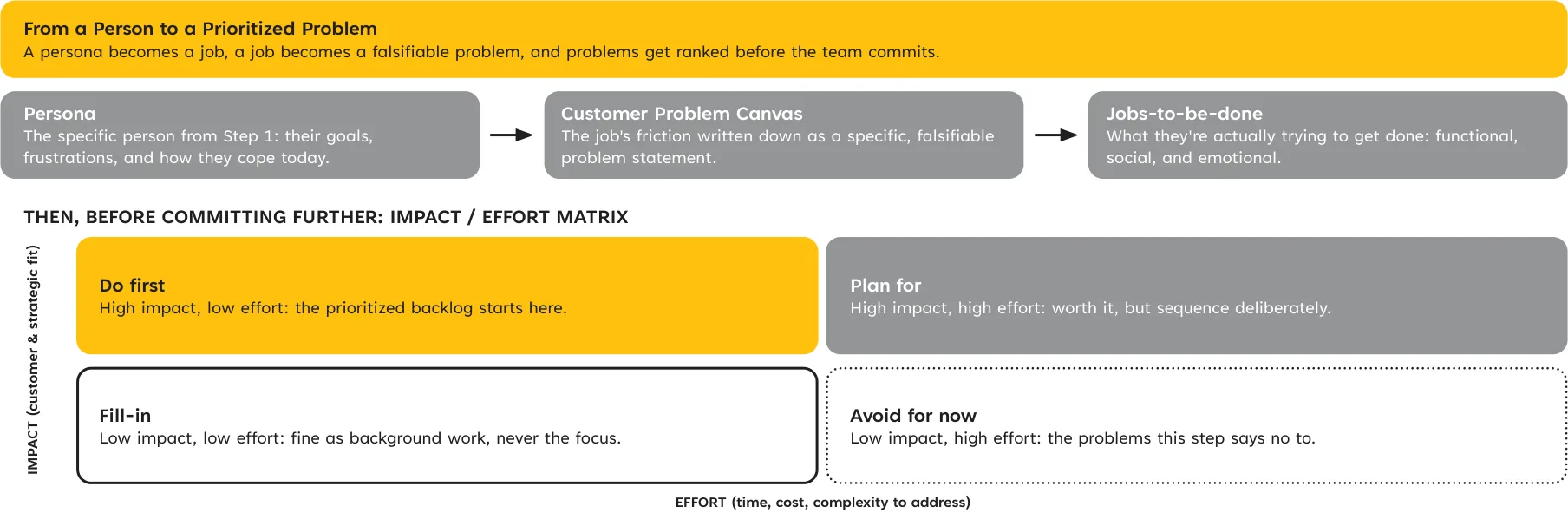
A persona becomes a job, a job becomes a falsifiable problem, and problems get ranked with the Impact/ Effort Matrix before the team commits further.
Not every problem deserves the next slice of time.
A team doing this work well will typically surface more validated problems than it can act on at once, and treating them all as equally urgent is its own kind of mistake. It leads to a team chasing five problems simultaneously and making real progress on none of them. This is where problems get ranked, not by whichever was argued for most persuasively, but against two deliberately simple questions. How much impact would solving this actually have, for the customer and for the strategy? And how much effort would it take to address?
The Impact/Effort Matrix is the practical tool for this: a simple two-by-two, impact on one axis, effort on the other. High impact, low effort problems go straight to the top of the backlog. High impact, high effort problems are worth doing, but need deliberate sequencing rather than being started on impulse. Low impact, low effort problems are acceptable background work, never the main focus. And low impact, high effort problems are the ones this step should say no to, clearly and on the record, so the conversation does not quietly reopen in a future planning meeting.
Common ways this step goes wrong.
A few mistakes account for most of the trouble here. Writing a problem statement that is really a solution in disguise: "customers need a mobile app" is not a problem, it is a conclusion smuggled in early. Skipping the falsifiability question and settling for what sounds right rather than what could be shown wrong. Prioritizing by enthusiasm or seniority, which quietly teaches the team that the loudest voice sets the roadmap rather than the evidence. And treating the backlog as fixed once ranked, when new evidence should move problems up or down the list. A ranking never revisited becomes stale as fast as the market underneath it.
What this step hands to the next one.
The team now has something far more useful than a persona: a specific, falsifiable problem statement, and an evidence-based case for why it is the one worth solving first. That is still not an answer. It is a sharply defined question, ready to be answered. The next step designs that answer: the Value Proposition, from problem to promise, using the Value Proposition Canvas to check that what the team proposes actually relieves the pains and creates the gains that matter to this specific person.
The love for customer (problems).
Philippe Starck, one of the most influential designers of our time, is renowned not only for his innovative and striking designs but also for his deep passion for understanding the problems of the people he designs for.

His approach to design is rooted in empathy, always seeking to identify the real needs of users rather than simply creating aesthetically pleasing objects. One of the most compelling stories that illustrate his commitment to this philosophy comes from his work on a project with the French hotel group, Mama Shelter. Starck was tasked with designing a new hotel experience that was both affordable and high-quality; something that balanced style with practicality. Rather than approaching the project from a purely design-centric perspective, Starck spent extensive time interacting with the community and understanding their daily struggles and aspirations. He spoke to both customers and hotel staff, observing the intricacies of their needs and frustrations. Through these conversations, he realized that the experience was not just about luxury or cutting-edge design, but about creating a sense of comfort, belonging, and functionality. This attention to the “human side” of design led him to create spaces that were not just visually beautiful, but also immensely practical and welcoming. He meticulously designed each room and public space to ensure that the hotel would feel like a home away from home. For example, he focused on making sure that the furniture was not just stylish but also highly functional and thoughtfully designed to make guests feel comfortable and at ease.
Starck's commitment to deeply understanding the Customer Problem is what sets him apart from many designers. His work is never just about following trends but always about finding the best solution to a problem that people may not even know they have. Whether designing furniture, interiors, or even everyday objects, Starck's philosophy is clear: Truly successful design comes from connecting with people and solving real, tangible problems in a way that enhances their daily lives.
Coolblue. (www.coolblue.nl) knows what customers try to solve when their washing machine is broken.
Every WOW begins with a problem that truly matters.
What if the key to unlocking growth lies not in your product or service, but in how deeply you understand the problem you're solving? It's a bold claim but one that separates thriving businesses from those that struggle to stay afloat.
Imagine this. Your washing machine is broken and it can not be repaired. What is the problem you try to solve here? Is your problem to replace your machine for a new one? Or is your problem not being able to wash your clothes?
If you believe the problem is about replacing the machine, then the product is your solution. You will offer the product online or in a store and compete on features and price.
If you believe the problem is about getting your clothes washed, the solution you offer goes beyond the product. Your solution is to help instantly getting your clothes washed by offering easy access to the washing machine including availability, delivery and installation.
If businesses aren't clear on what the real problem is, they offer a different solution and might end up competing on price only.
Yet, here's the harsh reality: 85% of executives admit their organizations fail to diagnose problems accurately.
In this chapter, we'll uncover why finding the right problem is harder, and more important, than solving it.
We'll explore how to size the opportunity, pinpoint the root causes behind customer challenges, and build solutions that don't just address surface-level pain points but deliver meaningful, lasting impact.
It all starts with one pivotal question: What is the customer's real problem?
Why organizations avoid defining the problem.
One of the most common downfalls of organizations is that they never pause long enough to define the right problem.
Structurally, companies are built around solutions. Teams are organized by products, channels, and technologies but not by customer tensions. Marketing optimizes campaigns. Product ships features. Sales pushes the pipeline. Each function moves forward, but rarely steps back.
KPIs reinforce the bias. Output is rewarded: Launches, releases, revenue, velocity. Problem clarity is invisible on dashboards. No metric captures how precisely a team framed the challenge before acting. So activity replaces diagnosis.
There is also a leadership tension. Narrowing the problem feels like narrowing opportunity. Executives worry that defining the problem too sharply will exclude adjacent possibilities or limit strategic flexibility. Keeping the frame broad feels safer.
Now add AI. Idea generation is frictionless. Concepts, features, and variations can be produced in seconds. This accelerates solution-first thinking. When ideas are abundant, the patience required for accurate problem definition feels slow and even inefficient by comparison.
Here is the critical insight: Defining the problem sharply reduces optionality. And that feels risky.
But constraint is not limitation. Instead it can lead to acceleration if done well. Speed does not come from expanding choices. It comes from eliminating the wrong ones. The core concept is simple: The more precisely you define the problem, the fewer directions you can pursue. Leading to faster and more purposeful movement.
Most common B2B consumer problems.
When we think of problems companies like to solve, we can clearly see a list of common problems. So despite not knowing the real business problem yet, you know what to look for.
Inefficiency and wasted time
Time is one of the most valuable resources for any business. When processes are slow or ineffective, productivity declines, costs rise, and growth is hindered.
- Problem: “Our processes are too slow, and we waste too much time on inefficiencies.”
- Example: Lengthy decision-making and approval processes.
Revenue loss and profitability issues
Maintaining steady revenue and healthy profit margins is a constant challenge. Businesses often struggle to grow revenue while managing rising costs and market pressures.
- Problem: “We are losing revenue, or our margins are shrinking.”
- Example: High customer churn and declining retention rates.
Talent acquisition and retention
Finding, hiring, and keeping the right employees is becoming increasingly difficult. Businesses face challenges in attracting top talent and ensuring long-term engagement.
- Problem: “We struggle to find and retain skilled employees.”
- Example: Shortage of qualified professionals in key roles.
Adapting to technological change
Technology evolves rapidly and businesses that fail to keep up risk becoming obsolete. Digital transformation, cybersecurity, and data management are major areas of concern.
- Problem: “We are falling behind in technology and digital transformation.”
- Example: Outdated legacy systems limiting efficiency and scalability.
Regulatory and market uncertainty
Businesses operate in an environment where regulations, economic conditions, and market trends shift constantly. Navigating these changes is a persistent challenge.
- Problem: “We are facing uncertainty due to regulatory, economic, and market shifts.”
- Example: Complex and frequently changing compliance requirements.
Most common B2C consumer problems.
When we think of problems you and I as a customer would like to solve, we can clearly see a list of common problems. So despite not knowing the real Customer Problem yet, you know what to look for.
Lack of time (time pressure and inefficiency)
Time is one of the most scarce resources in B2B. Customers want to complete tasks faster, easier, and with less effort.
- Problem: “I don't have enough time to do everything I need to do.”
- Example: Long wait times, slow processes, complex systems that take too much time to understand.
Uncertainty and lack of trust
Customers struggle to make decisions due to too many choices, lack of transparency, or fear of bad experiences.
- Problem: “I'm not sure if I'm making the right choice.”
- Example: Unclear pricing, poor customer service, products that don't meet expectations.
Frustration with complexity (ease of use and accessibility)
People abandon products or services when they are too complicated. They want intuitive, simple, and effortless experiences.
- Problem: “This is too difficult to understand or use.”
- Example: Unintuitive apps, unclear instructions, complex sign-up processes.
Lack of control and predictability
People don't want to depend on external factors; they want control over their choices, spending, and experiences.
- Problem: “I don't know what to expect and feel out of control.”
- Example: Unexpected costs, slow customer service, inconsistent product quality.
Dissatisfaction with quality or value (price vs. performance)
Customers want the best value for their money and avoid products or services that don't meet their expectations.
- Problem: “This is not what I expected or isn't worth the money.”
- Example: Poor product quality, bad service, hidden costs.
Observe and interview customers.
Interviews are where hypotheses meet reality. They reveal language, motivations, and decision dynamics you cannot infer from desk research alone.
The goal is not to collect opinions. People are polite, and they are poor predictors of their own behavior. What you want to understand is what actually drives their decisions at key moments. Select interviewees from the segments with the highest pain and urgency: they have the most to say and the least patience for a bad solution.
Use open, non-leading questions to explore:
- Goals and desired outcomes.
- Obstacles and constraints.
- Workarounds and trade-offs.
- Decision criteria, risk aversion, and trust triggers.
- Emotions at critical journey moments: stress, doubt, relief, pride.
- Specifics instead of hypotheticals. "Tell me about the last time..." beats "Would you use..." every time.
Interview in pairs where you can, one asking and one taking notes, and capture the customer's exact words rather than your summary of them. The phrasing customers choose is data in itself. When an answer surprises you, do not move on. Ask why, then ask why again. The second why is usually where the real insight lives.
How many interviews is enough? Stop at saturation, when the insights start repeating and new conversations stop changing your picture. Then synthesize immediately, while the conversations are still fresh in the team's mind. Insights left unprocessed for a week become anecdotes.
You could also consider going on a "customer safari". Instead of inviting customers to talk, you observe and interact with them in their natural environment: in stores, in homes, or during the activities where the problem actually shows up. The goal is to see firsthand how customers use products or services, spot pain points as they happen, and understand how decisions really get made. People will tell you one thing in an interview and do another in the wild, and the difference between the two is often the most valuable finding of all. This goes beyond traditional surveys or focus groups and delivers more authentic, real-world data. Just be mindful of whom you observe, as well as when and where. Otherwise this can become more dangerous than a real safari.
Output:
- A quote bank of real customer language.
- The top three frictions and their root causes.
- Confirmed versus falsified assumptions.
- An updated problem statement.
- MVP or MVT hypotheses with one or two measurable success KPIs for the next test.
Frame the right problem statement.
Too many teams fall in love with solutions before they understand the right customer problem statement. They jump in, driven by assumptions, deadlines, or excitemend and miss the point.
But here's the truth: if you start with the wrong problem, everything else will be misaligned. Your research will point in the wrong direction, your solution will miss the mark, and your product will struggle to find traction. Framing the right problem is not just a step in the process, it is the foundation for innovation.
The right problem statement brings urgency, clarity, and direction. It shifts your mindset from making something impressive to making something useful.
“A problem well stated is a problem half solved.” — Charles Kettering
Why it matters A strong problem statement changes everything. It helps your team:
- Align around a shared customer challenge
- Avoid assumptions and bias early in the process
- Prioritize efforts based on what customers truly care about
- Focus experiments and ideation where they count most
What makes a good problem statement? A great problem statement isn't long or complicated. But it is focused, evidence-based, and customer-centered. It should:
- Start with the customer, not your business goals or KPIs
- Describe real friction, not just desires or feedback quotes
- Include context: Who experiences it, when, where, and why it matters
- Avoid suggesting a solution; focus on what's missing or painful today
Try this structure
A [customer segment] is struggling to [achieve a goal or avoid a risk], because [obstacle], which leads to [negative outcome].
Examples:
- “Busy parents struggle to prepare healthy meals on weekdays, because they lack time and energy, leading to reliance on take-out and feelings of guilt.”
- “Procurement managers in mid-sized tech companies can't compare vendor contracts effectively due to inconsistent formats, resulting in missed savings and compliance risks.”
This type of structure brings together empathy, clarity, and a clear sense of why the problem is urgent and worth solving. And that's where real innovation begins.
Five common mistakes.
The quality of any strategy, product, or innovation effort depends on how precisely the Customer Problem is defined. Weak problem framing leads to wasted capital, misaligned teams, and solutions in search of justification.
And the frustrating part? Most of it is avoidable. These are the five most common and costly mistakes. Almost every team makes at least one of them, usually without noticing, because each one feels like progress while it is happening.
Defining a market trend instead of a problem.
"AI is booming." "Sustainability is growing." Teams love to anchor on macro trends, and it is easy to see why: trends feel urgent and they make great slides. But a trend is not a problem. A problem is a specific, recurring friction experienced by a clearly defined customer in a defined context. Nobody wakes up wanting "AI". They wake up dreading three hours of invoice reconciliation. Trend-driven framing produces opportunistic products without validated demand. The fix is a matter of sequence: let trends point you toward where problems might live, but make the problem stand on its own. If you delete the trend from your problem statement and nothing is left, there was no problem in it.
Framing the problem too broadly.
"Customers want a better experience." What does that tell you to do on Monday morning? Nothing, and that is the point. Statements like this lack diagnostic value. An effective problem statement isolates who experiences what friction, when, and with what consequence. Compare: "Independent restaurant owners lose an hour every night reconciling stock by hand, and over-order because they do not trust their own numbers." Now you know who to interview, what to measure, and what success would look like. Overly broad framing prevents prioritization and obscures measurable impact. Here is a simple test: if your problem statement could belong to any company in your industry, it is not yet a problem statement.
Confusing symptoms with root causes.
Declining sales, churn, and low engagement are symptoms. They are not problems themselves. The root cause may lie in onboarding friction, pricing misalignment, or expectations the product quietly fails to meet. Treat the symptom and you end up running a discount campaign for customers who were actually leaving because setup was confusing. The discount even works for a quarter, which makes it harder to spot the real issue underneath. Ask why the number is moving before you try to move it back. Then ask why again. Root causes rarely surface on the first why.
Starting from internal capabilities.
Problem framing often begins with "What can we build?" instead of "What pain exists?" That first question leads straight to solution-first thinking: "We have a strong mobile team, so the answer is an app." The solution arrives before any evidence has.
Capabilities matter, but they answer a different question. They should inform feasibility, not define the problem space. There is a real cost to getting this backwards: a team that starts from its capabilities will only ever find the problems it already knows how to solve, and those are rarely the ones customers are desperate about. First find the pain. Then ask whether you are the team that can solve it.
Accepting anecdotes as evidence.
One enthusiastic customer quote. One executive's strong opinion. One piece of feedback that happens to fit the story the team already wanted to tell. None of it is validation. Problem validation requires pattern recognition across segments and contexts: the same friction, showing up repeatedly, in different mouths. Anecdotal bias distorts prioritization and exaggerates edge cases. A single vivid story will outshout ten quiet data points in every meeting, unless you make the patterns visible to everyone. So set the bar explicitly before you start: agree as a team how many independent signals, from how many different segments, a problem needs before it counts as confirmed. Write the number down. It is much harder to lower the bar retroactively when it is on the wall.
Framing versus solving.
Framing is diagnostic. Solving is prescriptive. Conflate the two and you compress discovery into an afternoon, then call the first idea a strategy. Effective teams resist the urge to ideate before they deeply understand the context, intensity, frequency, and consequences of the pain. This discipline feels slow. In practice it is the fastest route to a product people actually want, because it spends the team's energy on one well-chosen problem instead of five guessed ones.
So before sketching, pitching, building, or scaling, ask one question: have we framed the right problem?
Because precision in problem definition determines the ceiling of innovation quality. You can execute brilliantly on a badly framed problem and still arrive nowhere.
Getting the problem right VS getting the problem wrong.
What if you solve the problem right?
If you solve the Customer Problem the right way, you unlock several benefits for your business:
Higher willingness to pay
A well-solved problem is valuable. Customers will pay a premium if they feel your solution is better than alternatives. Organic growth and word-of-mouth Satisfied customers become advocates. They refer others, reducing your acquisition costs. Competitive advantage A unique and well-executed solution makes it harder for competitors to copy or outshine you.
Repeat business and upselling opportunities
A happy customer is more likely to buy again or upgrade to premium offerings. Stronger customer loyalty When customers feel their problem is truly solved, they stick with your brand and are less likely to switch to competitors.
What if you don't solve the problem right?
If you don't solve the Customer Problem correctly, a few things can happen:
Loss of trust and credibility
Customers may lose confidence in your ability to understand and address their needs.
Low adoption and engagement
If your solution doesn't truly help, customers won't use it, meaning wasted effort and investment.
Negative word of mouth
Unhappy customers share their experiences, potentially damaging your reputation.
Competitive disadvantage
A competitor who better understands the problem will win the market.
Missed revenue opportunities
If customers don't see value, they won't pay, leading to lower sales and growth.
You can become a growthmaker inside your company and make a difference by starting with the right Customer Problem.
Tool
Customer Problem canvas.
- PERSONAL
- map customer insights
- ± 45 MIN
- session
- 3-5
- people per group
The Customer Problem canvas helps teams zoom in on the right Customer Problem before jumping to solutions; aligning everyone, avoiding unnecessary features, and grounding innovation in real user needs.
The Customer Problem canvas is a strategic tool that helps teams zoom in on the right problem to solve before jumping into building solutions. It supports problem-driven innovation by ensuring that your efforts are grounded in real, evidence-based customer needs. The ultimate goal is to de-risk your innovation by increasing your confidence that you are solving something that actually matters to your customers.
Think of it as a shared lens to:
- Align teams around a clearly defined and validated Customer Problem.
- Avoid building solutions for problems that aren't painful, frequent, or worth solving.
- Understand the current behavior of customers, including what they do today to work around the problem.
- Discover opportunities for innovation that can create real customer value.
Strategic benefits of using the canvas
- Clarity before creativity: You get clear on what matters before brainstorming solutions.
- Team alignment: Everyone, from designers to business leads, is on the same page about what you're solving.
- Customer-centric mindset: Keeps you close to real customer needs instead of internal assumptions.
- Better decision-making: Helps prioritize ideas based on which problems are truly worth solving.
- Stronger Value Propositions: You design offers that are deeply rooted in customer pains and gains.
- Shared language: A concise Customer Problem statement enables effective communication within teams.
When to use the Customer Problem canvas
- At the start of a new product or service development process.
- During a design sprint or innovation workshop.
- When you're revisiting or refining your Value Proposition.
- In a strategy session focused on growth, customer experience, or differentiation.
- When you sense your team is building features or ideas without a strong user problem behind them.
Working through the canvas
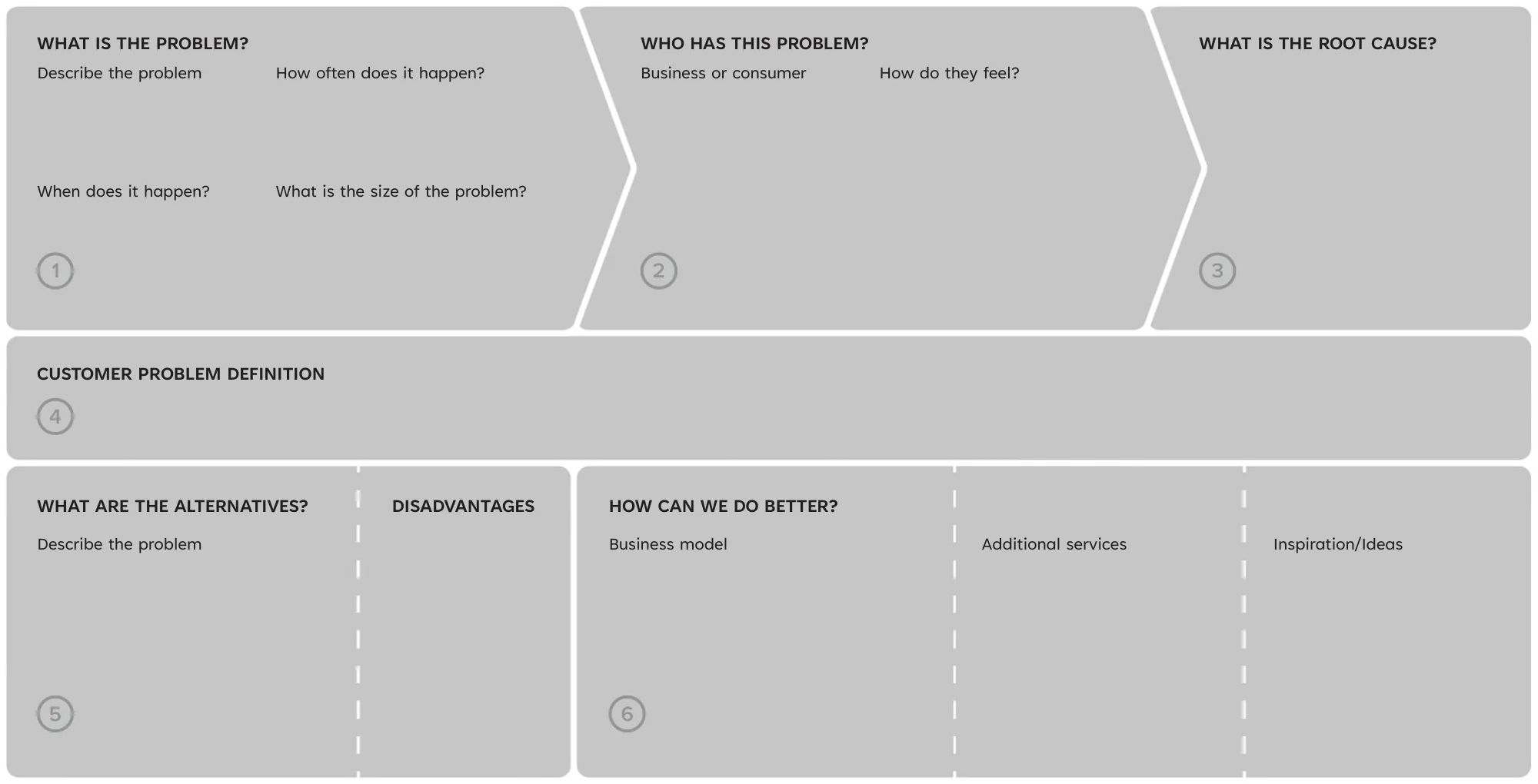
Steps 1–3 build a shared understanding of the problem. Step 4 distills it into a validated Customer Problem definition. Steps 5–6 turn that into alternatives and solutions.
What is the problem?
Begin with precision. State the problem so clearly that everyone recognizes it and can measure it. Describe when it occurs, how often, and how large the impact is in time, money, or trust. Zoom in on the exact moment in the journey (page, place, task, trigger) and anchor it to one or two KPIs so you have a baseline now and can demonstrate improvement later.
Questions to ask:
- When exactly does the problem occur (page/place/task/trigger)?
- How often does it happen, and to how many people?
- What is the measurable impact (conversion, revenue, time lost, error rate)?
- Under which conditions is it worse (device, channel, network)?
- Which 1–2 KPIs will we use as the baseline?
Who has this problem?
Make it personal. Identify who carries the pain and in which context. See the constraints in that moment, name the emotion (stress, frustration, uncertainty), and clarify what is at stake: time, reputation, money, momentum. Design for real needs, not abstract "users."
Questions to ask:
- Who experiences this (consumer/professional/team/organization)?
- Are they new or returning users; decision-makers or end-users?
- Which emotions appear (stress/frustration/uncertainty)?
- What is at stake (time, money, reputation, momentum)?
- What progress are they trying to make (Job-to-be-done)?
What is the root cause?
Go beyond symptoms and find the cause that explains the behavior. Ask "why" until the answer stops changing. Trace information, decisions, and handovers to see where reality diverges from intent. The core may lie in information, process, expectations, technology, behavior, context, or communication. Challenge your favorite explanation; what remains is worth solving.
Questions to ask:
- What is the observable symptom, and why does it happen (×5)?
- Where do information, decisions, or handovers break down?
- Which category fits best: information/process/technology/behavior/ context/communication?
- If we remove this cause, does the symptom reliably disappear?
- What is the smallest experiment to validate the root cause?
Customer Problem definition
Translate the insights from steps 1–3 into one clear, validated statement that aligns the team. This is not a restatement of the raw description from step 1, which was exploratory. The Customer Problem Definition is sharper and more precise: a synthesized articulation that captures the essence of the issue, free of any solution. A useful structure:
A [customer segment] is struggling to [achieve a goal or avoid a risk], because [obstacle], which leads to [negative outcome].
Questions to ask:
- Did you have reliable and sufficient information to fill in the blanks?
- Was your starting point the customer or organizational KPIs?
- Did the team agree on the proposed Definition?
- Have you refrained from suggesting a solution within the statement?
- Is it specific enough to decide on, and broad enough to leave solution space?
What are the current alternatives?
Examine how people cope today, whether through workarounds, substitutes, or doing nothing. Map the hidden costs (extra minutes, errors, rework, stress) and recognize when these stopgaps fail. This reveals what is truly valued and where friction concentrates. The bar is to convincingly outperform the status quo on effort, reliability, speed, clarity, and control.
Questions to ask:
- How do people currently handle the problem (workarounds/substitutes/ doing nothing)?
- What are the time, money, and error costs per alternative?
- When and why do these alternatives fail (failure modes)?
- Which parts do people actually value (keep)?
- What would make switching undeniably worthwhile?
Combine the previous learnings and your Customer Problem Definition to turn insight into a better path. Redesign the moment that matters so the experience is faster, clearer, and more in control. Choose a Business Model that aligns value and price (subscription, pay-per-use, on-demand, bundle), add Additional services that provide leverage through automation and human support (proactive assistance, on-site support, guided onboarding), and draw nspiration/Ideas from proven patterns in other industries to spark new directions. Keep what demonstrably works and define success in numbers.
Questions to ask:
- Which friction can we remove at the moment that matters?
- How do we boost speed, clarity, and control in one step?
- Which Business Model fits the value (subscription/pay-per-use/ on-demand/bundle)?
- Which services or automations add outsized value (proactive assistant, on-site help, guided setup)?
- Which proven patterns from other industries can inspire us?
- What are our success metrics, and which MVP experiment (with a go/no-go threshold) will we run?
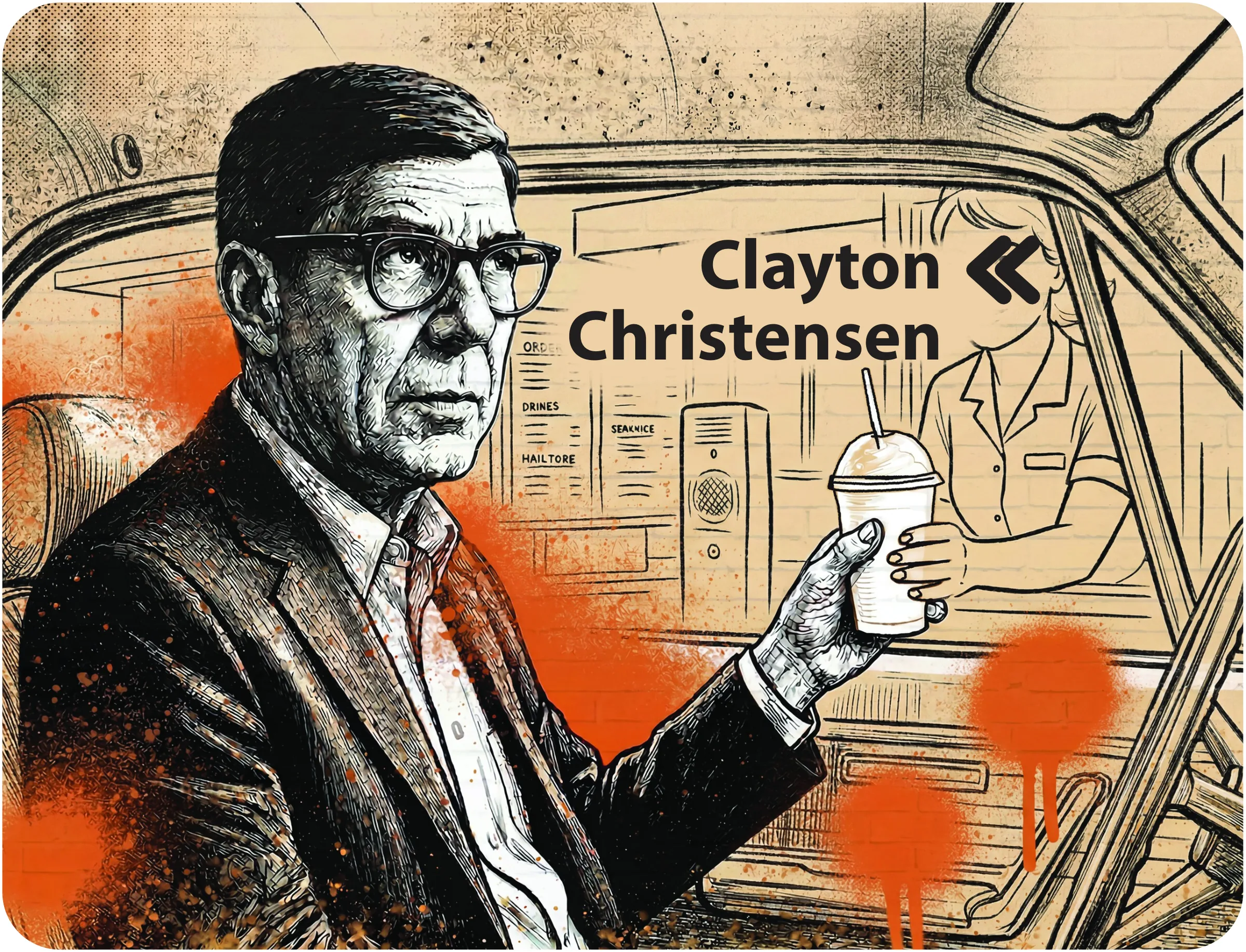
The Job-to-be-done classic theory.
The “Job-to-be-done” theory, developed and popularized by Clayton Christensen, offers a powerful lens to understand why customers make the choices they do.
Rather than focusing on customer demographics or product features, Job-to-be-done centers on the progress a customer seeks to make in a specific context, their “job.”
According to Christensen, people “hire” products and services to get a job done in their lives. A “job” is not just a task or activity, but a goal or desired outcome they are trying to achieve. This job can be functional (e.g. commuting to work), emotional (e.g. feeling safe or confident), or social (e.g. gaining peer approval).
The core idea is that customers don't buy products because of who they are; they buy them because of what they want to achieve in a particular situation. For example, a customer buying a milkshake in the morning might be “hiring” it to make their commute more enjoyable and satisfying without being too messy or filling.
Job-to-be-done theory helps companies uncover these deeper motivations and design solutions that align with real customer needs. Instead of asking, “What features should we add?”, the Job-to-be-done lens asks, “What job is the customer hiring this product to do and how can we do it better?”
Christensen's approach emphasizes the importance of context: The same product might serve different jobs for different people at different times. Success comes from deeply understanding the circumstance around the job, not just the product category or market segment.
This theory has significant implications for innovation, marketing, and strategy. It shifts focus from selling products to solving problems. Companies like Intuit, Airbnb, and Snickers have used Job-to-be-done insights to reframe their offerings and discover new growth opportunities. Ultimately, Job-to-be-done theory offers a practical, customer-centered framework for designing products that truly resonate and create value.
Customer Problem vs Job-to-be-done.
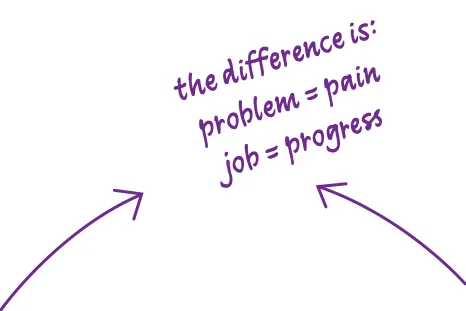
While Customer Problems and Jobs-to-be-done are closely related, they represent different aspects of customer understanding. Here's a breakdown with clear definitions and examples to show the distinction:
Customer Problem
A Customer Problem is a pain, frustration, or challenge the customer experiences. It describes what's not working well or causing friction in their current situation.
- It's often a symptom or barrier.
- It tends to be negative and reactive (“I can't…” / “It's hard to…”).
Job-to-be-done
A Job-to-be-done is the broader goal or outcome the customer is trying to achieve in a particular context. It focuses on the progress they want to make in their life or work.
- It's more aspirational and purpose-driven.
- It helps you design solutions with intent: “Help me [do something] so that [outcome].”
Examples to show the difference
| Job-to-be-done: | Ride-sharing (e.g. Uber) “Help me get to my destination quickly and reliably without owning a car.” | Coffee shop (e.g. Starbucks) “Help me start my day feeling energized and emotionally prepared for work.” | Meal kit service (e.g. HelloFresh) “Help me cook healthy meals at home without wasting time or ingredients.” | Note-taking app (e.g. Notion) “Help me organize my thoughts and tasks so I can be more productive.” | Online course platform “Help me gain new skills so I can advance my career.” |
|---|---|---|---|---|---|
| Customer Problem: | “Taxis are hard to find and often unreliable or expensive.” | “Getting a quick, quality coffee or snack on the go is often inconvenient and time-consuming.” | “Planning meals and grocery shopping is time-consuming and stressful.” | “My notes are scattered across too many tools and I keep forgetting things.” | “Traditional education is expensive, slow, and inflexible.” |
In summary:
- The Customer Problem is the pain.
- The Job-to-be-done is the progress they seek. The Jobs-to-be-done gives you the innovation target, while customer problems are relieved along the way.
Value vs benefits vs features.
One of the most common sources of confusion in innovation teams is the blurred line between features, benefits, and value.
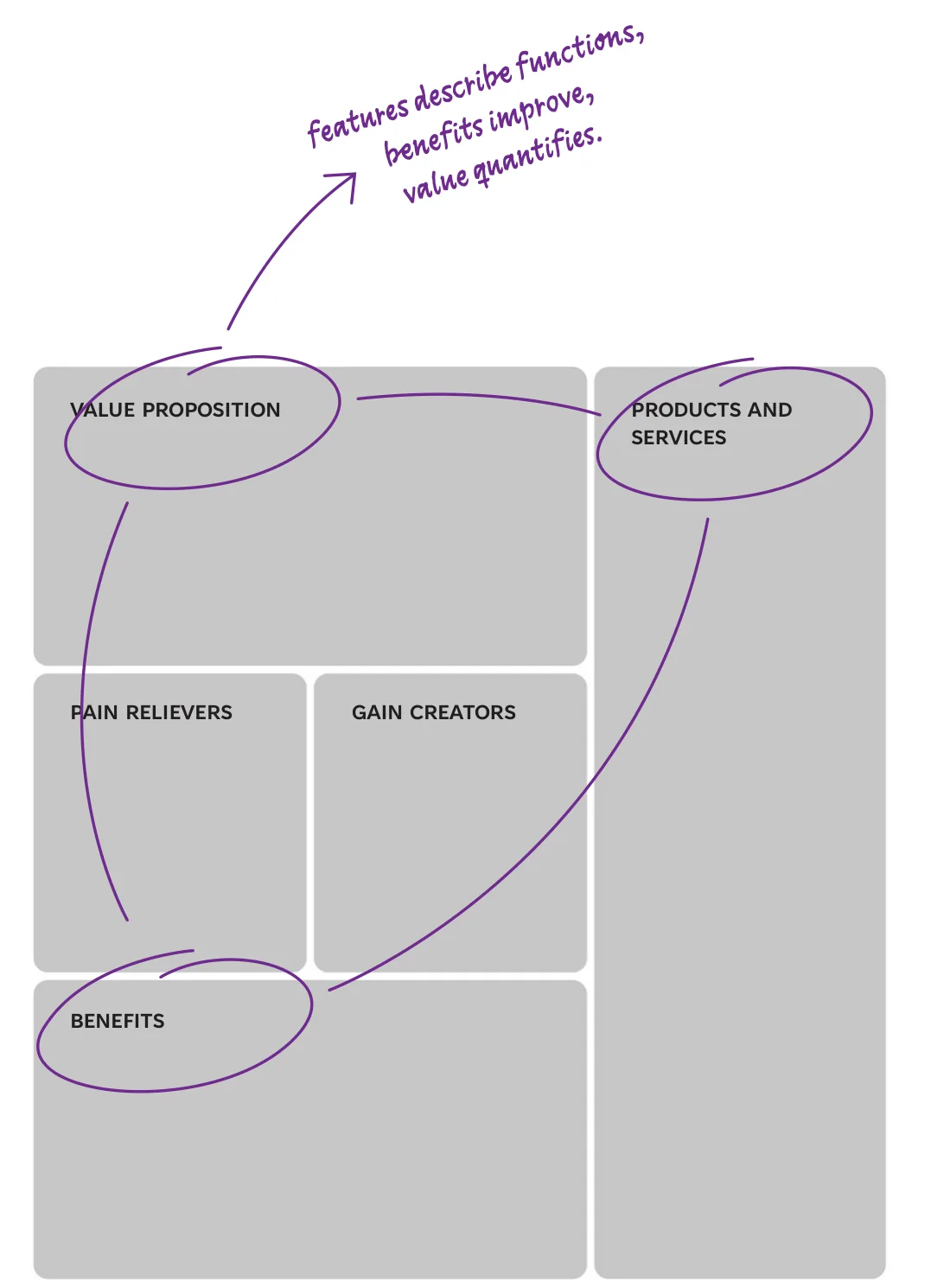
They are not the same, and confusing them slows everything down. A feature describes what your solution does. It is technical, functional, and internally oriented. For example: AI-driven demand forecasting. A benefit describes what that feature helps with. It translates functionality into an improvement in experience or performance, in this case more accurate predictions.
But neither a feature nor a benefit is yet value. Value is what changes in measurable terms for the customer or the business. It is the concrete impact that justifies action and investment. For example: Reduce inventory waste by 18% within six months. That is value. It is specific, time-bound, and economically meaningful.
When teams stop at features, discussions remain technical. When they stop at benefits, discussions remain abstract. Only when they define value do conversations become strategic and aligned. Measurable value increases speed because it enables testing. You can validate whether the promised 18% reduction is achieved, rather than debating opinions.
It also aligns stakeholders. Finance, sales, product, and leadership can rally around a shared outcome rather than subjective preferences. It supports monetization because pricing becomes easier when the economic impact is clear. And it strengthens decision-making, as trade-offs are judged against measurable impact, not opinion. If you cannot express your proposition in terms of measurable change, you are still describing what you built, not why it truly matters.
Case study · STËLZ
Reframing social drinking.
When Heineken chose not to launch a direct competitor to STËLZ but instead invested in the company, the decision revealed more than tactical restraint. It signaled recognition.
A global incumbent with distribution strength, manufacturing expertise, and a portfolio of established brands concluded that participation was more strategic than imitation. That choice alone underscores the depth of what STËLZ had built. The company was not simply entering the beverage market with another flavored alcoholic drink. It was reframing a social moment in a way that incumbents had not fully addressed.
At first glance, the product itself appears unremarkable. Sparkling water, fruit flavor, alcohol. The hard seltzer category already existed. The ingredients were widely available, and the production process did not require technical breakthroughs. From a chemical perspective, nothing about STËLZ demanded innovation. There was no patentable formula, no proprietary distillation method, and no manufacturing disruption. Yet something meaningful had shifted in how consumers perceived the act of drinking.
The innovation did not lie in the liquid, it lay in the tension.
To understand that tension, it is necessary to look beyond category definitions. For decades, alcohol brands competed within established cultural frames. Beer signaled sociability and accessibility. Wine suggested refinement and taste. Spirits conveyed intensity and status. Marketing strategies revolved around flavor differentiation, heritage narratives, and lifestyle positioning. The competitive battlefield was clearly defined, and innovation typically meant introducing a new variant, a limited edition, or a refreshed brand story.
Beneath these categories, however, a different dynamic was forming. A growing segment of consumers, particularly younger urban adults, began experiencing a subtle but persistent emotional conflict in social drinking environments. They wanted to participate in shared rituals such as festivals, house parties, terraces, and celebrations. They wanted to belong, to signal inclusion, and to engage in moments that traditionally revolved around alcohol. At the same time, they were increasingly conscious of health, personal control, and identity. Wellness culture was no longer a niche phenomenon but part of mainstream daily life. Ingredient awareness, calorie tracking, moderation, and self-optimization were becoming normalized behaviors rather than fringe interests.
The traditional trade-off was rarely articulated, but it was deeply felt. If you wanted to belong, you drank what everyone else drank. If you wanted to remain aligned with your health values, you abstained or compromised. Neither option felt fully satisfying. Abstaining could signal distance from the group, while indulgence could create regret the next morning or conflict with personal standards. The discomfort was not extreme, but it was consistent enough to shape behavior.
STËLZ entered at this precise intersection, not by asking how to improve beer or compete with spirits, but by observing the lived experience of that moment. Imagine standing in a crowded space with music playing, friends laughing, and a drink in your hand. In that environment, the question is not about flavor notes or alcohol %age. It is internal and immediate. Can I be part of this without betraying how I want to live?
That was the Customer Problem.
Most incumbents track market share, distribution metrics, and competitor launches. They analyze segments and growth rates. Startups that redefine markets often start elsewhere. STËLZ did not begin with a category gap analysis, it began with social observation. The founders recognized that identity negotiation was happening in real time. Consumers were not rejecting alcohol outright, nor were they abandoning social rituals. Instead, they were seeking alignment between participation and personal values.
The friction was emotional rather than functional. Consumers were not saying there were no flavored alcoholic beverages available. They were signaling discomfort with the binary choice between indulgence and abstinence. They wanted inclusion without excess and enjoyment without compromise. This distinction changed everything: The problem was not a product deficiency, it was an identity conflict.
By framing the challenge at this level, STËLZ escaped incremental innovation, it was no longer competing on marginal taste improvements or slightly adjusted alcohol content. It was addressing the alignment between social participation and self-perception. The product became a vehicle for resolving that alignment.
When companies design from category logic, they typically ask how to enhance existing offerings. How can we improve beer? How can we innovate within spirits? Those questions assume the category frame is correct. When companies design from tension, they ask what silent trade-offs customers have accepted because they believe no better option exists. In this case, the trade-off involved caloric density, heaviness, and loss of control versus social integration and belonging.
STËLZ responded with a product that felt lighter both physically and symbolically. Lower in calories, transparent in composition, and minimal in branding, the drink signaled participation without excess. The design language emphasized clarity and simplicity. The communication avoided moralizing or positioning itself as anti-alcohol. Instead, it subtly reframed drinking as compatible with a balanced lifestyle.
Consumers do not want to be corrected, they want to be understood.
This sensitivity in positioning mattered. Had STËLZ framed itself as a moral alternative, it might have alienated the very consumers it sought to serve. Instead, it acknowledged the desire for enjoyment and community while offering a format that reduced the internal friction associated with those moments. Holding a can of STËLZ did not contradict one's self-image as health-conscious or intentional. It allowed individuals to remain consistent with how they perceived themselves. The broader strategic implication is significant. If a company asks how to improve its existing product, it will likely generate incremental changes. If it asks what tension exists in the customer's life, it may redefine the market entirely. STËLZ did not win because sparkling alcohol was new. It gained traction because it reframed what drinking meant within a specific social context. It addressed a modern paradox: The desire for connection without self-betrayal.
Heineken's investment can therefore be interpreted as acknowledgment of this deeper shift. Rather than launching a reactive competitor focused on product attributes, the incumbent recognized that STËLZ had captured a cultural nuance.
The startup had positioned itself within a behavioral transition already underway. Participating in that trajectory offered strategic exposure to a reframed occasion rather than merely defending category share.
The lesson extends beyond beverages. Markets often appear saturated when analyzed through product features and price points. However, beneath established categories, emotional tensions frequently accumulate unnoticed. Consumers adapt to imperfect options until someone reframes the moment entirely. The opportunity lies not in adding complexity but in clarifying contradiction.
In the case of STËLZ, the drink was simply the output of a deeper insight. The breakthrough occurred at the level of understanding. By identifying a silent tradeoff and designing around it, the company transformed a familiar product into a new ritual. The can became more than a container of alcohol. It became a symbol of participation without excess, of inclusion aligned with identity.
The drink was the output. The insight was the breakthrough.
That distinction explains why an industry giant chose investment over imitation, and why reframing a moment can be more powerful than reformulating a recipe.