From a validated promise to a market you can learn from.
Every earlier step narrowed the risk. The market was sized, the customer understood, the problem sharpened, the proposition designed and validated. What arrives at go to market is not a guess. It is an idea with evidence behind it. But evidence about the customer is not the same as evidence about the market. You know the problem is real and the solution wanted. You still do not know which channel actually reaches those customers, which message moves them to act, what they will pay without flinching, or where in their journey they will quietly stall and disappear. Those are different questions, and no amount of validation answers them in advance. Go to market is where you find them out, and the most common way a good idea dies here is not being wrong. It is being invisible, being misunderstood, or being impossible to buy.
That distinction is worth sitting with, because to the market those failures all look the same. A proposition nobody hears about, a proposition framed in words the customer does not recognise as their problem, and a proposition with a buying process too heavy for the value it delivers all produce the same flat line in the numbers. Worse, they produce it silently. A failed interview tells you why it failed. A failed launch mostly tells you that it failed, and leaves the team to argue about whether the product, the message, or the channel was to blame. The whole design of this step exists to prevent that argument, by deciding in advance what each part of the launch is supposed to prove.
So treat this step the way you treated the others: as a learning problem, not a leap of faith. The temptation, after all that careful validation, is to decide the thinking is done and simply launch. It is an understandable instinct. The team is tired of testing, the evidence is good, and somewhere a deadline is waiting. But that instinct is where good products go quiet. A launch is not the end of the thinking. It is the moment the thinking meets the largest and least forgiving audience it has faced so far, an audience that owes you no attention, gives no second chances, and will not fill in a survey to explain why it walked past. The same discipline that sized the market and framed the problem is exactly what the launch needs now.
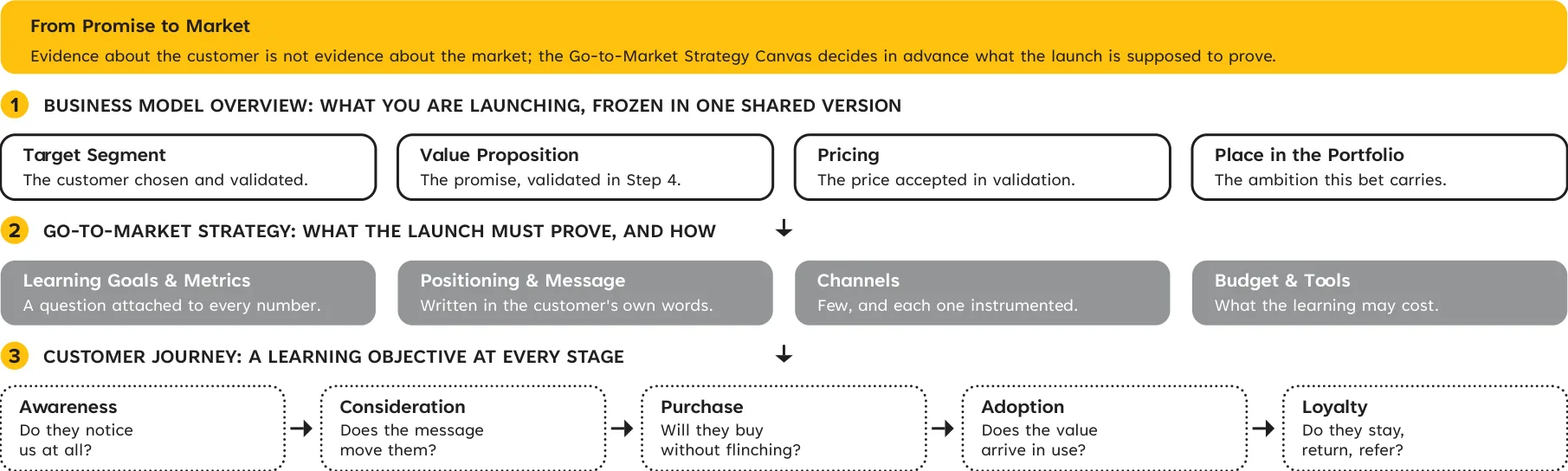
The Go-to-Market Strategy Canvas gives that discipline a shape. It holds the whole step on one board, in three stacked sections worked top to bottom, each one anchoring the section beneath it. The Business Model Overview fixes what you are taking to market and where it sits, almost all of it carried forward from the earlier steps. The Go-to-Market Strategy decides what you intend to learn and how you go about it, from goals and metrics down to channels, messages, and the tools behind them. And the customer journey walks the funnel a customer travels, from first awareness to lasting loyalty, with a learning objective attached to every stage. The rest of this step is a tour of those three sections, and how to fill them in without fooling yourself.
The Business Model Overview: fix what you are launching.
The top of the canvas is deliberately unexciting, and that is its value. Almost everything in it, the target segment, the validated proposition, the pricing, the place this bet occupies in the portfolio, was settled in the earlier steps, and the work here is to write it down in one place and freeze it. A launch involves more people than any step before it, and each of them arrives with a slightly different memory of what was decided. The overview replaces those memories with one shared version, so the launch tests the market rather than the team's recollection. If filling it in starts an argument, pay attention: the argument is a finding, and a disagreement that surfaces while writing three sentences costs nothing compared to the same disagreement discovered in the numbers after launch. For the team building for independent restaurant owners, the overview is short: the owner as segment, the Sunday-night report as the promise, the price owners accepted during validation, and the honest size of the ambition this bet carries.
The Go-to-Market Strategy: decide what the launch must prove.
The middle section turns the launch into a learning problem. Start with goals and metrics, and be ruthless about the difference between a number and an answer. Impressions, followers and traffic are numbers. What the launch needs are answers: does this channel reach the segment, does this message move them, does this price hold? Attach every metric to one of those questions, and drop the metrics that answer none of them. Write the positioning and message in the customer's words rather than yours; the interviews already collected that language, and this is where it pays. Then choose channels the way you chose experiments: few enough to read clearly, each one instrumented so you can tell which is doing the work. The restaurant team picks two, the supplier channels owners already buy through and the trade community where they already ask each other for advice, and frames the message the way owners framed the problem themselves: finding out on Sunday what could have been fixed on Tuesday. Two channels, one message each, and a question attached to every number the team will watch.
The Customer Journey: give every stage a question.
The bottom section walks the funnel from first awareness to lasting loyalty, and its job is to turn the silent flat line into a diagnosis. For every stage, the canvas asks what the customer is doing, what you are doing to meet them, and what you need to learn there. The learning objectives are the point, because when the launch underperforms, and early launches usually do somewhere, the journey tells you where. Plenty of awareness but no consideration is a message problem. Consideration that never becomes purchase is an offer problem, or a buying process too heavy for the value. Purchases that never become loyalty is a product problem that validation did not catch. Each failure calls for a completely different response, and without the journey they are indistinguishable, one disappointing number arguing with itself. When sign-ups stall, the restaurant team can see whether owners never heard of the product, heard about it and did not care, or cared and gave up halfway through signing up. Three different problems, three different fixes, and only the journey can tell them apart.
Reading the launch.
Treat the live launch exactly the way the previous step treated its experiments: as evidence arriving on a schedule. Read the journey weekly, stage by stage, and resist the verdict until the numbers can mean something, because early data is small and small numbers are noisy. The persevere, pivot or kill discipline applies here too, with one refinement: at launch, a pivot is rarely the product. It is usually the channel or the message, and the journey shows which. A channel that never produces awareness gets replaced. A message that produces awareness but no consideration gets rewritten, in words borrowed from the customers
who did convert. Only when every stage has been given its honest chance does the harder conversation about the proposition itself begin.
Read it together, not in parallel. The launch touches marketing, sales, product and support at once, and each of them holds a piece of the journey that the others cannot see: marketing knows what the channel cost, sales knows what prospects actually said, product knows where users stalled, support knows what confused them. A weekly reading with everyone at the same board is what prevents the argument this step was designed to avoid, because when the numbers disappoint, the question in the room is no longer whose fault it was. It is which stage of the journey needs a different answer next week.
Common ways this step goes wrong.
Four failures repeat. Launching everywhere at once: five channels, three messages, no instrumentation, and no way afterwards to say what worked. Vanity metrics: celebrating reach while conversion quietly starves, motion mistaken for impact. Internal language: a message built from features and categories the customer has never used to describe their own problem, when the interviews already supplied better words. And treating the launch as an event instead of a process: one big day, one big number, and a verdict declared before the data can mean anything. A launch read weekly, adjusted stage by stage, will outlearn a launch judged once.
What this step hands onward.
Customer Value Creation ends here, and what it hands onward is no longer a proposition but the beginnings of a business: a channel that demonstrably reaches the customer, a message that moves them, a price that has survived contact with real buyers, and a journey whose weak points are known and numbered. Just as valuable is what the step returns to the portfolio: evidence. The bet that entered this workflow as an ambition now carries data, and the portfolio rhythm, the quarterly review, the funding tranches, the persevere-pivot-kill decisions, can finally treat it as what it has become rather than what it promised to be.
Tool
Go to Market canvas.
- PERSONAL
- map go to market insights
- ± 90 MIN
- session
- 2-6
- people per group
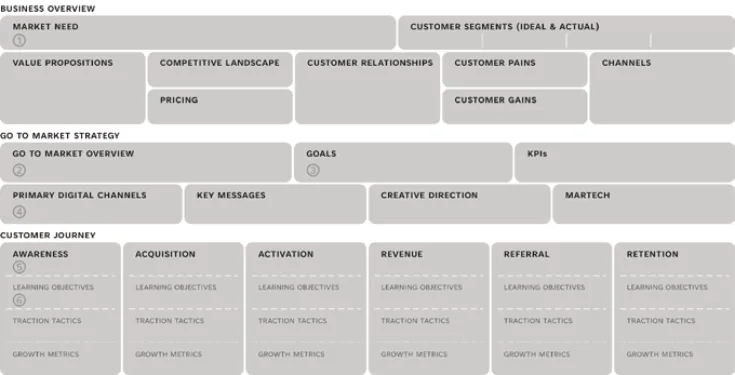
Do not treat this canvas as a fresh start, because it is not one, and notice what makes it unusual: it treats going to market as something you learn your way into, not a plan you execute blind. It stacks three sections, worked top to bottom. The Business Model Overview fixes your product and its market position. The Go-to-Market Strategy defines what you intend to learn, how you will learn it, and through which channels and messages. The customer journey then maps the funnel a customer travels, from first awareness to lasting loyalty, with a clear learning objective attached to every stage. Each section sets up the one beneath it, so fill them out of order and the lower parts float free of the decisions that should anchor them.
Go-to-Market Strategy Canvas, by Three Five Two, via Miro. Carry the Business Overview in, then decide the price.
The top section is about your product and where it sits in the market, and almost all of it is already done. Market need, customer segments, value propositions, the competitive landscape, customer pains and gains, channels: every one of these boxes is filled straight from the work of the earlier steps. The single genuinely new decision up here is Pricing, your price point relative to the market and competitive landscape. Decide it now, deliberately, because a price signals what the product is worth and who it is for, and every message and metric below inherits it.
Frame what you intend to learn.
The Go-to-Market Strategy section opens with a Go To Market Overview, and this is the box that makes the canvas different from an ordinary launch plan. It asks what you intend to learn, how you will go about learning it, why you chose the channels you did, what your timeline is, and why you are starting where you are in the funnel. Answer these honestly and the whole strategy becomes a set of experiments rather than a set of bets.
Set the Goals and KPIs.
Beside the overview, state what the strategy should accomplish, then name the high-level metrics it will be measured against. Keep the KPIs few and concrete, a number you could actually read off a dashboard, because a goal without a measure is only a hope, and a measure without a goal is only noise.
Decide how you will reach and move people. The lower half of the strategy section is the how: the Primary Digital Channels you will run experiments through, the Key Messages that move users through each stage of the funnel, the Creative Direction that decides what emotion the work should evoke and whether it should drive action, and the Martech, the tool stack you have to work with and the gaps in it. Every one of these should trace back to the model and position you set at the top.
Walk the customer journey, stage by stage.
The bottom section is the customer journey, followed through six stages in order: Awareness (interrupt the right people already looking for a solution), Acquisition (educate and win new users), Activation (get them to the moment the value first lands), Revenue (convert them into paying customers), Referral (turn them into advocates who bring others), and Retention (earn the repeat use that makes it a habit). Mapping the whole journey shows where customers will stall or drop off, so you can design for those moments before launch rather than discover them after.
Fill in the three rows under every stage.
This is the move that ties the canvas together. Each stage of the journey carries three rows. Learning Objectives state what you are trying to learn there, not just what you are trying to do. Traction Tactics name the concrete experiments you will run to move customers through that stage. Growth Metrics name the number that will tell you whether it worked. Together they turn the launch into a series of small, measurable experiments, and they are what let the whole thing feed the next cycle: what you learn about awareness or activation this time reshapes where you start next time.
One sentence to remember: the canvas is not finished when every box is filled in, but when every funnel stage has both a plan and a clear thing the team is trying to learn there.
Fill the canvas in together, and treat every disagreement as useful data rather than a delay. The canvas earns its place precisely at the moments it forces a choice, because a decision made here, on the board, is far cheaper than the same decision discovered after the launch budget is already spent. A tidy canvas that hides an unmade choice is worth far less than a messy one that has forced it into the open.
From strategy to a launch that learns.
What do you intend to learn.
The strategy section of the canvas opens with the Go To Market Overview, and it is the box that sets the tone for the whole step. It does not ask for a plan. It asks what you intend to learn, how you will go about learning it, why you chose the channels you did, what your timeline is, and why you are starting where you are in the funnel. That last question matters more than it looks. A product with no users starts at awareness and acquisition. A product with users who do not come back starts at retention. Naming the stage you are actually stuck at keeps the team from pouring effort into the top of a funnel that leaks at the bottom.
Answer the overview honestly and everything downstream changes character. The launch stops being one large bet and becomes a set of deliberate experiments, each with a reason for existing. Skip it, and the rest of the canvas fills up with activity that nobody can later connect to a question. When results come in, good or bad, a team without a stated learning intent cannot say what they proved.
Goals and KPIs: deciding what success looks like.
Next to the overview sit two boxes that keep it honest. Goals state what the strategy should accomplish, in plain words: gather customer feedback, win the first paying accounts, prove one channel works. KPIs then name the high-level metrics the whole strategy will be measured against, and the discipline is keeping them few and concrete. Fifty sales is a KPI. Awareness is not. A goal without a measure is only a hope, and a measure without a goal is only noise, so write them as a pair and agree in advance what result would count as a signal to change course.
Channels, messages, creative, and the stack behind them.
The lower half of the strategy section is the how, in four boxes that only work when they point the same way. Primary Digital Channels are the places you will run experiments, chosen because the target customer is already there, not because they are cheap or comfortable. Key Messages are the lines meant to move users through the stages of the funnel, written in the customer's language and leading with the change in their world, not the feature that produces it.
Creative Direction decides what emotion the work should evoke and whether it should inspire action, which sounds soft until you notice that two identical media plans with different creative can produce wildly different results. And Martech, easy to skip and quietly decisive, asks what stack you have to work with, where the gaps are, and how data moves across the tools, because a message you cannot deliver or a result you cannot measure is not a strategy, it is a wish.
The customer journey, told as a funnel.
The bottom section is the customer journey itself, told as a funnel. It follows a customer through six stages in order: awareness, acquisition, activation, revenue, referral, and retention. Awareness interrupts the right people already looking for a solution. Acquisition educates and wins new users. Activation gets them to the moment the value first lands. Revenue turns use into payment. Referral turns satisfied users into advocates who bring others. And retention earns the repeat use that makes the product a habit rather than a trial.
What makes the section more than a diagram is the three rows beneath each stage. Learning Objectives ask what you are trying to learn there, not just what you are trying to do. Traction Tactics name the concrete experiments that will move customers through the stage, a radio ad, a piece of merchandising, whatever fits the channel. And Growth Metrics name the number, reach, conversions, repeat visits, that will tell you whether the tactic worked. Read down a column and you have a complete experiment: a question, a tactic to test it, and a measure to judge it by. Read across the funnel and you can see exactly which stage is leaking when the numbers disappoint, instead of guessing whether the problem was the message, the channel, or the product itself.
A worked example.
Return to the restaurant inventory tool carried through the earlier steps, and put it on the canvas. The Business Model Overview writes itself from the validation work: owners will pay to stop guessing at their ordering, priced as a simple monthly fee a small business can approve without a committee. The Go To Market Overview is where the honesty starts. What the team intends to learn is whether frustrated independents will act on a message about waste, and the funnel entry point is awareness, because nobody is searching for a product that does not exist yet. The primary channel is where those owners already gather and trade advice, not a generic ad buy. The key message is "stop throwing away money on food you never sell," not "inventory software," because one sounds like their problem and the other sounds like enterprise machinery. The KPI is pilot restaurants signed, a number with a date. And the customer journey turns the launch into experiments: the awareness stage tests whether the waste message opens doors, the activation objective is finding the moment an owner first sees money saved, and the referral stage tests the real bet, that one owner's results become the proof the next hundred will believe.
Common ways this step goes wrong.
The most common mistake is skipping the overview box and jumping straight to channels and messages, which produces a busy plan with no stated intent to learn anything, so when results come in nobody can say what they proved. The second is filling the funnel top to bottom with tactics but leaving the learning objectives empty, which turns the customer journey back into the ordinary marketing funnel it was designed to improve on. The third is starting at the wrong stage, pouring budget into awareness when the real leak is activation or retention, which the overview box exists precisely to prevent. And the fourth is treating a completed canvas as a finished strategy, when launch is the beginning of the real learning, not the end of the work.
What this step hands to the next cycle.
Go to market is not the end of the workflow. It is the point where the loop closes and starts again, and the canvas is built for exactly that turn. Every learning objective you wrote under the funnel is a question the launch will now answer with real numbers: which message opened doors, which channel earned its cost, where customers stalled, and what they actually paid for. That is precisely the evidence the first step of the workflow needed. Market performance becomes the next round of market intelligence. The customer value workflow does not finish at go to market. It turns, feeding what the funnel just taught you straight back into the opportunities worth exploring next.