Design the value proposition, from problem to promise.
From a sharpened problem to a proposed answer.
Step 2 ended with something considerably sharper than a persona: a specific, falsifiable problem statement, and an honest, evidence-based case for why it is the one worth solving first. That is real progress. But it is still a description of what is wrong. It is not yet an answer. This step is where the team finally proposes one.
The discipline here is resisting a very natural shortcut: jumping straight from a well-understood problem to a favorite solution, on the assumption that understanding the problem well is the same as knowing what to build. It is not. A team can be exactly right about the problem and still design a promise that misses it.
The word promise is doing real work here. A value proposition is a promise made to a specific person: choose this, and your situation improves in this specific way. Framing it that way keeps the team honest, because promises can be broken, and this step is about designing one the team can actually keep.
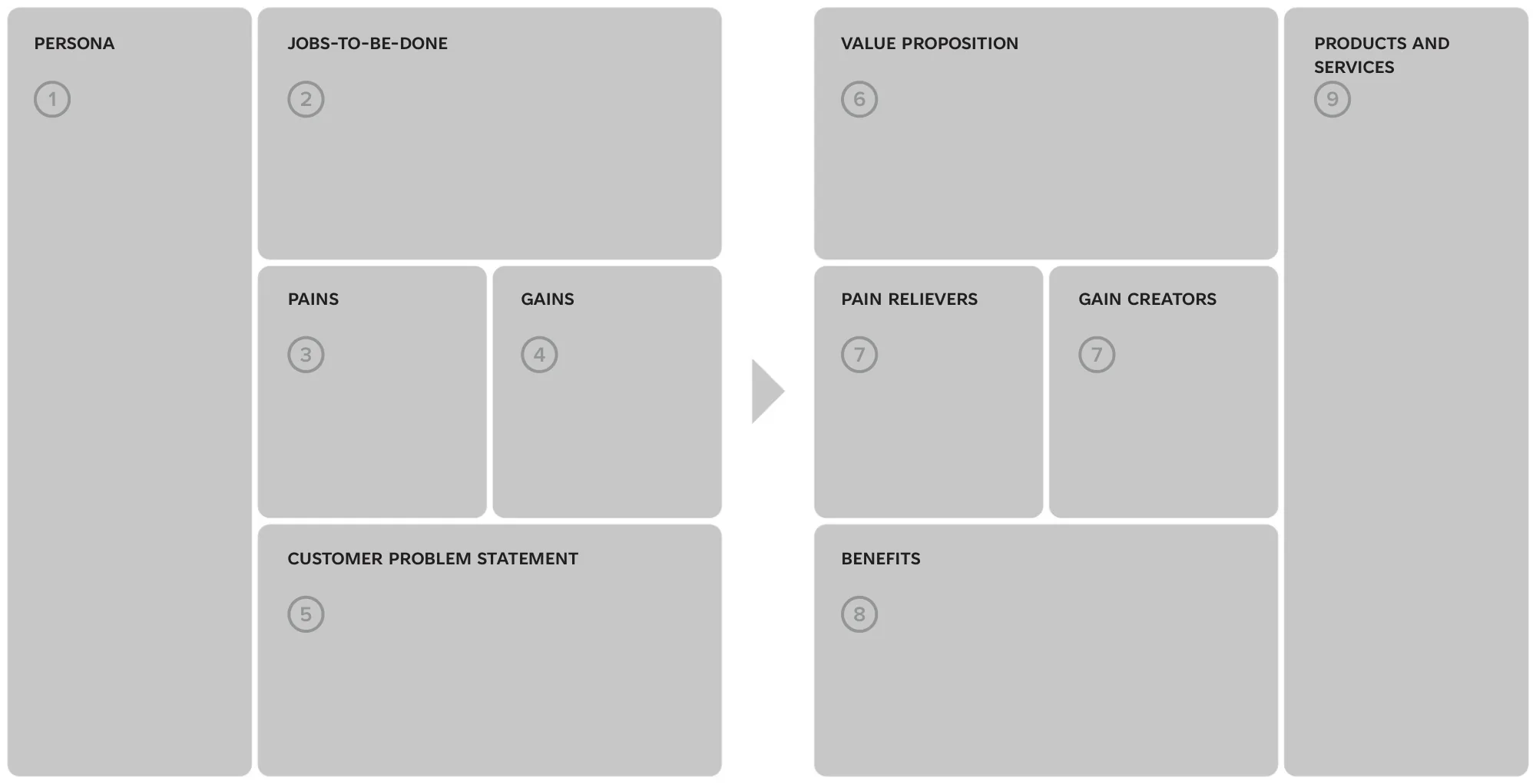
The tool built for exactly this job is the Value Proposition Canvas, used here in its more complete, extended form. Its purpose is narrow and specific. It does not generate ideas; that is a separate, earlier creative activity. It checks whether a specific proposed answer actually fits a specific, already-validated problem, rather than merely sounding like it should.
The core of the canvas is a simple match.
The canvas works by putting two profiles side by side and checking them against each other. On one side sits the Customer Profile, built directly from the previous step's work:
- Jobs: what the customer is trying to get done.
- Pains: what frustrates them along the way.
- Gains: what a better outcome would look like to them.
None of this is new information at this point. It is the persona and the problem statement, organized into a shape that can be matched against a proposed solution.
On the other side sits the Value Map:
- Products and features: what is actually being proposed.
- Pain relievers: how each one removes or eases a specific pain.
- Gain creators: how each one produces a specific gain.
The exercise, and the entire value of doing it deliberately rather than assuming it, is checking for fit line by line. Does this specific feature actually relieve a pain this specific customer named? Or does it just sound like the kind of thing that should help? A canvas filled with pain relievers that do not map to any pain on the other side is not evidence of a good value proposition. It is evidence that the exercise was done backwards: starting from a list of planned features and working to justify them, rather than starting from the customer's profile and designing toward it.
Run the matching as a team conversation, not a form-filling exercise. Put the Customer Profile on the wall first, complete, before anyone writes down a single feature. The order matters. A team that sees the pains before the products will design toward the customer. A team that starts from the products will spend the session defending them.
From a problem to a promise.
Continuing the independent-restaurant owner from the previous two steps makes the mechanics concrete. The validated problem was specific: the owner routinely over-orders perishable ingredients because they are estimating demand from memory rather than any actual record of what was used, and the resulting waste is both a direct financial loss and a source of ongoing stress.
On the Customer Profile side, the job is keeping food costs under control without new administrative burden. The pain is the recurring loss and the anxiety of guessing wrong. The gain would be ordering with actual confidence instead of a rough mental estimate.
On the Value Map side, a proposed feature might be a simple weekly usage report, generated automatically from point-of-sale data the restaurant already produces. As a pain reliever, it replaces memory-based guessing with an actual record, directly addressing the named pain. As a gain creator, it turns next week's order into a decision backed by data rather than a habit, directly producing the named gain.
The test is whether each proposed feature earns its place this way, against a specific pain or gain already on the other side of the canvas, rather than being included because it seemed generally useful or technically interesting to build. Notice what is not on the map: no dashboard, no supplier marketplace, no loyalty module. Not because those are bad ideas, but because nothing on the customer's side asks for them yet.
The XL layer, checking whether the fit is viable.
A core jobs-pains-gains match can be real and still not be enough to act on, because fit alone does not say whether the opportunity is viable. The extended, or "XL", version of the canvas adds three layers of context around that core match, each answering a question the core canvas is silent on. Each is a cheap question to ask now and an expensive one to discover later.
- Competitive alternatives ask what the customer is already using instead. As the previous step's competitor analysis should have surfaced, this is often not a direct competitor at all but a notebook or a habit. A value proposition that does not clearly beat the customer's actual current alternative, on the dimension that matters most to them, will not displace it, no matter how elegant the fit looks on paper.
- Willingness to pay asks for an early signal of what this promise is actually worth to the customer, before the team invests further in building it. Even a rough answer is more useful than none. The restaurant owner already pays for this problem today, in spoiled stock. That number is a starting point for what a solution is worth.
- Channels ask which paths could actually reach this specific person with this specific offer. A value proposition that fits perfectly but cannot reach the customer it is meant for is not yet a viable business. It is a well-designed idea.
Together, the core match and the XL layer turn a loose collection of feature ideas into an argued promise: this offer, for this person, against this alternative, at this rough price, through this channel. Every element of that sentence is still a claim. But each one is now specific enough to be checked.
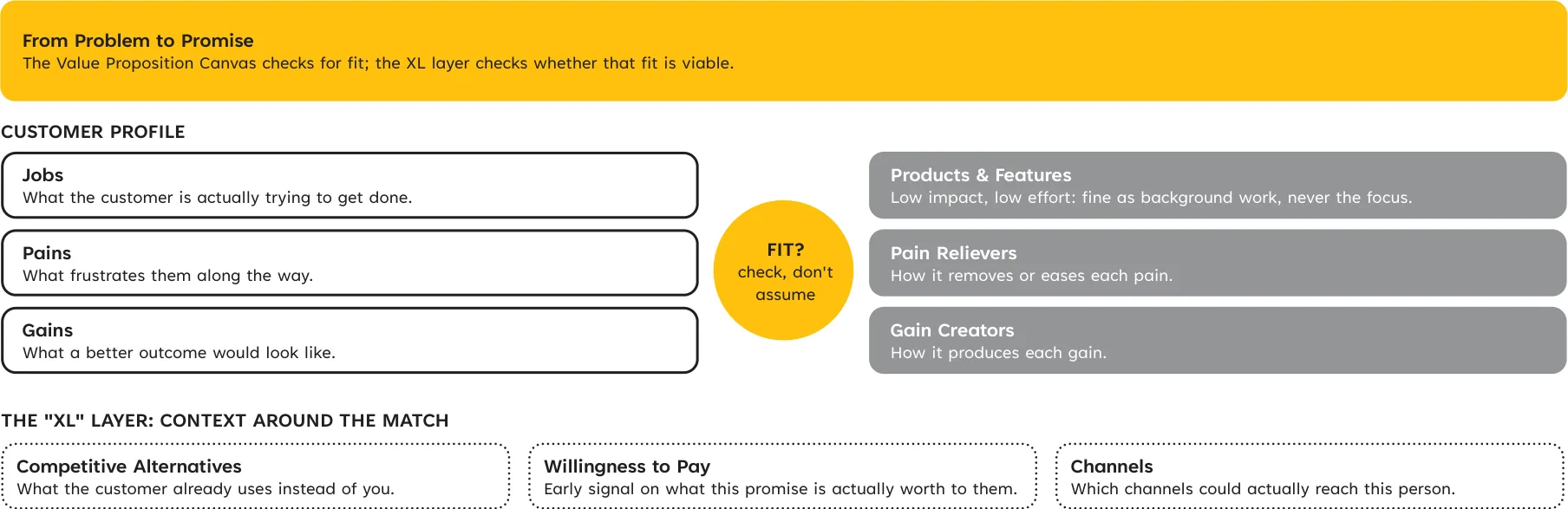
The core canvas checks for fit between the customer's jobs, pains, and gains and the proposed pain relievers and gain creators. The XL layer checks whether that fit is viable.
Checking for fit, not just coverage.
It is worth naming the difference between two things that can look similar on a filled-in canvas: coverage and fit. Coverage means every pain and gain has something written opposite it. Fit means the thing written opposite it would actually, plausibly, address it for this specific customer. The difference matters because a canvas can achieve full coverage while being almost entirely wrong. The check worth running, box by box, is not "did we address this?" but "would this specific customer agree that this actually helps?" Where the team cannot confidently answer that, the honest move is to mark it as unconfirmed rather than quietly assume it and move on. This canvas is a design tool, not a validation tool. It organizes a claim about fit clearly
enough to be tested, but the testing itself is the next step's job, not this one's.
Common ways this step goes wrong.
The most common failure is building the Value Map first, from a feature the team already wanted to build, and then reverse-engineering a Customer Profile that happens to justify it. That produces a canvas that looks complete but was never actually a test of anything. The second is treating the core jobs-pains-gains match as sufficient and skipping the XL layer, which is how a team ends up with a value proposition that fits beautifully and still fails commercially, because a competitor's habit-forming alternative or an unreachable channel was never checked. The third is including a long list of pain relievers and gain creators to make the canvas look thorough, when a shorter list that maps precisely to the highest-priority pains and gains from Step 2 is far more useful than broad but shallow coverage.
And the fourth is treating the canvas as finished and final, when it is better understood as the most current, best-argued version of a claim that Step 4 still needs to test.
What this step hands to the next one.
By the end of this step, the team has a specific promise: a proposed set of features, explicitly justified against a specific customer's jobs, pains, and gains, checked against what that customer already uses instead, with an early read on what it might be worth and a view of how it could actually reach them. That promise is still exactly that: a promise, argued for on paper, not yet tested with a real customer. Whether it holds up outside the canvas is the entire question the next step exists to answer: Validate with Evidence, seeing the whole customer relationship end to end with a Customer Journey Map, then running real experiments to replace this step's best argument with actual proof.
How to 'crack' the 'code' on Value Propositions.
If you start at products and services, you'll argue about features. If you start at persona and job, you'll align on value.
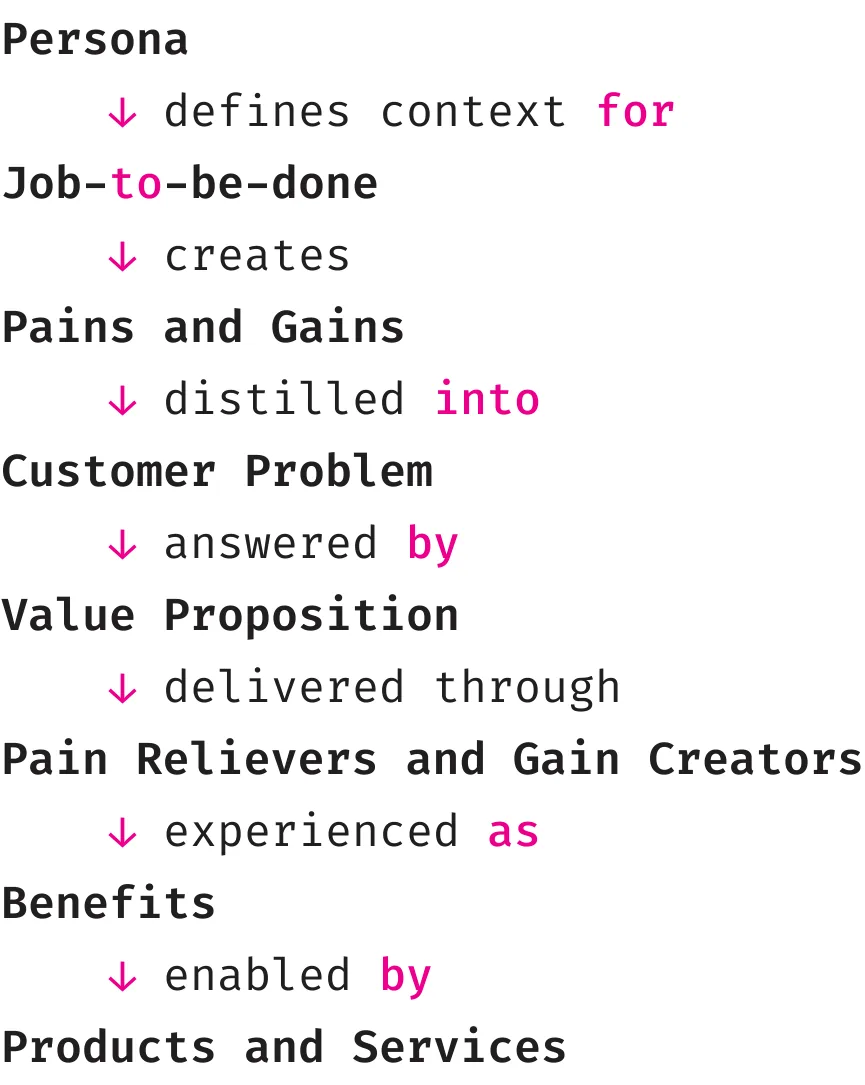
From problem to value.
Defining a Value Proposition is a foundational step in building a successful business strategy. It clearly articulates why customers should choose your product or service over others.
Without a well-defined Value Proposition, even the most innovative offerings can struggle to find traction in the market. A compelling Value Proposition communicates the unique benefits you deliver, how you solve specific Customer Problems, and what differentiates you from competitors.
It serves as a guiding principle for decision-making across product development, marketing, sales, and customer experience. It helps align your team around a shared understanding of what truly matters to your target audience. When crafted effectively, it becomes the backbone of your brand messaging and the anchor for consistent communication.
In an increasingly competitive landscape, clarity is power. Customers are inundated with choices and limited in attention. A strong Value Proposition cuts through the noise, quickly answering the question: “Why should I care?” It helps you attract the right customers, retain them longer, and create loyalty through meaningful value delivery.
Moreover, it brings focus. Instead of chasing every opportunity, a clear Value Proposition ensures you prioritize initiatives that reinforce your unique advantage. In short, defining your Value Proposition is a strategic imperative for growth and relevance.
In a world full of products, services, and promises, being good is not enough. You need to be relevant and recognizable.
The anatomy of a strong Value Proposition.
A clear Value Proposition is not clever wording. It is structured clarity. It answers five questions without ambiguity:
A specific customer
A clearly defined segment with a shared problem in a specific context. If you can't picture the customer in a real situation, it's too broad.
A concrete problem
A painful, costly, or frustrating situation that occurs repeatedly. It should be observable and describable in one sentence.
A clear outcome
A measurable improvement: Save 30% time, reduce costs by 18%, increase conversion by 12%, eliminate a 3-step manual process. If it's not measurable, it's not sharp.
A distinct advantage
Why is this better than the current alternative? Clear Value Propositions articulate contrast:
- Faster than…
- Cheaper than…
- Easier than…
- More reliable than… If a competitor can copy your statement word for word, it's weak.
Simplicity
It can be expressed in 3–4 precise lines. If it takes a slide deck to explain, it's not clear. In one line: A clear Value Proposition connects a specific customer to a measurable outcome, delivered in a distinct way, and expressed so simply that it eliminates confusion.
The Value Proposition logic.
Most Value Propositions look solid on paper. The boxes are filled, the logic flows, and the features map neatly to gain creators and pain relievers. And yet, somewhere between the canvas and the customer something essential gets lost.
What's missing is not another sharper sentence or a cleverer promise. What's missing is the connection. Traditionally, the Value Proposition canvas has been quite straight forward in aligning a company's products and services with their customers' needs. So straight forward in fact, that a lot of valuable context and even the Value Proposition itself were left on the roadside. Without giving the proper space to understand the customer you are solving a problem for and what exactly their problem is, the solution becomes blurry and impersonal.
The Value Proposition itself then becomes a description of what we offer, not a reflection of what truly changes for the customer. We list features. We summarise advantages. But we rarely articulate the moment of difference: What becomes easier, safer, faster, or less heavy? What shifts in the customer's day, behavior, or sense of control once this proposition exists?
And even when benefits are described, they are often functional or rational by default. Efficiency. Savings. Performance. Important, but incomplete. Because customers are not only trying to get something done. They are trying to feel something: Confident instead of uncertain, relieved instead of overwhelmed, seen instead of ignored. This emotional Job-to-be-done rarely finds its way onto the canvas, even though it silently drives adoption, loyalty, and trust.
Finally, many Value Propositions avoid the hardest part altogether: The real customer truth. The inconvenient context. The constraints, trade-offs, habits, fears, and contradictions that shape behavior. Without this truth, the canvas becomes aspirational rather than accurate. More wishful thinking than strategic clarity. This chapter zooms in on what is currently missing in the Value Proposition canvas as it is commonly applied today. It defines a new design.
It reconnects the dots between the Customer Problem, the Value Proposition, the tangible and emotional benefits of change, and the lived context in which customer actually decide. Not to add complexity, but to restore honesty, relevance, and resonance.
Because a Value Proposition only works when the customer recognises themselves in it and thinks: Yes, this is exactly my reality.
Think of these elements not as separate boxes, but as one causal chain that starts with the customer's reality and ends with the productsand services that you need to turn the Value Proposition into reality. Here's how they connect step by step:
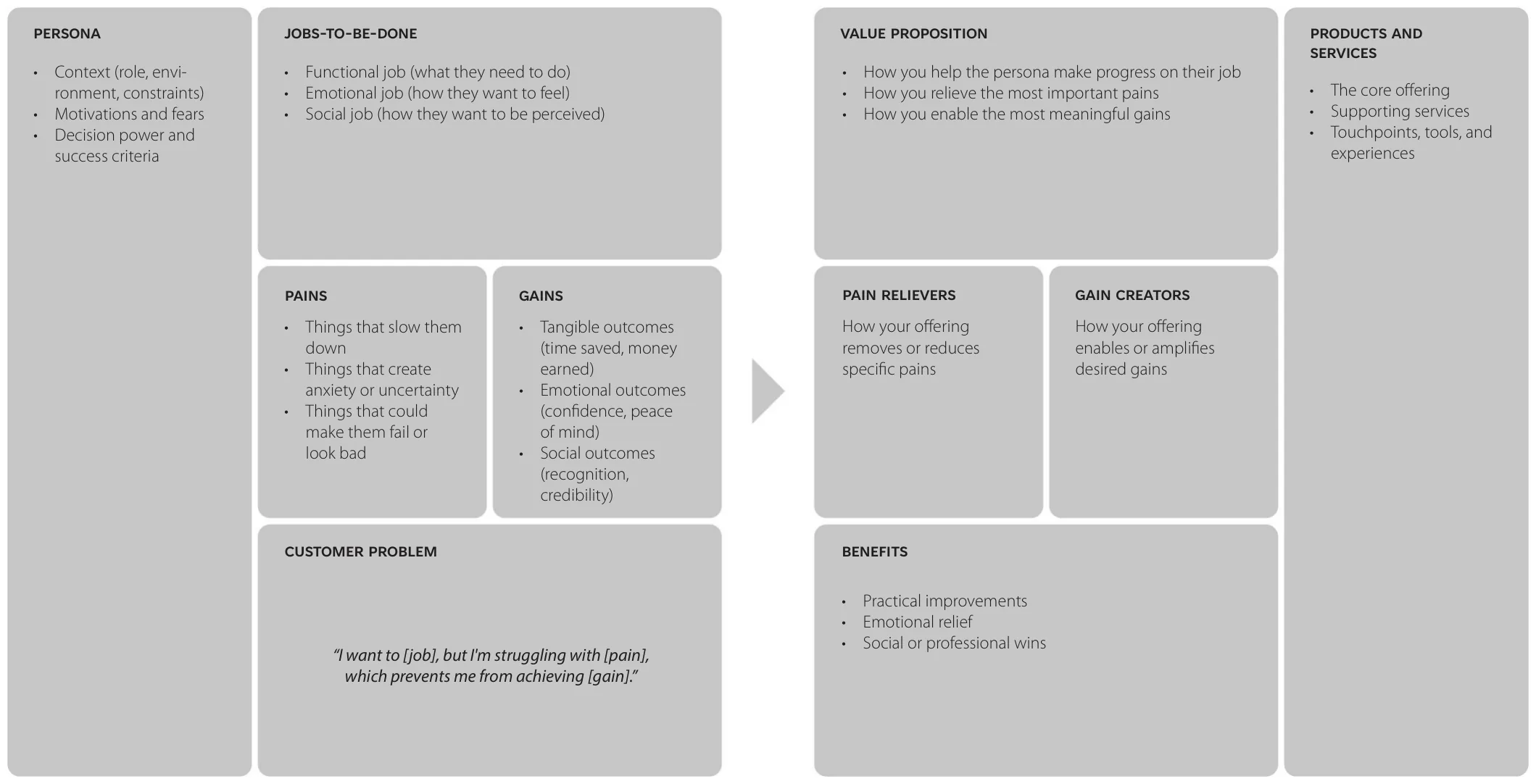
8 Building blocks to design the Value Proposition.
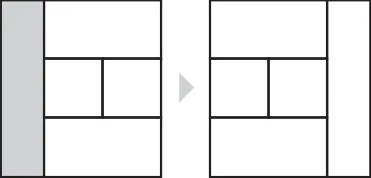
BLOCK 1: Persona
Who is experiencing the problem
The persona gives the Value Proposition a human anchor. It represents a pattern of behavior, context, and motivation, not a demographic profile.
A good persona clarifies:
- The situation they are in
- Their responsibilities and pressures
- What success and failure look like to them
- Their decision power and constraints
Ask yourself: “Do the expectations and goals of the persona match the context?”
Connection: Without a persona, every other element becomes abstract. You can't define a “job,” pain, or gain without knowing who is carrying it.
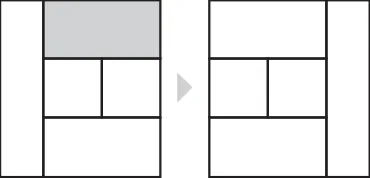
BLOCK 2: Jobs-to-be-done
What they are trying to accomplish
The Job-to-be-done (Job-to-be-done) describes the progress the persona wants to make in a specific context. It is not a task, feature, or solution.
A job includes:
- Functional dimension (what needs to happen)
- Emotional dimension (how they want to feel)
- Social dimension (how they want to be perceived)
Ask yourself: “Would this job look different if it were created for a slightly different persona?”
Connection: The job exists because of the persona and their context. It then sets the direction of value: Everything that follows must help the customer make this progress.
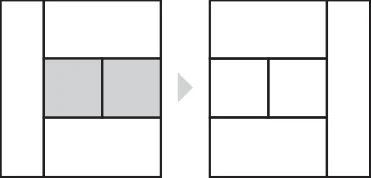
BLOCK 3: Pains and Gains
Why is this hard and what does success look like?
Pains and gains emerge directly from the job:
- Pains = Obstacles, risks, frustrations, fears that block progress
- Gains = Desired outcomes, relief, success signals
They are not random lists; they are symptoms of struggling (or succeeding) at the job.
Ask yourself: “What makes this job difficult, risky, or stressful?” “What would make this job feel like a win?”
Connection: Pains and gains are not abstract, they are job-specific. Without the connection to a job, there can be no meaningful pains or gains.
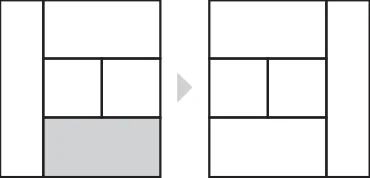
BLOCK 4: Customer Problem
Where the job breaks down
The Customer Problem is the critical pain (or cluster of pains) that prevents the persona from successfully completing the job. The Customer Problem is a synthesis, not a new input.
This is the moment where:
- Frustration peaks
- Existing solutions fail
- Inaction becomes costly
Ask yourself: “Why can't they make the progress they want today?”
Connection: This is the bridge between customer understanding and your solution. This is the moment where insight becomes sharp. A strong Customer Problem statement forces prioritization and creates focus.
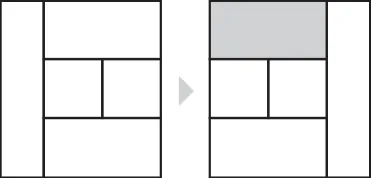
BLOCK 5: Value Proposition
What is the promise?
The Value Proposition is your promise to solve the Customer Problem in a meaningful way. The Value Proposition is your explicit response to the Customer Problem. It is not a feature list; it is a clear statement of relevance.
It encompasses:
- The job they are trying to do
- The pain that blocks them
- The outcome they care about
Ask yourself: “Why should this customer choose us to help them make progress?”
Connection: Move from Problem to Promise. The Value Proposition is the connective tissue between customer reality and your offering.
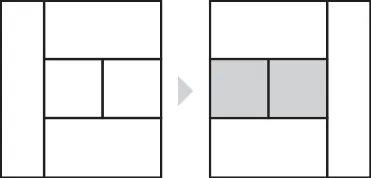
BLOCK 6: Pain relievers and gain creators
How you deliver on the promise
These are the mechanisms that make the Value Proposition real:
- Pain relievers: How your offering removes or reduces specific pains
- Gain creators: How your offering enables or amplifies desired gains
Each one should map directly to a specific pain or a specific gain.
Ask yourself: “How exactly do we remove this frustration?” “How exactly do we create this positive outcome?”
Connection: Make the promise actionable. Here you turn your promise into mechanisms. If a pain or gain isn't addressed here, it's not truly part of your Value Proposition.
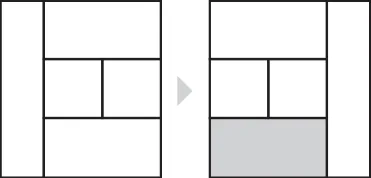
BLOCK 7: Benefits
What the customer experiences
Benefits describe the positive impact of your Value Proposition on the customer's life or work. The customer-facing translation of pain relievers and gain creators.
They translate value into:
- Practical improvements
- Emotional relief
- Social or professional wins
Ask yourself: “What is better because we exist?” “Are our Benefits really customer-facing, or product-facing?"
Connection: From intent to customer outcome. Place the offering and mechanisms within the customer reality.
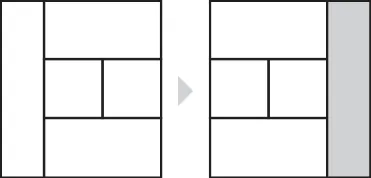
BLOCK 8: Products and services
What you actually provide
Products and services are the tangible manifestations of your Value Proposition.
They include:
- The core offering
- Supporting services
- Touchpoints, tools, and experiences
Ask yourself: “How can we materialize our offering to deliver real value to our customer?”
Connection: Products and Services are carriers of value, not the value itself. They are replaceable as long as the benefits remain. Customers don't want products, they want job progress: This is why strong Value Propositions survive technology shifts.
Tool
Value Proposition canvas.
- PERSONAL
- map Value Proposition insights
- ± 45 MIN
- session
- 2-6
- people per group
The essence of a Value Proposition
A Value Proposition clearly articulates why a specific customer should choose your offering over alternatives. It describes how you help a customer make progress in their life or work by solving a meaningful problem or creating a valuable outcome, in a way that is relevant, differentiated, and desirable. A strong Value Proposition is never about what you offer first, but about what the customer is trying to achieve and struggles with.
A next-generation improvement
This Value Proposition canvas builds on and significantly improves the original Value Proposition canvas by strengthening the learning loop and sharpening the problem–solution logic. It introduces clearer distinctions between customer understanding and solution design, explicitly adds the Customer Problem as a synthesis step, and separates benefits from features to avoid solution bias. The result is a canvas that supports deeper customer insight, better prioritization, and more testable Value Propositions.
The benefit of using the canvas
The canvas helps teams move from assumptions to insight by:
- Creating a shared, structured understanding of the customer
- Forcing teams to learn before they design
- Preventing premature solution thinking
- Making Value Propositions explicit, comparable, and testable
- Aligning multidisciplinary teams around what truly matters to the customer
When to use this canvas
Use the Value Proposition canvas when you want to:
- Design a new Value Proposition or refine an existing one
- Enter a new market or target a new customer segment
- Improve product–market fit
- Align teams around customer value
- Prepare for experimentation, validation, or go-to-market decisions
Learning-first focus: Customer before Value Proposition
This canvas is deliberately structured to start with deep customer understanding before defining any solution. The first half is entirely dedicated to learning about the customer: Who they are, what they are trying to achieve, where they struggle, and what success looks like to them. Only once this understanding is solid do you move to designing the Value Proposition. This sequencing reduces bias, increases relevance, and leads to stronger, evidence-based choices.
Building blocks Persona
Add a customer pesona including their role, context, and relevant characteristics.
Job-to-be-done
State the functional, emotional, or social task the customer is trying to accomplish or make progress on.
Pains
List the frustrations, risks, or obstacles the customer experiences while trying to get the job done.
Describe the outcomes or positive results the customer values most.
Summarize the core problem or unmet need that emerges from the combination of jobs, pains, and gains.
Articulate how you help the customer solve their problem and create value in a way that is meaningful to them.
Pain relievers and gain creators
Explain how your solution reduces pains and amplifies desired gains.
Describe the tangible and intangible value the customer actually experiences when using your solution.
List the concrete products, services, or features that deliver the promised value.
Case study · The Coolblue way
Designing happiness.

Pieter Zwart never set out to build one of the Netherlands' most beloved brands. He just wanted to make customers smile.
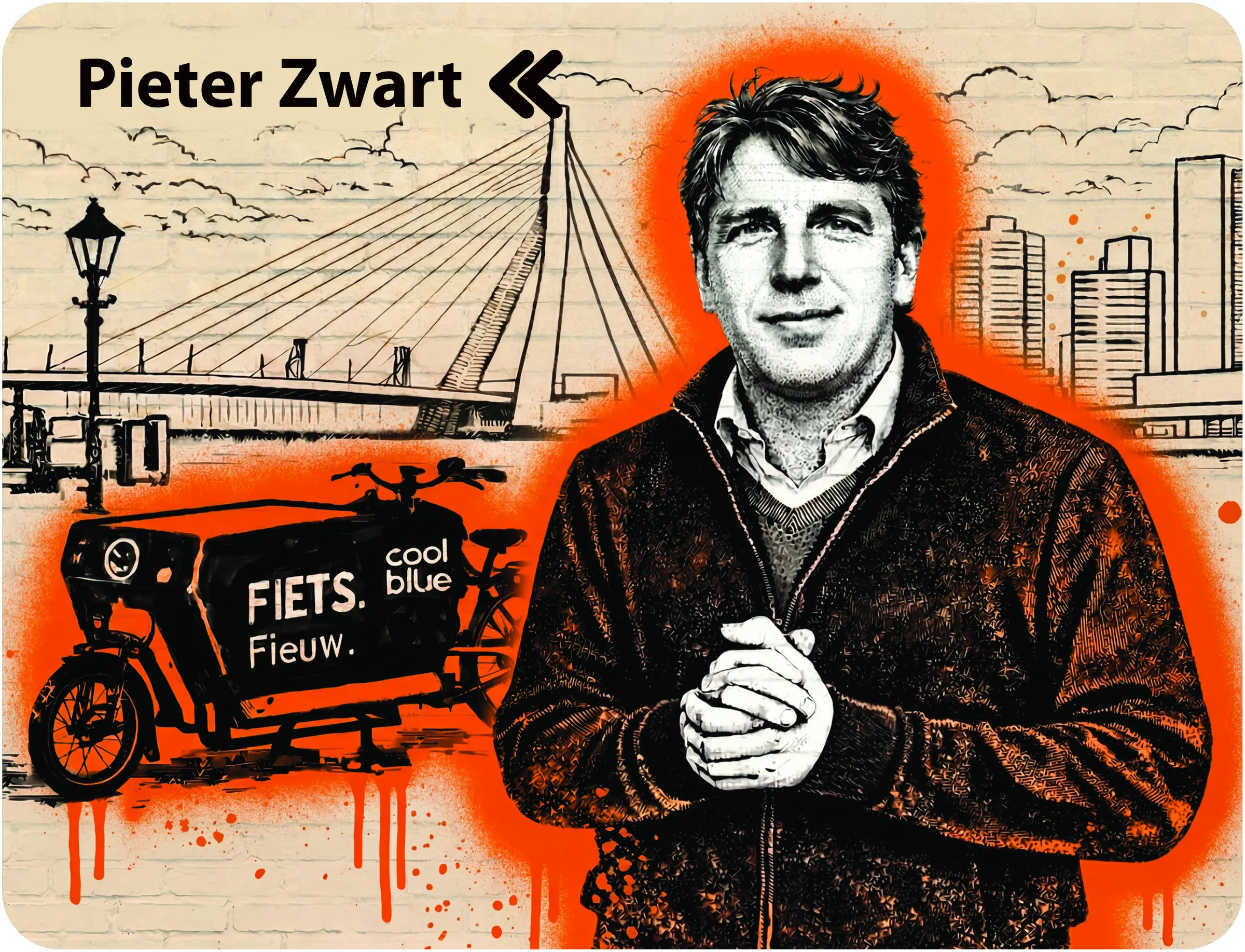
That might sound naïve in a world obsessed with scale, margins, and market share. But that single ambition, “Alles voor een glimlach,” everything for a smile, became the heartbeat of Coolblue. The e-commerce company that quietly redefined what customer satisfaction can look like when it's built into the DNA of a Business Model rather than taped on as a department.
Today, Coolblue is known for its quirky humor, blue boxes, and the kind of customer service that borders on fanaticism.
But none of that happened by accident. It started in 1999, when Pieter and two university friends launched a website called MP3man.nl from a dorm room in Rotterdam. They sold portable music players. The margins were thin, the logistics clunky, and the market brutally competitive. Yet they had one clear insight: People weren't buying gadgets; they were buying trust.
When customers had questions, Pieter answered them himself late into the night, typing emails that began with “Hi!” and ended with a smiley face. Because he realized early that emotion travels faster than information. People don't remember the price. They remember how you made them feel when something went wrong.
Lesson 1: Design around the human, not the transaction
As Coolblue grew from one webshop to dozens, then to a unified brand, that human-centric design philosophy never left.
Every product page, every warehouse workflow, every delivery van; all of it was designed backward from the question: “What will make the customer's life a little easier, a little happier, a little more delightful?” This wasn't marketing fluff. It was a design system for empathy. The product was the experience.
Coolblue turned the tedious act of buying electronics into something frictionless and even fun. If a customer ordered a washing machine, they didn't just get a machine, they got two smiling delivery drivers who carried it upstairs, installed it, and tested it before leaving. The extra steps weren't viewed as “costs.” They were investments in trust capital, the kind that compounds faster than any marketing budget.
Lesson 2: Measure the smile
While most companies obsess over conversion rates, Coolblue measured smiles. Their Net Promoter Score (NPS) became a sacred metric, not just in PowerPoint slides but in everyday conversations.
Every employee, from warehouse packers to marketing interns, knew how the company scored. And when the score dropped, they didn't launch meetings about “efficiency.” They asked: “What went wrong for the customer?”
That's the beauty of designing for human experience: The KPIs become emotional feedback loops, not management instruments. The entire organization was wired to feel what customers felt and go on to fix it.
Lesson 3: Build culture like you build products
Zwart's genius wasn't in technology; it was in culture design. Coolblue was built on four values: Friends, flexible, just do it, and unconventional. Those values were used as hiring filters, design criteria, and decision-making tools.
If a customer issue didn't fit into standard procedure, employees were empowered to improvise. That's why a customer once received a hand-drawn apology card from a Coolblue employee whose order went wrong, and why that story went viral, not because of PR, but because it was genuine.
Zwart often says, “If you hire nice people, they'll make customers happy.” Culture became the invisible interface between business and customer.
Lesson 4: Solve the real problem, not the perceived one
Coolblue's design thinking was practical, not theoretical. They constantly asked, “What is the real customer Job-to-be-done here?”
Customers didn't want an air conditioner. They wanted a good night's sleep. They didn't want a camera. They wanted to capture a memory perfectly. They didn't want a laptop. They wanted confidence that it wouldn't crash before a deadline.
Once you understand the real job, everything changes: Your marketing, your service, and your logistics. That's why Coolblue built its own delivery network, its own repair service, even its own stores. Because the moment a third party touches your customer, you lose control of the smile.
In Business Model terms, Coolblue verticalized trust.
Lesson 5: Make improvement a daily sport
Zwart describes his leadership philosophy in one sentence: “Elke dag een beetje beter.” Every day, a little better.
It's deceptively simple but culturally transformative. Continuous improvement is an identity. The company treats mistakes as design input. Every complaint is a prototype waiting to be improved. This mindset turned Coolblue into a learning organism, not just a logistics machine.
Teams run daily retrospectives, tweak packaging to save seconds, test different humor in emails, and re-evaluate delivery scripts for tone. Nothing is ever static. Everything is an experiment.
Lesson 6: Humor is a design tool
Walk into a Coolblue store, and you'll notice something strange: People smile. Not because they're told to, but because the environment is light. The posters are witty, the product copy is playful, and even the boxes have jokes printed on the inside.
Zwart once said, “If you can make people laugh, you've already solved half the problem.” Humor humanizes digital interaction. It's a subtle design tool for building emotional connection in an otherwise transactional world.
Lesson 7: Organize everything around the smile
Most companies organize around product lines, channels, or functions. Coolblue organizes around moments of truth: The key emotional peaks in the Customer Journey. Each function, from tech to logistics to marketing, owns a piece of that emotional curve.
That's why their marketing team designs trust instead of only producing ads. Their logistics team delivers peace of mind instead of just shipping boxes. Their call center is an empathy engine instead of just being a cost center.
Everything is structured to serve one purpose: The smile.
The blueprint of customer-obsessed business design
Underneath the humor and humanity lies a remarkably disciplined system. Coolblue combines design thinking (deep empathy, iteration, human insight) with business design (profitability, process, and scale).
They don't see empathy and efficiency as opposites. They see them as co-dependent: Empathy creates loyalty; efficiency sustains it. The result? A company that competes not on lowest price, but on highest trust.
Epilogue: The business of happiness
When asked what keeps him up at night, Pieter Zwart doesn't talk about competitors or economic downturns. He says: “It's when a customer is not smiling.”
Because that's what Coolblue truly sells. Not electronics, not delivery speed, but a feeling. The feeling that someone, somewhere, actually cares about your experience.
And maybe that's the ultimate design lesson: In a world where businesses chase growth, the real differentiator is still the same as it was when Pieter Zwart wrote those first late-night emails, making people smile. And build your company around that.
The transferable principles
- 1. Design around the real Job-to-be-done (not the product): Sell the outcome, remove the hassle.
- 2. Own the critical moments of truth: Where trust is won/lost (delivery, setup, support).
- 3. Verticalize trust selectively: Bring key steps inhouse if partners break the promise.
- 4. Measure smiles, not just sales: NPS/CSAT/CES tied to specific journey steps.
- 5. 'Every day a little better': Small, continuous improvements > big-bang projects.
- 6. Human tone of voice: Clear, candid, often humorous; reduces friction and anxiety.
- 7. Evidence over opinion: Run tests, ship small, iterate fast (and keep what works).
Coolblue. Value Proposition Analysis.
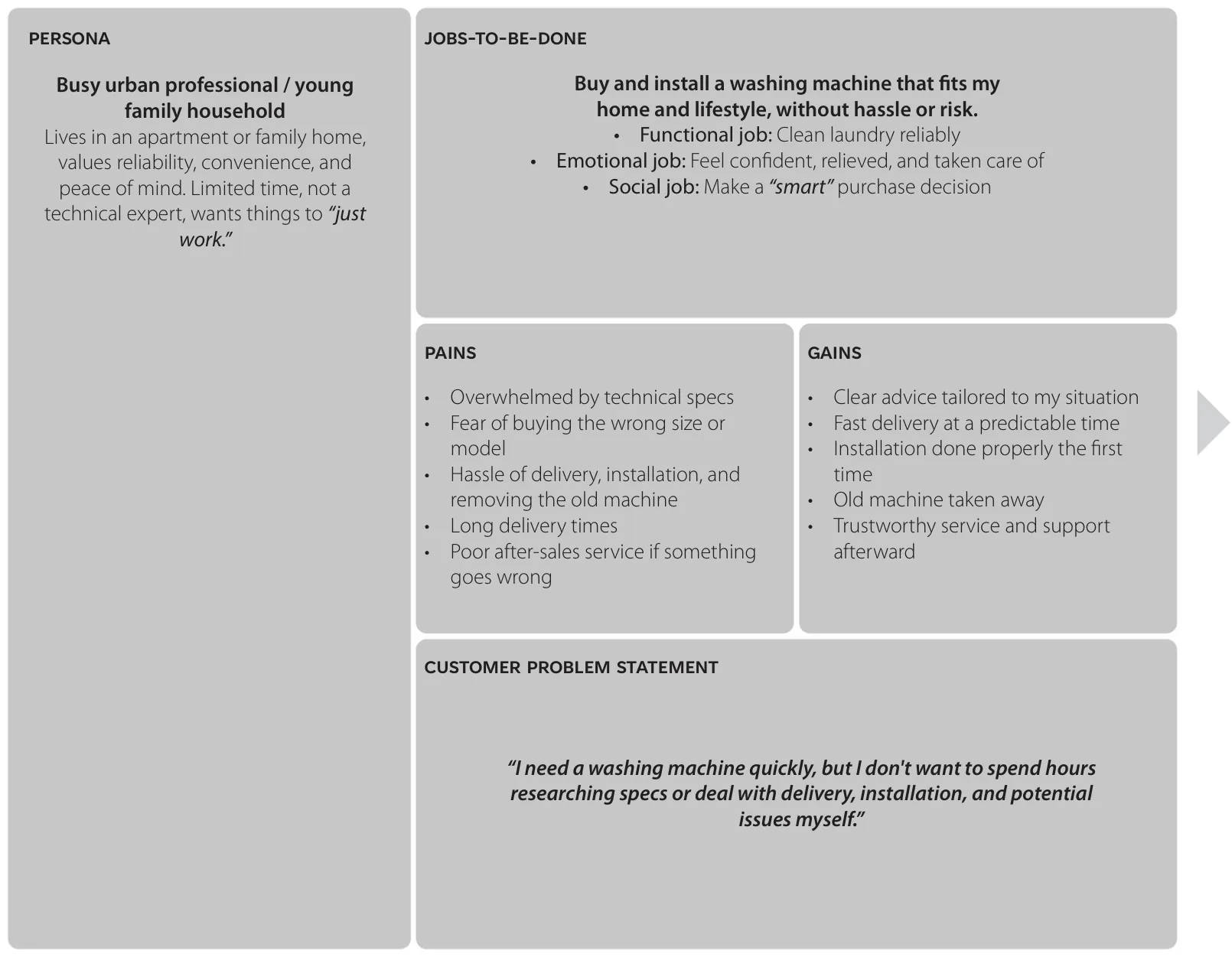
In the Value Proposition canvas for Coolblue, the essence of the consumer is someone who wants to buy products without hassle, doubt, or wasted time, and who values clarity, reliability, and feeling taken care of. The consumer is not looking for the cheapest option per se, but for confidence that the right choice is being made effortlessly.
The persona, Job-to-be-done, pains, gains, and Customer Problem all have one thing in common: They revolve around reducing cognitive and emotional effort. The Job-to-be-done is completing a purchase smoothly and confidently; the pains are confusion, uncertainty, delays, and poor service; the gains are reassurance, speed, ease, and a pleasant experience. Together, they define a Customer Problem centered on decision stress and trust. Coolblue's strength lies in deeply understanding this consumer mindset and designing every interaction to remove friction, guide decisions, and make the customer feel supported from start to finish.
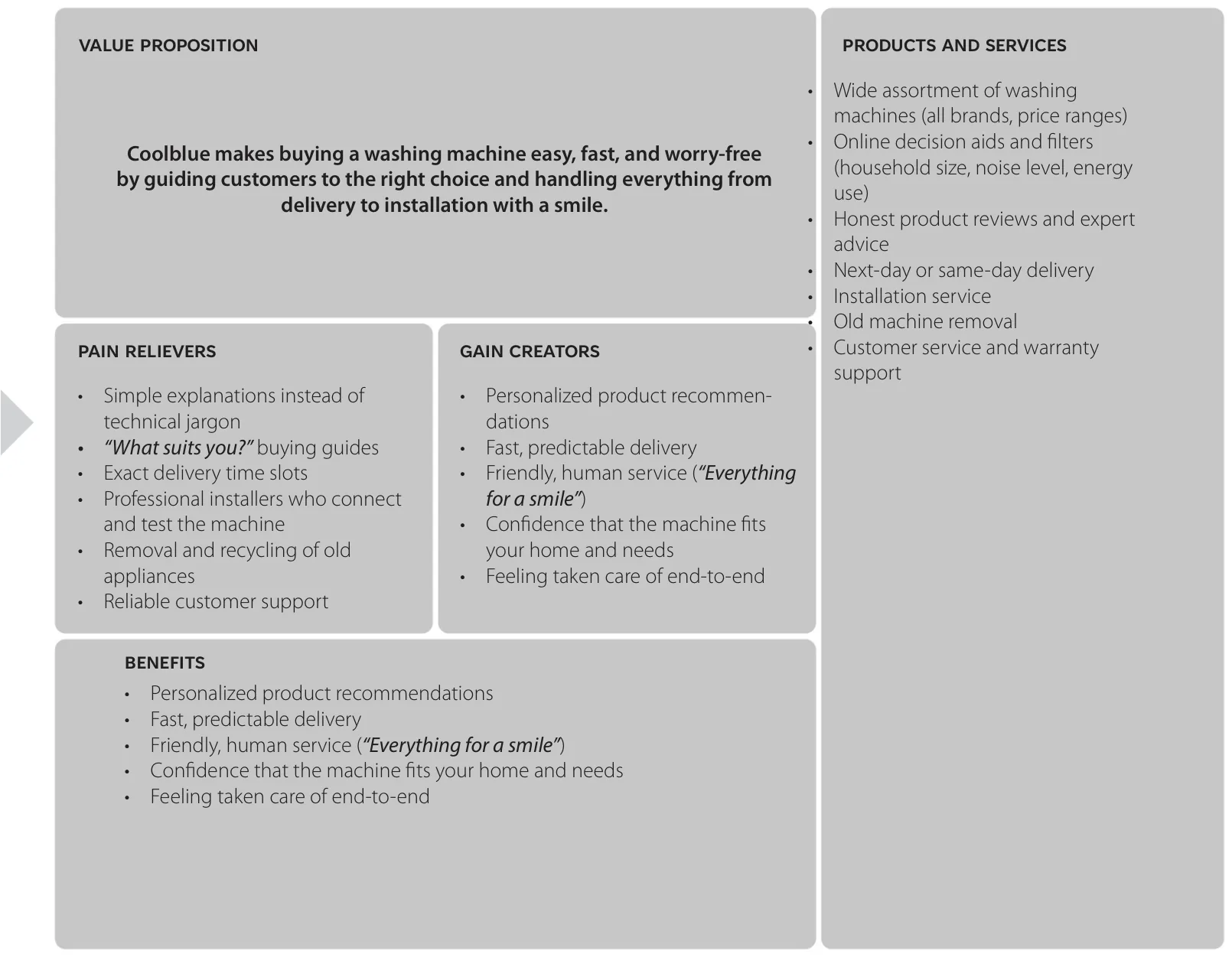
Coolblue makes buying a washing machine easy, fast, and worry-free (household size, noise level, energy by guiding customers to the right choice and handling everything from use)
- Personalized product recommen technical jargon dations
- Professional installers who connect for a smile”) and test the machine
- Removal and recycling of old your home and needs appliances
The essence of Coolblue's Value Proposition in the Value Proposition canvas is making customers happy by removing friction from buying, using, and returning electronics. Coolblue doesn't win on price alone, but on certainty, ease, and human service at every step of the journey. The proposition is built around trust: Customers know exactly what they get, when they get it, and who will help them if something goes wrong.
What the Value Proposition, pain relievers, gain creators, benefits, and products and services have in common is that they all serve this single promise. Pain relievers reduce hassle through clear advice, fast delivery, easy returns, and proactive customer support. Gain creators add confidence, convenience, and even enjoyment through personal tone of voice, expert reviews, and reliable service. The benefits customers experience are peace of mind, speed, and feeling cared for. All products and services, from webshops to delivery and service desks, are designed to consistently deliver on this promise.