The reframe.
The Augmented Collaboration Operating Model
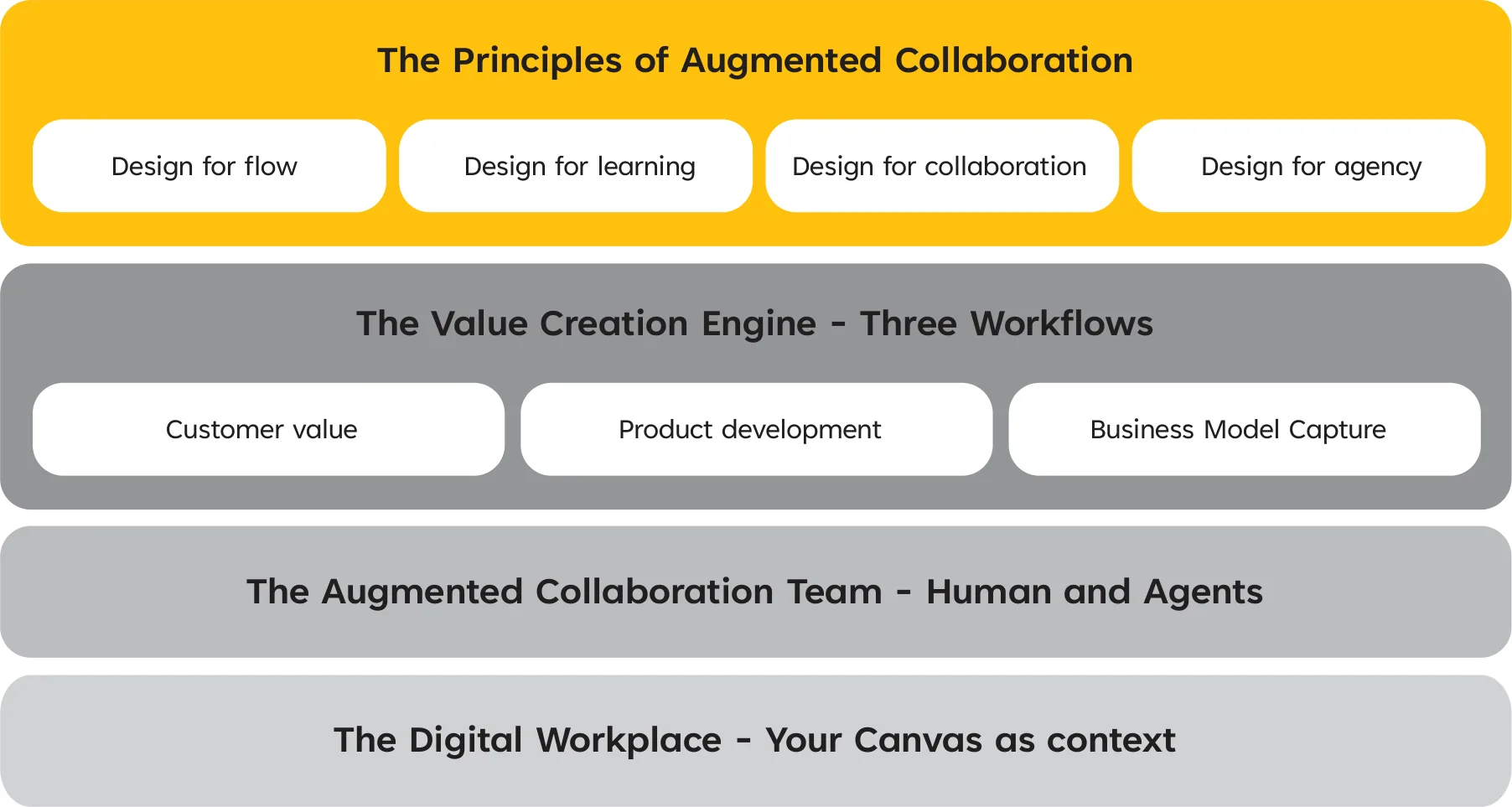
What is augmented collaboration?
The future of work is not humans versus AI. And it is not simply humans using AI as another tool, the way a previous generation used spreadsheets or search engines. Both framings miss the real opportunity, which is something more fundamental: humans and AI working together as one system, each doing what it does best, neither trying to be the other.
We call this Augmented Collaboration.
Augmented Collaboration is the practice of combining human and artificial intelligence in a shared system of thinking, creating, deciding, and acting. It is not about replacing human intelligence with artificial intelligence. It is about designing the conditions in which both can contribute what they do best, and where the combination becomes more powerful than either could be alone. The word that matters most in that sentence is designing. This kind of collaboration does not happen by accident. It happens on purpose, or it does not happen at all. Every practice in this book is, in the end, an act of that design: a deliberate choice about how thinking, making, and deciding are shared between people and machines.
At its simplest, we can describe Augmented Collaboration as an equation: Human intelligence + AI intelligence + shared context + workflow + digital workspace = Augmented Collaboration.
Every element of this equation matters, and the equation fails if any one of them is missing. AI alone does not create collaboration. Giving people access to increasingly powerful models does not automatically make teams smarter, faster, or more innovative. Most organizations are discovering exactly this: they have bought the tools, and very little has changed. The value does not live in the model. It emerges when intelligence is connected to context, embedded in workflows, captured in a shared workspace, and continuously improved through feedback. Take any of those away and you are left with a powerful engine bolted to nothing.
It is worth pausing on what each element contributes, because each one fails in its own way. Without human intelligence, there is no direction: the system produces output, but nobody has decided what matters, and nothing that comes out of it carries an owner. Without AI intelligence, the system runs at yesterday's speed, limited by what people can read, remember, and produce by hand. Without shared context, both intelligences work blind: the human repeats what the organization already knows, and the AI generates plausible answers to questions it does not really understand. Without workflow, contributions have nowhere to land, and even good output dies between one person's screen and the next person's priorities. And without a digital workspace, everything that was learned lives in fragments, scattered across private chats and personal files, invisible to the colleague and the model that need it next. Each missing element breaks the system differently, but the result is always the same: activity without compounding.
The equation also explains something that puzzles many leaders: why results with AI vary so wildly between organizations using identical tools. The difference was never the model. It was everything around the model: how much context it could reach, how deeply it sat inside the daily work, and how much of what it produced was captured, challenged, and reused rather than generated and forgotten. The equation is a way of seeing that whole, and of noticing which part of it your organization has left unbuilt.
Throughout this book, we will return to three layers that make this possible. Think of them not as parts of a diagram but as three different kinds of contribution, each necessary, none sufficient on its own.
The human layer.
The Human Layer represents what people uniquely bring to the system: judgment, empathy, creativity, curiosity, courage, relationships, and leadership. Humans understand meaning and nuance. They establish trust, navigate ambiguity, challenge assumptions, make choices, and take responsibility for the consequences. This last point is easy to pass over and impossible to overstate. Accountability is not a feature that can be delegated to a machine. Someone has to be willing to put their name against a decision and live with how it turns out. A customer, a colleague, or a regulator who asks "who decided this?" expects a person, not a process, and certainly not a model. That expectation does not weaken as AI grows more capable; if anything, it sharpens.
Much of this layer is also relational, and that is not a soft footnote to the real work; it is the real work. Trust is built between people, not between a person and an output. A customer stays because someone understood their situation, a team holds together because its members have earned each other's confidence, and a difficult decision lands because the person delivering it is believed. None of that can be generated.
There is a second contribution that is easy to miss because it looks like nothing is happening:
humans decide what the work is for. A model can optimise toward any goal it is given, brilliantly and indifferently. It cannot tell you whether the goal is worth pursuing, whether the customer being served is the right one, or whether the cost of winning is one the organization should be willing to pay. Those are questions of purpose and values, and they stay human even in the most augmented system. Human intelligence provides direction, purpose, and the ability to decide what actually matters, which is a question no amount of processing power can answer on its own.
And as AI grows more capable, these contributions do not shrink in importance; they become the bottleneck and the differentiator at once. When every competitor can generate polished output, judgment about which output deserves to exist, and the courage to say no to the rest, is where the difference is made. The Human Layer is not what remains after automation has taken its share. It is the part whose value rises with every capability the machines gain.
The AI layer.
The AI Layer brings a different set of capabilities: speed, synthesis, pattern recognition, generation, simulation, and automation. AI can process vast amounts of information, explore possibilities, identify connections a person would never spot, generate alternatives by the dozen, simulate scenarios, and execute repetitive tasks at a scale no human can match. Where a person tires, hesitates, or loses the thread across hundreds of documents, AI does not. These are real strengths, and pretending otherwise helps no one. But they are strengths of a particular kind: breadth, tirelessness, and speed, not meaning, judgment, or care.
The honest way to work with this layer is to treat it as a contributor with a distinctive profile rather than a lesser or greater version of a person. It reads everything and understands nothing the way a human understands it. It never gets bored, which makes it superb at the work boredom used to ruin, and it never gets suspicious, which makes it useless at the moments where suspicion is the beginning of insight. It produces its best work when the question is clear and the context is rich, and its worst when either is missing, delivered in exactly the same confident tone.
There is one more property of this layer that shapes everything built on top of it: it does not stand still. Every capability listed above is broader today than it was a year ago, and will be broader again a year from now. That means the line between what people do and what AI does is not a decision an organization makes once; it is a boundary that has to be revisited as the layer underneath it moves.
Treating that boundary as fixed is how teams end up doing by hand what the system could carry, or delegating what still needs a human eye. The layers are stable. The border between them is not.
That is the point. Neither layer reaches its full potential in isolation. AI without human direction produces fluent, confident output that no one owns and no one quite trusts. Humans without AI move at the pace of memory, meetings, and manual effort. Each is weakest exactly where the other is strongest, which is precisely why the connection between them matters so much.
The collaboration layer.
That is why the third layer, the Collaboration Layer, is the one this book cares about most. It is the system that connects human and artificial intelligence, and it is the part most organizations forget to build.
The Collaboration Layer consists of the workflow, the shared context, the digital workspace, and the feedback loops through which people and AI continuously interact. It determines how information flows, when humans should lead, when AI should contribute, how ideas evolve, how decisions are captured, and how learning is fed back into the system so the next cycle is sharper than the last. It is the difference between a room full of talented individuals and an actual team.
This layer is where collaboration becomes designed rather than accidental. Without it, people and AI work in parallel but not together: the human asks, the machine answers, and the context evaporates the moment the conversation ends. Multiply that across an organization and you get the familiar picture of a thousand private conversations with AI, each starting from zero, none of them leaving anything behind. With the layer in place, the opposite happens: context accumulates, decisions leave a trail, and every interaction builds on the ones before it.
Designing this layer means answering practical questions, and the rest of this book works through them one by one. Where in the workflow does AI contribute, and where must a human lead? What context does the system need to hold, and who keeps it current? Where do decisions get captured so they stay visible, and how does what one team learns reach the next? None of these questions is technical, which is exactly why the technology alone never answers them.
The tools are the easy part to buy. This layer is the hard part to build, and it is where the real advantage lives.
It also changes the question we should be asking. Instead of asking, "What can AI do?", the more useful question is, "What can humans and AI accomplish together that neither could accomplish alone?" The first question leads to a feature list. The second leads to a way of working.
That is the promise of Augmented Collaboration: not the automation of humans, but the augmentation of human potential. The goal was never to remove people from the work. It was to remove everything that gets in the way of the work only people can do.
The organizations that thrive in the AI era will not simply have the best AI tools. Those tools are available to everyone, at roughly the same price, almost immediately. The durable advantage sits somewhere much harder to copy: in learning how to design better systems in which human and artificial intelligence continuously amplify each other. The winners will not be the ones who adopted AI first. They will be the ones who learned to collaborate with it best.