The digital canvas as a layered innovation system.
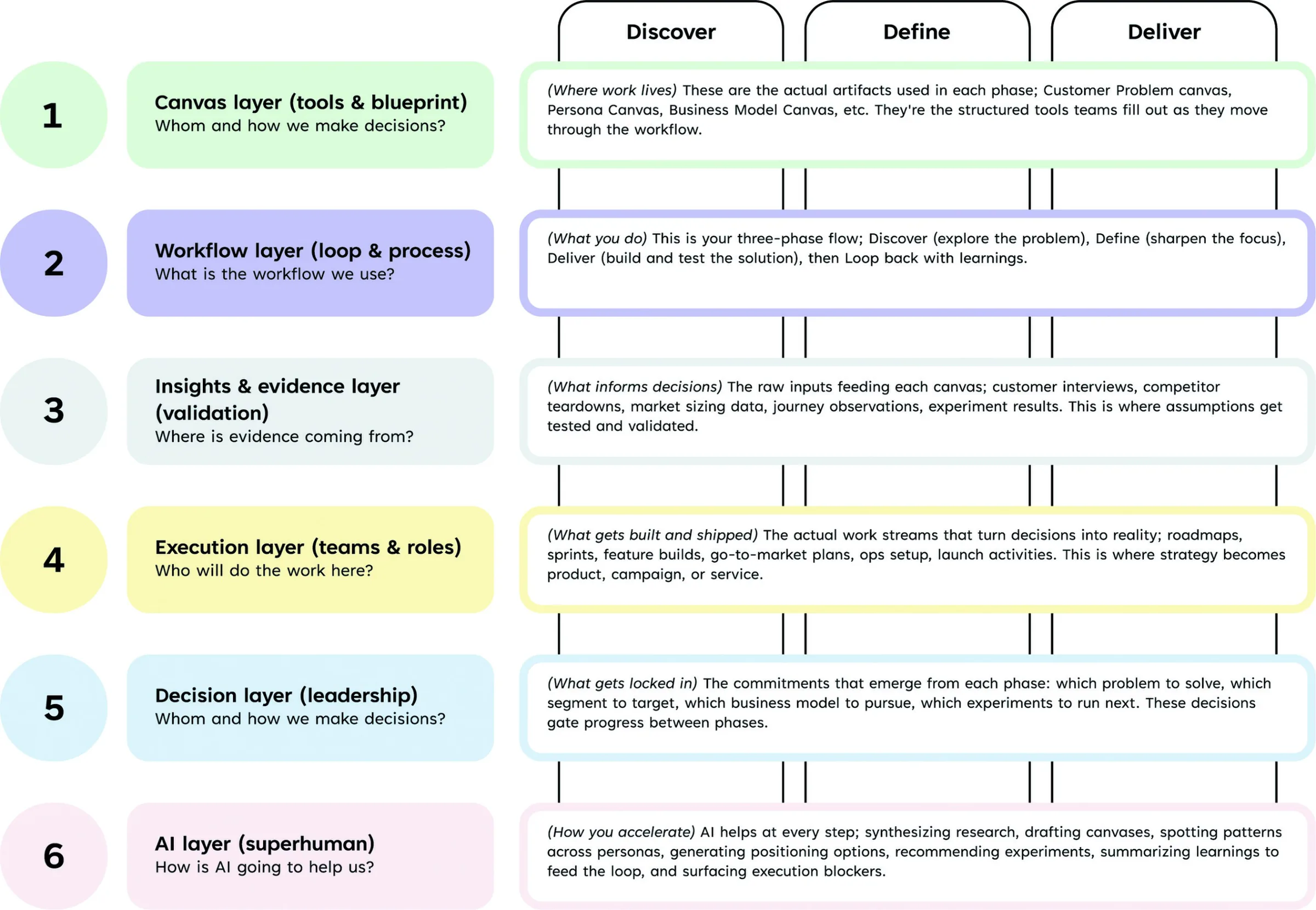
From paper to whiteboard to system
For decades, tools like the Business Model canvas have helped teams structure their thinking. These tools are powerful but they are often used in isolation, as static snapshots of ideas at a single moment in time. With the rise of digital collaboration platforms like Miro, the canvas has evolved. It is no longer just a place to capture ideas; it has become a dynamic, layered system that supports the entire innovation journey.
To fully leverage this potential, it is helpful to understand the digital canvas not as a single board, but as a system of six interconnected layers:
- Workflow
- Tools
- Insights & Evidence
- Decisions
- Execution
- AI
Together, these layers transform Miro into an environment where teams can move seamlessly from exploration to execution.
The tool layer: Structuring thinking through canvases
While the workflow provides direction, the tool layer provides structure.
Each phase is supported by specific canvases that guide thinking:
- In Discover, tools like the Customer Problem canvas, Persona canvas, and Customer Journey (as-is) help teams explore and understand.
- In Define, tools such as the Value Proposition canvas and Competitive Positioning help teams make strategic choices.
- In Deliver, tools like the Business Model canvas and Business Model Portfolio support solution and business design.
Importantly, these tools are not isolated. They are interconnected:
- Personas inform value propositions
- Value propositions shape business models
- Current journeys inform future journeys
The digital canvas allows these tools to coexist and interact in one continuous space.
The workflow layer: Giving direction to innovation
At the core of the digital canvas lies the workflow layer. This layer defines the structure of the innovation process and ensures that all activities follow a clear progression.
The workflow is organized into three key phases:
Phase 1: Discover
In the Discover phase, teams explore the problem space. The goal is not to jump to solutions, but to deeply understand customers, their needs, and the broader context.
Typical activities include:
- Mapping customer problems
- Building personas
- Analyzing current customer journeys
- Exploring competitors
- Estimating market size (TAM/SAM/SOM)
This phase expands understanding and uncovers opportunities.
Phase 2: Define
In the Define phase, teams move from exploration to focus. Insights are synthesized, and strategic choices are made.
Key activities include:
- Refining the problem statement
- Selecting target customer segments
- Focusing market opportunities
- Designing value propositions
- Positioning against competitors
This phase is about clarity, deciding what truly matters.
Phase 3: Deliver
In the Deliver phase, ideas are translated into concrete solutions and business designs.
Teams work on:
- Designing the business model
- Exploring multiple business model options (portfolio thinking)
- Creating future customer journeys
This phase prepares the organization to move toward execution and scaling.
The insights and evidence layer: Grounding work in reality
A common pitfall in innovation is relying on assumptions instead of evidence. The insights and evidence layer addresses this challenge.
This layer feeds all canvases with real-world input:
- Customer interviews and observations
- Quotes and behavioral insights
- Market data and trends
- Experiment results and validations
In the Discover phase, insights are raw and exploratory. In Define, they are synthesized into patterns and themes. In Deliver, they are validated and used to support decisions. This layer ensures that the work is not just creative, but credible.
The execution layer: Turning ideas into action
Many innovation efforts fail not because of poor ideas, but because of weak execution. The execution layer bridges this gap.
This layer translates strategy into action:
- In Discover, teams plan research and assign responsibilities.
- In Define, they design experiments and prepare validation.
- In Deliver, they build roadmaps, define initiatives, and assign ownership.
Within Miro, execution can be visualized through task boards, timelines, and integrations with delivery tools like Jira or Asana. The digital canvas thus becomes not just a place to think, but a place to act.
The decision layer: Creating focus and alignment
Innovation generates many ideas, but progress requires choices. The decision layer ensures that teams move from exploration to alignment.
At each stage, critical decisions are made:
- In Discover: Which problems are worth exploring further?
- In Define: Which customer segment and problem should we focus on? Which value proposition is strongest?
- In Deliver: Which business model should we pursue? Which initiatives should be prioritized?
Digital tools like voting, prioritization matrices, and structured frameworks make these decisions visible and transparent. The result is not just discussion, but commitment.
The AI layer: Accelerating the entire system
The final layer is the AI layer, which enhances and accelerates all others.
AI can support teams by:
- Generating personas and initial ideas
- Summarizing large sets of insights
- Clustering data and identifying patterns
- Refining problem statements and value propositions
- Structuring complex outputs
Rather than replacing human thinking, AI acts as a co-pilot, reducing manual effort and increasing speed.
From canvas to system
What emerges from these six layers is a different way of working. A traditional canvas is a tool for thinking. A digital canvas, when used in layers, becomes a system for innovation.
It connects:
- Direction (workflow)
- Structure (tools)
- Evidence (insights)
- Alignment (decisions)
- Action (execution)
- Speed (AI)
Conclusion: Designing for outcomes, not just ideas
The true power of the digital canvas lies in its ability to integrate all aspects of innovation into one environment.
It allows teams to:
- Move seamlessly from discovery to delivery
- Ground ideas in evidence
- Make clear, shared decisions
- Translate strategy into execution
In doing so, it shifts the role of tools like Miro, from a collaborative whiteboard to a complete innovation operating system.
| Layer ↓ / Phase → | Discover | Define | Deliver |
|---|---|---|---|
| 1Tool layer (canvases) |
|
|
|
| 2Workflow layer (direction) |
|
|
|
| 3Insights & evidence layer (truth) |
|
|
|
| 4Execution layer (action) |
|
|
|
| 5Decision layer (focus) |
|
|
|
| 6AI layer (acceleration) |
|
|
|
Testing before building.
One of the most expensive mistakes organizations make is confusing progress with production.
Teams feel productive when they are building, designing features, refining interfaces, writing code, aligning stakeholders. Yet none of those activities prove that value exists. They prove only that effort exists. Real progress in innovation is not measured by how much you have built, but by how much uncertainty you have removed. And the most dangerous uncertainty is not technical feasibility; it is whether customers truly care. That is why testing before building is not a tactical step. It is a strategic discipline. Before heavy investment, before scaling teams, before integrating into legacy systems, you must validate whether the proposed value resonates strongly enough to trigger real engagement. Speed does not come from faster development. Speed comes from faster learning.
The core principle is simple: Test value before you build the full solution. You are not validating features. You are validating willingness: Willingness to click, to sign up, to pay, or to commit time. These signals are far more reliable than verbal enthusiasm. Customers are often polite in interviews. They are rarely polite with their wallets or their calendars. If customers are not willing to engage before the product exists, the value is not strong enough. That line should guide every innovation effort.
One of the simplest and most powerful tools for early validation is the landing page. A landing page is not marketing fluff; it is a value hypothesis made visible. It forces clarity. You must articulate in a few lines who this is for, what problem it solves, what outcome it creates, and what action you want the visitor to take. That action becomes your first behavioral metric. Do people sign up for early access? Do they request a demo? Do they join a waitlist? Do they pre-order? A landing page transforms abstract strategy into measurable interest. Traffic can be driven through targeted ads, newsletters, partnerships, or existing customer bases. What matters is not impressions; what matters is conversion behavior. If only a small fraction of a clearly defined target audience takes action, your proposition may lack clarity or urgency. The landing page becomes a learning device, not a branding exercise.
Beyond digital signals, problem-solution interviews deepen understanding. These are not sales conversations. They are structured explorations of pain and response. The purpose is to test whether the customer recognizes the problem as meaningful and whether your proposed solution feels compelling. Focus on real experiences. When did this problem last occur? How was it handled? What did it cost in time, money, or frustration? Then introduce your proposed solution and observe the reaction. Not the words alone, but the energy. Do they lean forward? Do they ask how soon it is available? Do they compare it to their current workaround? Or do they change the subject? The difference between mild interest and urgent curiosity is the difference between incremental improvement and breakthrough value.
A/B testing extends this logic by comparing alternatives. Instead of debating internally which positioning is stronger, present two versions to the market. Two headlines, two pricing models, two value statements; let behavior decide. Data does not eliminate judgment, but it disciplines it. Early A/B tests replace opinion with evidence and accelerate alignment because stakeholders rally around what works rather than what they prefer. Testing different framings can reveal which dimension of value resonates most: Cost reduction, speed, convenience, risk mitigation, or revenue growth. Often the solution stays the same, only the framing changes. Yet the framing makes all the difference.
Pre-selling is an even stronger validation mechanism. Asking for commitment before the product exists is uncomfortable, which is precisely why it works. A pre-sale can take many forms: Paid pilot programs, letters of intent, deposits, early access subscriptions, contractual commitments contingent on delivery. Pre-selling forces a clear conversation about value and price simultaneously.
If customers are willing to commit financially to something not yet fully built, you have evidence of real demand. If they hesitate, negotiate heavily, or delay, you have learned something equally valuable. Strong Value Propositions create momentum, weak ones require persuasion.
Fast prototyping complements these methods. A prototype is not a finished product, but a learning artifact. It can be a mock-up, a clickable wireframe, a slide simulation, a manual service delivered behind the scenes, or a simplified concierge version where humans replicate what technology will later automate. The purpose is to reduce risk at minimal cost. Instead of building a complex system, you simulate the core experience. Instead of automating everything, you test manually. Feedback cycles shrink from months to weeks or days. You observe how customers interact, where they hesitate, what confuses them, and what excites them. Fast prototyping keeps the team focused on learning rather than perfection.
Speed in innovation does not come from working harder. It comes from confronting reality sooner. Every month spent building without validation increases sunk cost and emotional attachment.
Teams become defensive, leaders hesitate to pivot, and political stakes rise. Testing before building avoids this trap. When validation is embedded early, change becomes expected rather than feared. You are not correcting failure; you are refining hypotheses. Engineers, designers, marketers, and finance align around evidence instead of opinion.
Ultimately, testing before building is about discipline. It requires humility to admit internal conviction is insufficient. It requires courage to expose ideas early. It requires patience to iterate before scaling. But this discipline dramatically increases speed over time. Instead of launching after eighteen months only to discover weak traction, you discover within weeks whether value resonates. If it does, you scale confidently. If it does not, you adjust without catastrophic loss. The rule remains simple: If customers are not willing to engage before the product exists, the value is not strong enough. Engagement is the first currency of validation. Investment should follow engagement, not precede it. When value is tested early, development becomes execution rather than exploration, and execution is always faster than correction.