Validate with evidence, from promise to proof.
From a designed promise to a tested one.
Step 3 ended with a specific promise: a proposed set of features, explicitly justified against a specific customer's jobs, pains, and gains, checked against what they already use instead, with an early read on what it might be worth to them and how it could reach them. It is a well-argued canvas. And it is still, entirely, an argument. Nothing on it has yet been confirmed by an actual customer doing an actual thing.
This final step of Customer Value Creation exists to close that gap, and it does it in two moves. First, seeing the customer's whole relationship with the problem, not just the moment of a sale. Then, testing the proposed promise directly, so that real evidence stands in for the team's best guess. Everything up to now has been careful thinking. This step is where thinking meets behavior, and behavior wins every argument.
It is worth being honest about what is at stake in skipping this step. A team that has done Steps 1 through 3 well can still be wrong. Carefully, articulately wrong. Because every one of those steps has been reasoning about the customer, not yet checking with them. This step is where that checking finally happens, before the much larger investment of Product Development begins.
See the whole relationship first.
Before running any experiment, it is worth stepping back and looking at the customer relationship as a whole, rather than as a single transaction. That is what the Customer Journey Map is for: laying out the stages a customer actually moves through, and noting what they are thinking, feeling, and struggling with at each one.
- Aware: the customer recognizes the problem as a problem.
- Consider: they weigh their options, including doing nothing.
- First use: their first real experience with a solution.
- Ongoing use: the habit forms, or fails to.
- After: whatever comes next: renewal, referral, or quiet abandonment.
Why does this come before experimentation, rather than after? Because teams that only study the moment of purchase routinely miss the moment, earlier or later in the journey, where the real friction or the real opportunity actually lives. A value proposition can be a perfect answer to the "first use" stage and still fail completely at the "aware" stage, if the customer never recognizes the problem as worth solving in the first place. Or it can fail at "after", if the value is real but nothing about the experience gives the customer a reason to keep using it or tell anyone else about it.
Build the map as a team, in an hour, from the evidence you already have: interview quotes, sales feedback, behavioral signals. Where the map runs out of evidence and someone says "presumably", mark that stage. Presumably is where the risk lives.
Mapping the restaurant owner's journey.
For the independent-restaurant owner carried through the previous three steps, the journey looks like this:
- Aware: the owner notices, usually after a particularly bad week of waste, that they are throwing away money on spoiled ingredients. Though they may attribute it to bad luck rather than a fixable, systemic gap in how they order.
- Consider: they weigh this against what they already do, which is nothing formal. The real competing option is continuing to guess, not a rival product.
- First use: they see their first weekly usage report and compare it against their own mental estimate.
- Ongoing use: the report becomes part of a Sunday-night routine before the week's order goes in.
- After: they either notice a real reduction in waste and tell another restaurant owner about it, or the report becomes one more thing they stop opening after a few weeks.
Mapped this way, it becomes clear that the riskiest moment is not "does the report work". It is "aware" and "after". Will an owner who has normalized a certain amount of waste as a cost of doing business even recognize it as a solvable problem worth acting on? And once the novelty of a new report wears off, is there anything about it that earns a permanent place in a Sunday-night routine, or does it quietly join the pile of tools tried once and abandoned? Those two questions, not the feature itself, are what the next stage needs to test.
From assumption to evidence.
With the full journey in view, the team is finally ready to test the idea directly with customers rather than take it on faith. A handful of experiment types, roughly in order of how much they cost to run and how convincing their result is, cover most of what is needed:
- A smoke test: a simple ad or pitch that measures only whether anyone cares enough to click.
- A landing page: the promise described in real language, measuring whether anyone would actually sign up.
- A concierge version: the team delivers the value by hand, manually, before building any automation at all.
- A clickable prototype: testing whether customers understand and can actually use what is being proposed.
The goal of every one of these is identical: replace an assumption with evidence. None of them proves the final product will succeed. That is not their job. Their job is narrower and more useful: to find out, cheaply and quickly, whether the riskiest assumption identified by the journey map is true, before the team spends months of engineering time discovering the answer the hard way. One discipline makes all of them sharper: set the pass condition before you launch. What result, by what date, counts as a yes? Deciding afterwards invites the team to grade its own homework generously.
Testing the promise.
For the restaurant owner, the cheapest test of the riskiest assumption, will they actually recognize the problem and stick with a solution, does not require building anything close to the finished product. A concierge version fits naturally here. For a small group of pilot restaurants, someone on the team manually pulls the point-of-sale data each week and emails a simple usage summary by hand, with no automation behind it at all. This tests the two moments the journey map flagged as riskiest, directly. If owners open the email, act on it, and are still opening it in week six, that is real evidence the "after" stage can hold. If most stop opening it by week three, that is just as valuable to learn now, by hand, as it would be to learn later, after the reporting feature has been fully engineered and shipped.
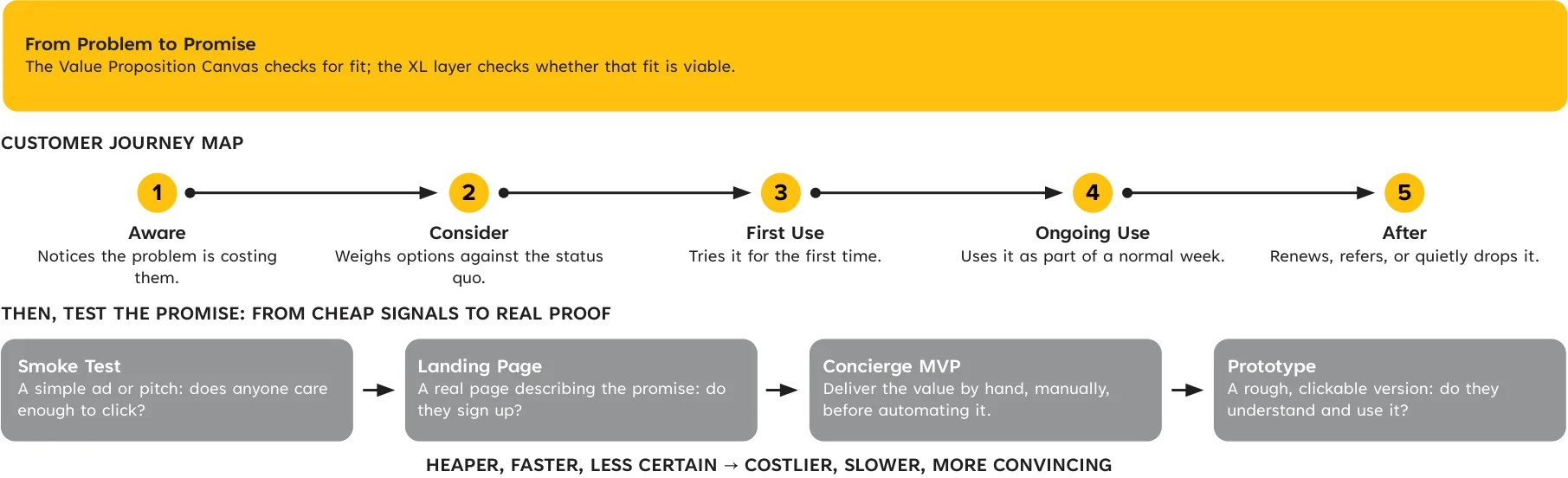
Weighs options against the status them.
The Customer Journey Map shows where the real risk sits. Experiments then test that risk directly, from cheap signals to real proof.
Persevere, pivot, or kill.
An experiment only has value if the team is willing to act on what it shows, even when that means abandoning work it is proud of. There are three honest outcomes, and each is a legitimate result, not a failure:
- Persevere: the evidence supports the value proposition as designed, and it is ready to move into Product Development largely as is.
- Pivot: the evidence shows the problem or persona was right but the specific promise was wrong. The team returns to Step 2 or 3 with a sharper, evidence-informed view.
- Kill: the evidence shows the problem was not as significant, or as solvable this way, as the team believed. The honest move is to stop.
The discipline this step asks for is not running the experiment. It is being willing to hear an answer the team did not want, and to change course because of it rather than explaining it away.
Common ways this step goes wrong.
The most common mistake is designing an experiment to confirm rather than to test: asking leading questions, or showing the concept only to customers inclined to like it. The second is treating one enthusiastic customer's positive signal as sufficient evidence, when this step is looking for a pattern, not a testimonial. The third is skipping the journey map and jumping straight to testing the product itself, which validates "does this feature work" while leaving "does anyone care enough to start, and stay" unexamined. And the fourth, the most costly, is overriding a clear negative result because the team has grown attached to the idea, which defeats the purpose of the experiment.
What this step hands to the next workflow.
Customer Value Creation has now produced something far more valuable than an idea: a validated problem, a value proposition tested against real behavior rather than argued on paper, and an honest decision about whether it is ready to move forward. That narrowing, from a market sized in the millions down to a specific, tested promise, is the output of this entire workflow, and what every other workflow in this book is built to receive. The next question is mechanical: how does a team turn a tested promise into something built, released, and improved? That is where Product Development picks up, starting from exactly what this workflow produced: the jobs, the problems, and the evidence-tested value proposition.
The customer experience CX explained.
Classic customer experience (CX) theory plays a pivotal role in bridging the gap between the Customer Problem and the Value Proposition by placing the customer at the center of business strategy. Rooted in the understanding that customer perception drives loyalty and growth, CX theory provides a structured approach to identifying, interpreting, and responding to customer needs throughout their journey.
At the core of CX theory lies the idea that every touchpoint, whether digital or physical, shapes a customer's overall perception of a brand. By mapping the Customer Journey, businesses can uncover pain points, unmet needs, and emotional triggers that define the Customer Problem. This process doesn't just reveal functional issues but also emotional drivers like frustration, trust, or delight. These insights are essential for crafting a Value Proposition that resonates.
The theory also emphasizes consistency and relevance across the customer lifecycle. By aligning internal processes, communication, and culture to deliver a seamless experience, organizations can demonstrate how their offering directly addresses the identified problems. This alignment transforms a generic Value Proposition into a personalized solution, enhancing perceived value.
Moreover, CX theory encourages continuous feedback loops through surveys, reviews, and data analytics. These loops allow businesses to refine both their understanding of Customer Problems and the relevance of their Value Proposition in real time. This adaptability is crucial in a rapidly changing market environment. Another key component is empathy. CX theory promotes the use of personas and empathy mapping to deepen the connection with target audiences. By truly understanding the customer's perspective, businesses can design experiences and solutions that not only solve problems but also create emotional value, turning transactions into relationships.
In essence, classic customer experience theory serves as the connective tissue between recognizing a customer's problem and delivering a meaningful, differentiated Value Proposition. It ensures that solutions are not just created for the market, but with the customer in mind.
Lou Carbone, according to Everise Insights, is credited with coining the term “customer experience” and is widely regarded as the father of the experience movement.
Tool
Customer Journey canvas.
- PERSONAL
- map customer journey insights
- ± 90 MIN
- session
- 2-6
- people per group
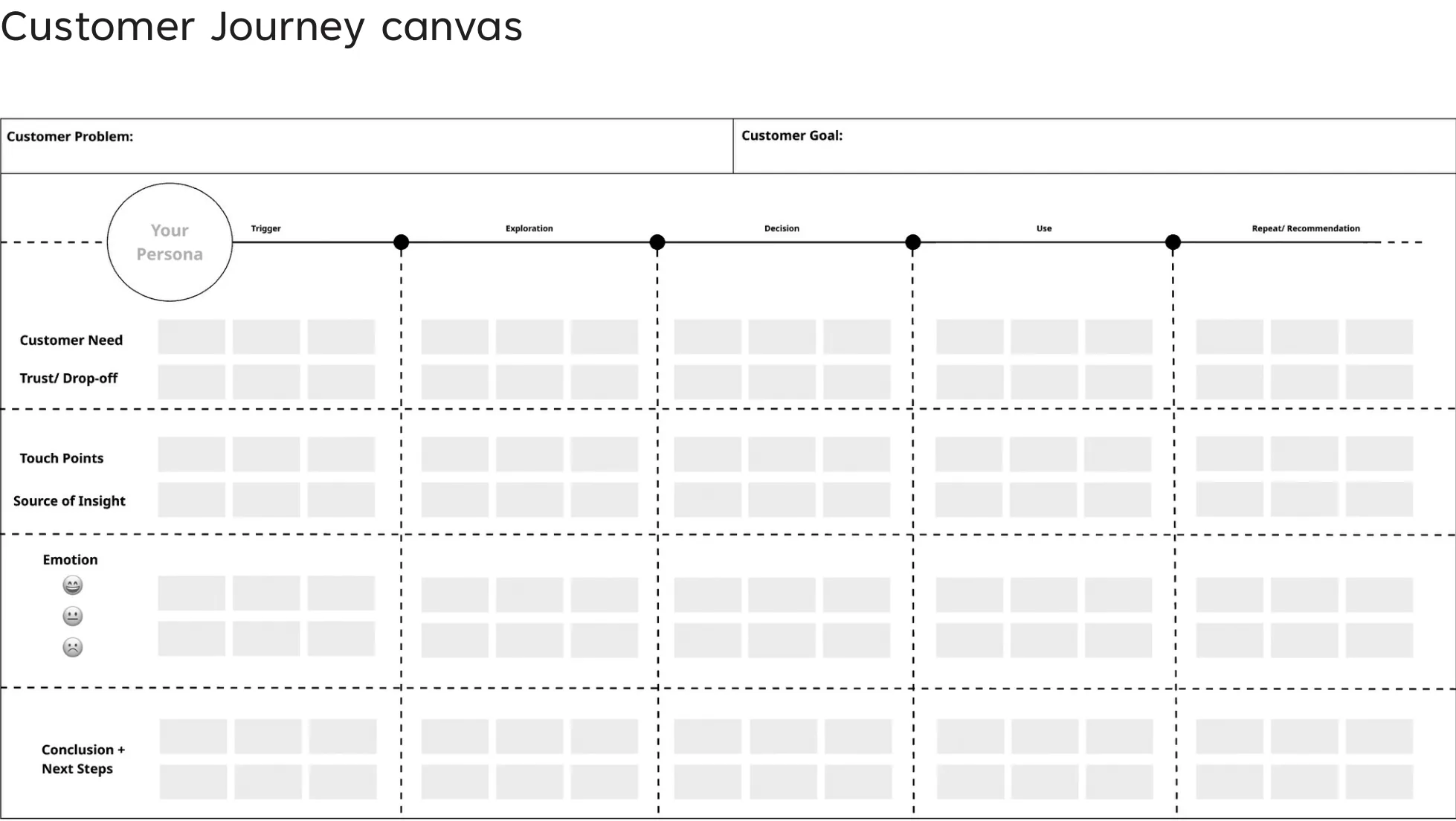
The Customer Journey canvas helps you understand the customer's reality more deeply. Not from the perspective of the organization or its offering, but from the perspective of the person who is trying to make progress. By using this canvas, you map the Customer Journey in a clear and structured way, with the goal of identifying where friction occurs, where decisions are made, and where value is experienced.
Within Create the WOW, the focus is not on solutions, but on the problem a customer is trying to solve. The Customer Journey canvas is therefore not a descriptive overview of touchpoints, but a design tool that shows how customers experience situations in real life. It reveals how problems unfold over time and forms the bridge between understanding the Customer Problem and designing a meaningful solution.
The starting point of the Customer Journey canvas is always the customer's context. You begin by selecting one specific persona and describing the situation this person is in. Next, you define the central problem this person experiences: What prevents progress? Finally, you clarify the customer's goal. What is this person trying to achieve or avoid? Together, these three elements form the guiding thread throughout the journey.
Based on this foundation, the journey is structured into five fixed moments: Trigger, exploration, decision, use, and repeat or recommendation. Each moment represents a different situation, with distinct questions, expectations, and emotions. Placing these moments side by side creates clarity across the journey.
For each moment, you analyze the journey using the same perspectives. You examine what the customer needs to move forward, which moment is decisive for success or drop-off, through which touchpoint the customer experiences it, and which emotion dominates. By recording whether insights are based on assumptions or real customer data, the canvas remains honest and testable.
The strength of the Customer Journey canvas lies in the combination of simplicity and depth. Its fixed structure keeps the tool practical and easy to use, while inviting reflection, discussion, and deeper insight. The outcome is not a final document, but a shared understanding of customer reality and a strong starting point for improvement.
Working with the Customer Journey canvas
Use the Customer Journey canvas by following the steps below in sequence.
Define the persona
Select one specific persona for whom you are mapping the Customer Journey. Briefly describe who this person is and the context they are in.
Define the central problem
Describe the main problem this persona experiences. Formulate it from the customer's perspective and focus on what prevents progress.
Clarify the customer goal
State what the customer is trying to achieve, solve, or avoid. This goal forms the guiding thread across all moments.
Define the five moments Structure the journey into five fixed moments: Trigger, exploration, decision, use, and repeat or recommendation.
Describe the customer need per moment
For each moment, identify what the customer needs to move forward, such as information, certainty, support, or reassurance.
Identify the crucial moment
Determine which point is decisive for trust or drop-off.
Identify the key touchpoint
Through which touchpoint does the customer experience this crucial moment? This could be a website, email, or another channel.
Map the customer emotion
Describe how the customer feels at this moment. Is the emotion positive, neutral, or negative?
Indicate the source of insight
Note whether insights are based on assumptions or real customer data.
Draw conclusions and define next steps
Identify key friction points and define improvement actions or experiments to test assumptions.
Validate with real data.
It is easy to believe you understand your customer until you test that belief against reality. Internal opinions converge because teams talk to each other more than to the market; familiarity gets mistaken for understanding. So gather real signals: customer interviews, sales feedback, win and loss analysis, and behavioural data showing what people actually do.
Interviews are the richest signal, but only with discipline. Ask about the past, not the future: what someone did last time beats what they claim they would do, because hypothetical questions invite politeness and false confidence. One question stands out: "What happened that made you decide to act?" It reveals the trigger, the moment a problem stopped being tolerable, and separates a real buying story from a wish list. People tolerate imperfect situations for years; a tolerated problem does not create a customer, urgency does. Miss the triggers and you build for customers who agree but are not ready to move, the most expensive agreement there is.
Sales feedback and win-loss analysis add a second layer, and lost deals teach more: why someone else, or nothing at all, which objections recurred, who was at the table? Behavioural data is the most honest layer, what people do rather than say: pages revisited, terms searched, features used, purchases abandoned, support questions. When interview and behaviour disagree, behaviour deserves more weight.
The quietest trap is talking only to existing customers, who confirm rather than challenge. Those who walked away, chose a competitor, or chose nothing hold the insights that grow a business; skip them and validation is just a satisfaction survey. Validation also improves communication: an organisation that says "modular storage solutions" while customers say "I just want to find my things" keeps missing. Capture their exact words and reuse them everywhere; their language connects faster than yours. And validation turns segmentation from internal fiction into a tool: real segments emerge from patterns, clustered to reduce complexity, focus, and standardise rather than over customise.
Example:
In interviews, functional customers say, "I couldn't stand cooking there anymore, it just didn't work"; lifestyle customers, "We wanted a space to host and enjoy time together"; investment buyers, "We renovated to increase the value before selling." Sales feedback sharpens it: functional buyers move fast on reliability and timelines, lifestyle buyers explore design, investment buyers ask about return and resale; a loss to a faster competitor tells a different story than a loss to an inspiring showroom. Behaviour adds a layer: storage-optimisation pages signal functional needs, inspiration galleries lifestyle, financing comparisons investment. Triggers reveal urgency: a broken appliance or a move pushes functional buyers, hosting more triggers lifestyle, selling plans activate investors. Someone talking lifestyle but browsing storage is probably a functional buyer with aspirations; where signals conflict, keep testing, where they align, act with confidence. Then put numbers on confirmed segments: which converts fastest, spends most, returns? Volume makes a priority; rarity makes a niche to serve efficiently or set aside. Aligned signals make segments grounded realities: propositions sharpened, offers standardised where needs overlap, marketing in the customers' own words, a segmentation the market confirmed, not one the organisation believes.
Evaluate segment attractiveness.
Once you have identified segments, ask the harder question: is this actually a business worth pursuing? Not every interesting problem is a viable opportunity; some segments lack the scale, urgency, or economics to justify investment, and the earlier you learn that, the cheaper.
How large is the segment, and is it growing? A small segment that compounds can beat a large one in decline: a trajectory, not a snapshot. Is there real urgency, or mere tolerance? The most overestimated dimension: agreeing the problem is real and budgeting to solve it this quarter are very different. Will they pay at a sustainable level? The proxy is what they already spend on workarounds; a segment spending nothing rarely starts because your solution arrived. Can you reach and serve them? One reachable only through expensive channels is unprofitable at any size. And does it fit your strategy and right to win: the assets, skills, relationships, or brand that make you credibly better placed?
Evaluate comparatively: judged alone, almost any segment can be argued into attractiveness; side by side, differences become harder to argue away. Rate each segment on each dimension, justifying every rating with validation evidence, not opinion; the score matters less than the argument it forces, where hidden assumptions surface. Score with the right people in the room: sales knows who converts, finance the economics, operations what serving demands, marketing what reach costs. One team inherits its blind spots; together the dimensions check each other and the room begins committing to its decision.
Teams go wrong chasing vocal but small segments, mistaking feedback volume for opportunity size; large markets of price-sensitive customers who barely convert; or, subtler, segments that score well but demand capabilities the organisation lacks and a roadmap it did not choose. The result is scattered effort; progress comes from focus, a meaningful problem, sound economics, and the right to win. Strategy is deciding where not to play as much as where to; saying no frees the resources focus requires, and a rejected segment is parked, not dead, with a note on what would need to change.
Example:
Which kitchen segment is worth pursuing? Functional improvement is sizable, need grows as homes age, urgency is high because frustration is daily, willingness to pay solid, customers easy to reach through search: a strong fit for a company built on execution. Lifestyle and experience can also be large and growing, but urgency is lower, the sales cycle longer and more emotional, and reach takes stronger branding; it fits a strategy of design and differentiation. Investment is smaller and situational, tied to housing markets; customers are cost conscious, return focused, hard to reach, a fit only if you demonstrate financial value. None of this is guesswork: interviews gave urgency, win-loss feedback convertibility and willingness to pay, behaviour reachability, the numbers size and growth; evaluation is the moment gathered evidence gets weighed.
Side by side, the decision shapes itself: the functional segment scores highest on nearly every dimension, lifestyle becomes a second bet if the brand can carry it, investment a niche served with a standardised offer that proves return without absorbing attention. The choice cascades into execution: marketing that speaks to frustration rather than inspiration, an offer built on speed and predictability, a sales process for customers who have already decided and need confidence. You are not identifying who could buy but deciding who you should serve, and strategy only becomes real when you choose where not to play.