From positions and options to explicit bets.
Every organization already allocates its portfolio. Most just do it implicitly: through last year's budget plus three percent, through whoever argues loudest in planning, through the quiet gravity that pulls all resources toward the biggest current business.
Implicit allocation always favours the present, because the present has advocates in the room and the future does not. This step makes the allocation explicit precisely to break that gravity. The zones from step 2 and the options from step 3 turn allocation from argument into arithmetic. Scale businesses need funding to extend, and their claim is measured in demonstrated returns. Invest businesses need capability-building capital, and their claim is measured against the attractiveness that put them in that zone. Transform businesses need redesign investment, bounded and milestone-gated. Harvest businesses release resources, and saying so out loud is what makes the rest of the arithmetic work. The explored options bid for the new-model allocation, and their currency is evidence: tested assumptions, not polished decks.
The 70-20-10 shape is not folklore. Research published in Harvard Business Review, tracking how companies across industries divide their innovation investment, found that firms holding roughly a 70-20-10 balance across core, adjacent, and transformational work outperformed their peers, and that the long-term returns arrived in the inverse shape: the small transformational slice produced the largest share of new value. Read those two findings together and the discipline writes itself. The core pays for the future, the future pays back the portfolio, and the ratio only works if it is held on purpose, through the quarters when the core is hungry and the new bets have nothing to show yet.
Three disciplines keep the decision honest. Different metrics for different horizons: core bets answer for revenue and margin, adjacent bets for validated traction, new bets for evidence produced per euro spent, and judging a new bet by core metrics kills it instantly. Explicit kills: ending a bet is a normal, respectable outcome, and a portfolio where nothing ever dies is a museum with a payroll. And named ownership: every funded line has a person, a budget, and the authority to spend it without renegotiating monthly.
That is why this step is a decision meeting, not a budgeting exercise. Budgets describe what departments spend. An allocation declares what the organization intends. It is the difference between a company whose strategy lives in a document and one whose strategy is legible in every funded line, and it is the strongest signal leadership sends about whether the portfolio language of the last three steps was real. Teams watch where the money goes, not what the slides say, and they adjust their ambitions accordingly. Fund the future visibly and people will bring you futures to fund.
Tool
Ambition matrix.
- PERSONAL
- allocate across horizons
- ± 90 MIN
- session
- 2-6
- people per group
Making the investment split across core, adjacent, and new explicit, on one page, is what turns a positioned portfolio into a strategy.
An allocation argument without a picture degenerates into a budget fight, and budget fights are won by the present. The Ambition matrix is the picture. It plots every funded initiative by how far it stretches from the capabilities the organization has and the markets it serves. Three bands fall out. Core sits in the near corner, improving what exists for the people already served. Adjacent occupies the middle, existing strengths carried to new customers or new offers to existing ones. Transformational sits in the far corner, new capabilities for markets that do not know the company yet.
The matrix carries an evidence base. The research behind it found that companies holding roughly a 70-20-10 split across core, adjacent, and transformational outperformed their peers, with returns arriving inverted: the transformational slice produced the largest share of long-term value. What the research really argues is narrower and stronger: the ratio must be chosen and defended as a decision, because left to itself it collapses
toward 95-5-0. The core has revenue and advocates; the future has a hypothesis and an intern. Only a held ratio keeps that fight fair.
What makes the matrix a decision tool is what gets written on it: the ratio the organization has chosen, the owner of every funded line, the tranche each new bet is on, and the condition that would end it. A matrix carrying those four things is an allocation; without them it is wall art.
Benefits
- Answers: Where is the money actually pointed? Does the split match the strategy?
- Prevents the future being funded from leftovers.
- Exposes an empty transformational corner before the market does.
- Creates shared language: core, adjacent, transformational.
- Enables different metrics for different horizons.
- Surfaces bets that have quietly become unkillable.
Limitations and pitfalls
- Don't treat 70-20-10 as a law; choose your ratio deliberately.
- Avoid judging transformational bets by core metrics.
- Plot funded reality, not stated strategy.
- Keep tranches tied to evidence, not to the calendar.
- Revisit quarterly; allocations decay like maps.
- Involve the budget owners; a split decided without them is a wish.
How to use it: The 6-step process. Plot what is actually funded.
Every initiative currently receiving money or people goes on the matrix, placed by how far it stretches existing capabilities and existing markets. Funded reality, not intention.
Read the three bands.
Add up where the investment actually sits across core, adjacent, and transformational. Compare that shape with what the strategy claims; the gap is the real agenda.
Choose the ratio.
Adopt 70-20-10 as the default and adjust it deliberately: a strong, stable core may warrant 80-15-5, a threatened one 60-25-15. Write the numbers on the matrix and defend them as a choice.
Fund the new in tranches.
Within the new-model slice, allocate to the options with the strongest evidence from step 3, in tranches tied to the next assumptions they must test.
Name owners and end conditions.
Every funded line gets a person, a budget, a milestone that earns the next tranche, and a condition that ends it. Decisions without tripwires become permanent by default.
Publish the split.
The whole organization should be able to see the ratio and what it funds. An allocation kept vague is an allocation still being litigated.
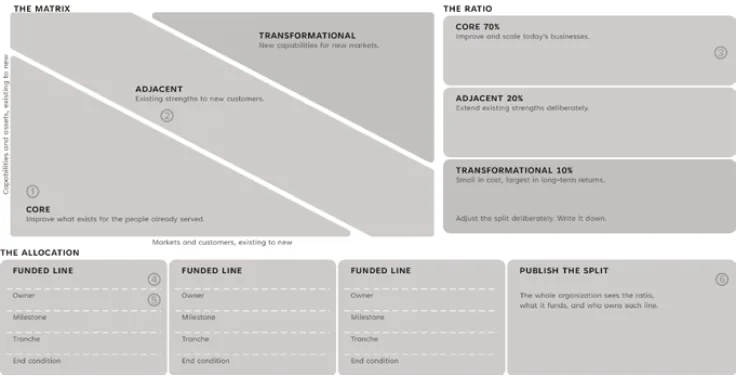
Deciding like a portfolio manager.
Kill gently, and on purpose.
The hardest allocation move is not funding a bet. It is ending one. Every organization accumulates projects that are neither growing nor dying, sustained by sunk cost and the awkwardness of the conversation. The explicit allocation makes these visible, and the discipline is to treat ending a bet as the system working: the test was run, the evidence came back, the money and the people move to a better bet. Harvest is not a punishment, and neither is a killed experiment; both are the portfolio breathing.
Decades of decision research explain why this is so hard. The more an organization has already spent on something, the more committed it becomes to spending more, even when the evidence has turned, because walking away means admitting the earlier spending bought nothing. The defence is structural, and it is decided in advance: the end condition written on the allocation line the day the bet is funded. A pre-committed tripwire converts a face-losing argument into an administrative step. Nobody has to stand up and kill the project; the project met the condition everyone agreed to when hope was still cheap. And the gentleness matters as much as the discipline: the people who ran killed bets must visibly land well, in good roles, with the learning credited to them, or nobody honest will volunteer to run the next one.
Harvest deserves the same design attention as launch. A business wound down gracefully returns more than budget: customers handed to better-fitting offers rather than abandoned, a brand that exits with its reputation intact, people released in planned waves into the bets that need them, and contracts run out rather than broken. Organizations rehearse launches for months and improvise endings in a week, and the improvised endings are what teams remember when they are asked to take the next risk. An endgame plan on every Harvest line, with dates, is the cheapest trust-building instrument the portfolio owns.
A worked example.
The inventory company writes its first explicit allocation. Seventy percent to the core subscription: onboarding automation, the price revision the numbers have been demanding, channel investment to reduce dependence on referrals. Twenty percent adjacent: productizing the services business's setup knowledge into a self-serve tier, extending the core capability to restaurant groups without scaling headcount. Ten percent new: the data product from step 3, funded in tranches, next tranche due when the supplier willingness-to-pay test comes back. The services business itself moves to managed harvest: current clients served well, no new deals, engineers released back to the product over two quarters. Every line has an owner and a milestone. The whole thing fits on one page, and for the first time the company's strategy and its spending say the same thing.
Two quarters later, the allocation earns its keep. The willingness-to-pay test comes back positive and tranche two releases the same week, without a new meeting, because the decision was pre-wired to the evidence. The self-serve tier misses its adoption milestone, and its tranche holds: not a crisis, not a failure, just the mechanism doing its job while the team fixes onboarding. The harvest completes early and releases three engineers, and because the split is published, everyone already knows where they go, to the core's channel work, not to whichever manager lobbies hardest that week. The allocation has stopped being a document. It has become the way the company routes energy.
Common ways this step goes wrong.
The first failure is peanut-butter allocation, spreading investment evenly to avoid conflict, a decision not to decide. The second is funding the future from whatever is left over once the core is fed, which guarantees the 10 becomes 2. The third is annual lump-sum funding for new bets, when tranched funding is safer and kinder. The fourth is unkillable bets, allocations without end conditions.
Updated in the document as well.And the fifth is secrecy: an allocation nobody can see cannot discipline anyone's behaviour, and the informal budget quietly reasserts itself.
Each failure has a tell you can hear in meetings. Peanut butter sounds like "everyone got something this year." Leftover funding sounds like "let's see what's left in Q4." Lump sums sound like "they got their budget in January, ask them again next January." Unkillable bets sound like "we've come too far to stop now," which is the sunk-cost argument wearing a suit. And secrecy sounds like "that's between us and finance." The fixes are all the same shape: write it down, date it, put a name on it, and publish it.
Vagueness is not a neutral state; it is the habitat every one of these failures lives in.
The decision meeting itself deserves design. The people who own the budgets are in the room, because an allocation decided about someone is an allocation they will quietly undo. Finance is in the room, because tranches and end conditions have to survive contact with the ledger. And one person carries the standing job of arguing against the room's favourite bet, rotated each cycle, because the matrix inherits every bias step 2 warned about: powerful people's projects drift toward the core band, and unfamiliar bets get scored as more transformational, and riskier, than they are.
The deepest reason to defend the smallest slice is the one the research keeps finding: the returns arrive inverted. The transformational ten percent is small in cost and large in consequence, the source of the models the organization will live on next decade, and it is always the first thing leftover-funding eats, precisely because it has no revenue to defend itself with. Protecting it is not optimism. It is the same arithmetic a fund manager applies to any asymmetric bet: bounded downside, portfolio-changing upside, and worth a deliberate, held position.
What this step hands to the next.
A funded portfolio: explicit percentages, named owners, milestone-gated bets, and freed resources moving from the past to the future. What it does not yet have is motion. An allocation decided once decays exactly like a map drawn once, which is why the final step turns the whole workflow into a rhythm.
The allocation also hands the rhythm its agenda. Every funded line is now a standing question for step 5's quarterly cycle: did the milestone land, did the tripwire fire, does the tranche release or hold, has anything moved zones since the split was chosen. The allocation page is not filed after the meeting. It is the meeting, from now on, and the step that follows exists to make sure it keeps happening.
One page, published, does one more job that nothing else in the workflow can: it communicates. Boards read an explicit allocation and understand the strategy in a minute. Teams read it and know which ambitions the organization will actually fund. And the people running small bets read it and see, in writing, that their ten percent is a held position rather than a favour, which is often the difference between the organization's best people volunteering for the future or hiding in the core.