From an exercise to an operating rhythm.
The difference between organizations that manage their portfolios and organizations that once did a portfolio project is not intelligence or tooling.
It is rhythm. The project produces a beautiful snapshot; the rhythm produces a living instrument. And the rhythm is cheaper than it sounds, because each quarterly pass reuses everything the last one built. The map is updated, not redrawn. The matrix moves a few positions, not all of them. Two or three experiments report back, not twenty. A well-run quarterly cycle takes a leadership team a day, and it replaces the weeks-long annual strategy scramble almost entirely.
The inertia this rhythm defeats is measurable. The reallocation research this section met in step 1 found that the average company moves less than a tenth of its capital between businesses in a given year; the rest simply follows last year's pattern. Annual planning is structurally incapable of beating that inertia, because it happens once, under deadline, with every incentive in the room pointed at defending existing budgets. A quarterly cadence beats it not by being smarter but by being frequent: small adjustments, made often, against fresh evidence, before positions harden into politics. Moving two percent of the portfolio four times a year is easier than moving eight percent once, and it compounds into the reallocation rates that the long-run studies associate with higher returns and higher survival.
The rhythm also changes what kind of evidence the organization runs on. In an annual cycle, experiment results wait months for a meeting that can act on them, and arrive stale. In a quarterly one, the tests launched in step 3 report into a room that can release a tranche, hold one, or redirect one that same afternoon. The cadence is borrowed from the disciplines that already work this way: product teams reviewing every sprint, fund managers re-grading a portfolio every quarter. A company's business models are its largest positions. They deserve at least the seriousness a fund gives a stock.
A business model is not a decision the organization makes once. It is a hypothesis the market re-grades continuously, and the organizations that endure are the ones that treat model change as routine maintenance rather than crisis response. The quarterly cycle is that maintenance, institutionalized.
None of this requires new systems or a strategy department. It requires a date on the calendar, the owners in the room, and the three artifacts the workflow has already produced: the map, the matrix, and the allocation. The rhythm is simply the habit of looking at them together, on purpose, four times a year, and refusing to leave the room until something has actually moved. Everything else in this step is technique in service of that habit.
Tool
Portfolio review.
- PERSONAL
- run the quarterly cycle
- ± 90 MIN
- session
- 2-6
- people per group
Reviewing the whole portfolio on one rhythm, with every model leaving the room with an explicit action, is what keeps the map, the matrix, and the allocation alive.
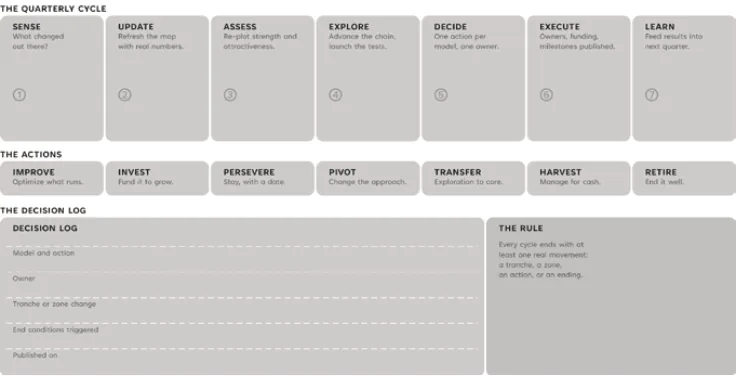
The Portfolio review is the page that runs the quarterly meeting. It carries the seven phases of the cycle, sense, update, assess, explore, decide, execute, learn, and it works on deltas, not status: what changed since last quarter, which positions moved, which experiments reported, which tranches are due. A review built on deltas takes half a day. A review built on status takes two hundred slides and teaches everyone to dread it.
Its central discipline comes from portfolio management practice: every business model on the map leaves the review with exactly one explicit action. Improve it, invest in it, persevere with its current bet, pivot it, transfer it from exploration into the running portfolio, harvest it, or retire it. One model, one action, one owner. A model that leaves with three actions has none, and a model that leaves with no action has just been silently parked, which is how drift starts.
The page ends with the decision log, and the decision log enforces the cycle's one
hard rule: every quarter ends with at least one real movement, a tranche released or held, a zone changed, an action assigned, a bet ended. The conversation is not the product. The movement is. A cycle that discusses everything and moves nothing was a photograph session, and the organization can feel the difference within two quarters. Teams prepare differently for a meeting that moves money than for a meeting that admires slides, and that preparation, evidence gathered because it will be acted on, is half the value of the rhythm.
Benefits
- Answers: What changed, what moves, and who owns it?
- Prevents the portfolio decaying into a photograph.
- Replaces the annual scramble with a repeatable half-day.
- Creates shared language: one action per model per quarter.
- Enables small, frequent corrections instead of crisis response.
- Surfaces drift while it is still cheap to fix.
Limitations and pitfalls
- Don't let it grow into a status meeting; deltas only.
- Avoid running it without the budget owners in the room.
- Keep one action per model; more is none.
- A cycle that moves nothing was a photograph session.
- Don't skip busy quarters; that is when drift is fastest.
- Keep the map, matrix, and allocation live between reviews; update, never rebuild.
How to use it: The 7-phase cycle. Sense.
What changed out there: market and technology shifts, competitor moves, regulatory signals. The tripwires set in earlier steps report here first.
Update.
Refresh the map with real numbers: customer insight, model performance, the actual figures on every canvas. Dates change, fiction dies.
Assess.
Re-plot strength and attractiveness. Which businesses moved zones? Which are drifting toward Transform or Harvest while nobody says so?
Explore.
Advance the chain: new shifts in, new options out, and the next experiments launched on the riskiest assumptions.
Decide.
One action per model: improve, invest, persevere, pivot,
transfer, harvest, or retire. Tranches released or withheld against milestones. At least one real movement per cycle.
Execute.
Owners, funding, and milestones assigned and published. The cycle's decisions leave the room as commitments, not intentions.
Learn.
Experiment results, market responses, and post-mortems feed back into the map, so next quarter starts smarter than this one did.
Making the rhythm stick.
Small and regular beats grand and annual.
The gravitational pull is always back toward the annual offsite: one big meeting, one big deck, one big plan. Resist it. The future does not arrive on the planning calendar, and a quarterly half-day that actually moves money beats an annual week that produces a document. The test of the rhythm is not the quality of the conversation but the presence of decisions: if a cycle ends and nothing moved, no tranche, no zone, no owner, the meeting was a photograph session.
The design of the half-day matters more than its length. The first hour belongs to sense and update: what changed outside, what the real numbers now say, delivered as deltas against last quarter rather than as presentations. The middle belongs to assess and explore: the matrix re-plotted, the experiments reporting, the next tests chosen. The final hour belongs to decide and execute: actions assigned, tranches moved, the decision log written, and everything published within the week. Anything that is pure status gets pushed to a pre-read, and any topic that needs a deep dive gets its own session, because the review's job is to steer the portfolio, not to audit it. Teams that protect this shape report the same thing: the meeting gets shorter every quarter, and the decisions get faster, because the artifacts stay warm.
The cadence also protects against the opposite failure to drift: whiplash. An organization that reacts to every signal reorganizes monthly and exhausts itself. The quarterly rhythm is a deliberate buffer, long enough to absorb noise, short enough to catch signal, and the discipline of writing sensed changes down and acting on them at the review, rather than in the corridor, is what separates a managed portfolio from a nervous one.
A worked example.
Four quarters in the inventory company's cycle. Q1: the supplier willingness-to-pay test comes back positive; the data product's next tranche releases, and a second supplier segment enters exploration. Q2: a point-of-sale platform announces free basic inventory tools; the sense phase catches it, the core's attractiveness score dips, and a Transform question mark goes against the subscription's long-term model. Q3: the services harvest completes ahead of schedule, engineers return to the product, and the freed budget tops up the adjacent self-serve tier, which is beating its milestone. Q4: the annual look-back finds the portfolio measurably rebalanced, the core defended by deeper prediction capability, the data product now producing revenue, and one experiment killed cleanly when owners' consent patterns broke in a new region. No quarter contained a crisis. That is the point.
By the second year, the cycle is boring, which is the achievement. New leaders learn the whole portfolio in one meeting because the artifacts are current and shared. The annual offsite shrinks to a half-day of ambition-setting, because the fact base no longer needs rebuilding. And when a genuine shock arrives, the point-of-sale platform acquires a competitor and bundles inventory management for free, the company does not convene a task force or commission a strategy study. It moves the review forward three weeks and runs the machinery it already has: sense the change, re-score the core, advance the Transform work that the Q2 question mark had already seeded. The shock is absorbed by a system, not by heroics, and the response starts two quarters earlier than it otherwise would have.
Common ways this step goes wrong.
The first failure is the rhythm without teeth: reviews that discuss but never reallocate, which teaches everyone the cycle is ceremonial. The second is delegation to a strategy function, when the cycle only works if the people who own the businesses and the budgets sit in the room. The third is letting the cycle grow until it is dreaded, two hundred slides and a full day of status, instead of one map, one matrix, one allocation, and the deltas. And the fourth is skipping a quarter because things are busy, which is how the instrument becomes a photograph again, precisely when the market is moving fastest.
There is also a quieter decay: ritual compliance. The meeting happens, the artifacts update, but the numbers stop being checked against reality, and the map slowly refills with the flattering fictions step 1 was designed to kill. The defence sits in the learn phase: every quarter, one claim on the map gets audited against source data, a revenue line against the ledger, a retention figure against the cohort, chosen by rotation so nothing is safe. And rhythms die with their founders: if the cycle lives in one champion's diary, it leaves when they do. Put it in the operating calendar next to the financial close, give it a standing owner role rather than a personality, and it survives reorganizations the way payroll does.
Measure the rhythm itself with two numbers. Movements per cycle: how many tranches, zones, actions, or endings each review actually produced. And evidence-to-decision time: how long a reported test result waits before a decision uses it. The first number should never touch zero. The second should shrink every year. A team that tracks these two has a rhythm; a team that tracks neither has a recurring meeting.
What this workflow hands forward.
The same thing every workflow in this book hands forward: evidence, and a loop. The portfolio cycle's sense and learn phases feed the Customer Value workflow its next opportunities; validated products flow through Product Development and Go to Market into the portfolio as new models; and the portfolio decides which of them deserve the organization's weight. An organization that has run this workflow once has a better portfolio. An organization that keeps running it has something rarer: a way of changing what it is, on purpose, before it is forced to, with the whole team able to see why.
The compounding is quiet but real. Every cycle leaves the artifacts a little truer: claims audited, scores re-argued, endgames rehearsed, decisions logged with their reasoning attached. Within a few years the portfolio review is where the organization's actual story lives, not the story in the annual report, but the one about which bets worked, which died, and what each one taught. New leaders inherit that memory instead of restarting it. And the workflow's vocabulary, zones, tranches, actions, leap-of-faith assumptions, becomes the way the whole company talks about its future, which is the deepest kind of adoption a tool can achieve.
Which is why this section closes with the words it does. Letting go with intent is not the melancholy part of portfolio management; it is the proof the system works. Every model the organization retires deliberately, on evidence, with its people landed well and its lessons captured, funds and teaches the models that come next. Companies do not get to keep every business they build. The ones that endure are the ones that choose what to keep, choose what to release, and make both choices in the open, on a rhythm, together. Only that kind of company gets to be old.