Starting the value creation engine.
Martin Havik is a strategic innovation leader who helps organizations embed innovation into their everyday way of working.
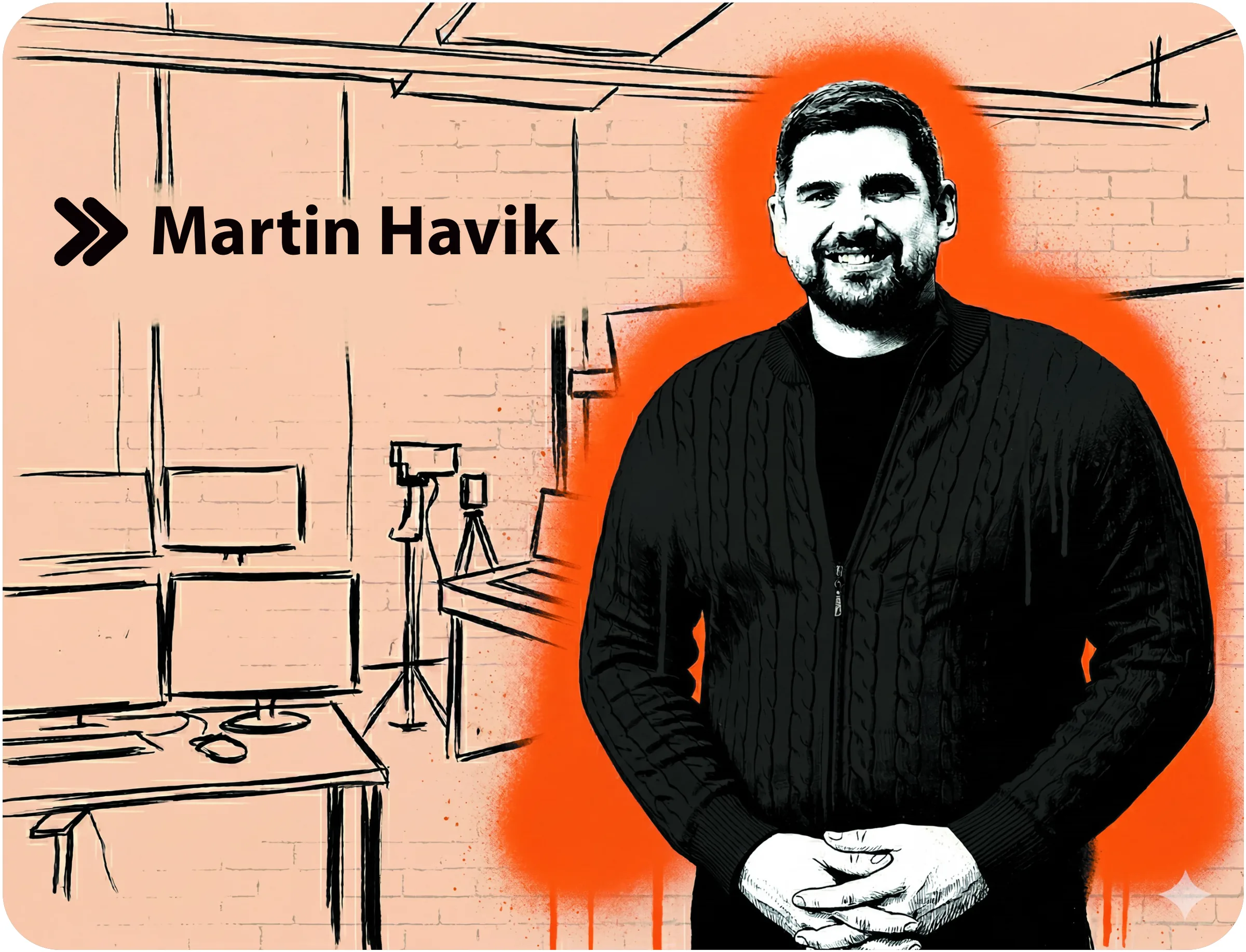
What follows is not a framework or a thought experiment. It is a first-person account from inside a real transformation: Martin Havik on starting the innovation engine at MM Group, told the way it actually happened.
Ground zero: Where it really begins
When I stepped into my role at MM Group, I expected my work to revolve around innovation in the familiar sense: new ideas, new propositions, new opportunities for growth. It became clear very quickly that innovation itself was not the real starting point. Before discussing what we might build, we first had to understand whether the organization was truly prepared to build anything new at all.
MM Group is not a single organization but a collection of companies, each with its own identity, leadership style, and culture. Some felt confident they were already innovative; others were strongly focused on operational excellence and consistent results. In both cases innovation existed in some form, but it was not embedded in the everyday way the organization worked. What appeared to be an innovation challenge revealed itself as a question of readiness.
Innovation does not start with ideas, it starts with readiness.
Before introducing new processes, tools, or strategies, there needed to be a shared understanding that innovation was not separate from the core business but an integral part of how the business evolves and creates future value.
The first barrier: Belief
In early conversations a pattern became visible. People were not resisting innovation; they were reacting to what it seemed to imply for their daily responsibilities. Most teams were already at full capacity, accountable for results and focused on today's performance, so innovation appeared as an additional task competing with the real work of running the business. This is where many innovation efforts quietly lose momentum: introduced on top of existing responsibilities rather than integrated into them, they become optional, and optional always loses to operational priorities.
If innovation is not part of running the business, it will always remain optional.
Recognizing this changed our approach. Instead of beginning with a formal innovation process, we started by shifting how people understood their role. Innovation was not positioned as the responsibility of a dedicated department or a temporary initiative but as a shared responsibility that cuts across the organization and influences everyday decisions. Changing that belief took patience and consistent reinforcement, because it meant redefining what people considered part of their work.
Making space: The work no one sees
Even when the importance of innovation is clear, another obstacle appears: most organizations simply have no space for it. Calendars are filled with operational meetings, priorities are fixed, and the system is optimized for efficiency rather than exploration.
Innovation rarely thrives in leftover time.
Creating space is one of the hardest parts of the transformation, because it forces leaders to choose explicitly what the organization should stop doing. That means letting go of activities that once made sense but no longer contribute to future growth. I often describe this step as building a 'Minus One Floor': before constructing something new, a layer of existing activity must first be removed. Without it, innovation remains theoretical. When space is created intentionally, people gain the capacity to think beyond the immediate horizon and engage with questions about the future.
A question that changes direction
During this transition we needed something simple that people could carry with them. Not another framework, but a question that gradually became a guiding principle.
Where is the value next?
At first glance it appears almost too simple to be meaningful, yet that simplicity is what gives it power. It encourages people to pause, look beyond the immediate tasks in front of them, and consider where the organization might create value in the future rather than only maintaining current operations. Over time the question became more than a conversation starter: a habit of thinking that influenced meetings, discussions, and decisions across the organization. When people carry the question with them, innovation moves from theory into practice.
The future does not start with answers. It starts with better questions.
Starting small: The power of momentum
Many organizations assume innovation must begin with large programs or comprehensive transformation initiatives. The intention is understandable, but scale becomes a barrier to action.
When a challenge appears too large, people tend to hesitate before taking the first step.
So we deliberately chose a different starting point: small actions. A single conversation about a customer problem. A simple canvas used to structure an idea. A small exploration of an opportunity that had gone unnoticed. These steps were intentionally modest because they made action possible. Once people began taking them, curiosity grew, teams connected ideas in new ways, and momentum came not from grand ambition but from a series of small, tangible actions that built confidence and engagement.
From fragmentation to flow
Working across several companies introduced another complexity: each approached innovation differently, with its own tools, processes, and maturity. At first the fragmentation looked like a major obstacle. Beneath the surface, though, the challenges were remarkably similar: every company needed to understand its customers more deeply, clarify where value could be created, and explore opportunities for growth. Recognizing those shared patterns let us introduce a common flow connecting the work across companies while allowing each to adapt it to its own context. The flow was not a rigid system but a shared rhythm: discover opportunities and explore customer needs, define which opportunities matter most, decide where to focus, build tangible solutions, and learn from the outcomes. It created alignment without forcing uniformity.
Making innovation visible
In the past, innovation activity happened in isolated moments, workshops and brainstorming sessions that generated energy but were hard to sustain. Digital collaboration tools changed this by making the work visible and persistent. Ideas no longer disappeared after a meeting; they could be revisited, refined, and expanded, and the work itself became a shared space where teams collaborate and build on previous progress. When innovation becomes visible, it becomes shareable and scalable. For a group like MM this was particularly valuable, because different companies could observe how others approached similar challenges and learn from each other in real time.
Learning across companies
Organizations often believe their situation is unique, and to a degree it is. Yet when we began mapping businesses with the same structures and frameworks, recurring patterns appeared: similar customer needs, comparable business models, shared growth challenges. Instead of starting from scratch with every initiative, we began building on insights that already existed somewhere in the group, sharing examples, demonstrating successful approaches, and adapting what had proven effective elsewhere. We called this principle 'Copy with Pride'. Innovation scales by learning faster and letting knowledge compound, and in a multi-company environment that mindset lets progress in one part of the organization benefit many others.
Beyond the annual cycle
Another shift involved time. Many organizations operate almost entirely within a one-year planning horizon, necessary for performance management but limiting for long-term thinking, and meaningful change rarely happens within a single annual cycle. We gradually introduced a three-year horizon for opportunities and initiatives. The longer timeframe let teams explore ideas that would not produce immediate results but could shape the organization's future, while creating a structure for revisiting initiatives and monitoring progress.
Innovation needs time to grow, but discipline to deliver.
Balancing those two dimensions kept innovation from remaining abstract ambition and turned it into tangible outcomes.
Leadership: Creating the future
Ultimately, the success of innovation depends on leadership behavior. Operational teams are rightly focused on delivering today's results. Leadership carries an additional responsibility: creating the conditions in which the future can emerge. That means making space for exploration, encouraging questions that do not yet have answers, letting teams experiment, and demonstrating through actions that innovation is a genuine priority rather than a temporary initiative. Leaders do not simply run the business; they shape what the business becomes.
When the engine starts running
Looking back, starting the innovation engine at MM Group was not a single moment or a dramatic transformation. It was many small shifts that gradually began to connect. Conversations changed how people thought about their role. Decisions created space for exploration. Processes made it easier to act. Over time these changes reinforced each other: collaboration became more natural, ideas were explored with greater confidence, and teams increasingly looked beyond immediate tasks toward future opportunities. Eventually a subtle but important transition occurred. Innovation no longer needed to be launched repeatedly; it had become part of the organization's way of working, and leadership's role shifted from starting the engine to sustaining the conditions that keep it moving.
You know the engine is running when innovation no longer needs permission.
The 90-day installation plan.
Installing a Collaborative Innovation System inside a business unit
The real difficulty of enabling effective innovation lies in the way work is organized and coordinated across the organization. Strategy discussions often take place in one environment, customer insights are gathered in another, product teams focus on designing solutions, and operational units eventually execute what has been defined upstream. Each of these activities may be well intentioned and professionally executed, yet the connections between them remain fragile.
Information moves slowly between these silos of activity. By the time insights from customers reach the teams responsible for execution, the original problem has often been diluted, reframed, or simplified in ways that no longer reflect the reality of the customer's situation.
This fragmentation is what we describe in this book as the 'Linear trap'. Work progresses sequentially from one department to the next, with each function optimizing its own tasks and responsibilities. The organization generates outputs, reports, and plans, but the relationship between Customer Problems, value creation, and execution gradually weakens.
'Create the WOW' proposes a different approach. Instead of coordinating work through handovers and departmental boundaries, organizations can install a Collaborative Operating System that allows teams to work around the same Customer Problems at the same time. In such a system, collaboration becomes the primary mechanism through which insight turns into action.
Rather than moving through a chain of departments, work moves through shared workflows that make the development of an opportunity visible and collaborative. Visual collaboration environments allow teams to structure and synthesize their work while building a library of proven use cases and workflows that can be reused in the future.
The purpose of the 90-day installation plan is to demonstrate how such a Collaborative Operating System can be installed inside a business unit.
When this system is installed correctly, innovation stops being an occasional initiative and becomes part of everyday collaboration.
Innovation as a Collaborative Operating System
Most organizations already rely on Operating Systems for critical functions such as finance, HR, and operations. These systems define how information flows, how decisions are made, and how teams coordinate their activities.
Innovation rarely benefits from the same level of structure. Instead, each initiative starts from scratch because the organization lacks a shared infrastructure for collaboration.
A Collaborative Operating System addresses this problem by defining how teams work together when they explore opportunities and solve complex Customer Problems. It connects the entire chain of value creation inside the organization, linking strategic intent with real customer situations. In practical terms, the system connects:
Strategy → Customer Problems → Value Propositions → Business Models → experiments → learning → execution
Instead of passing work between departments, teams collaborate around shared problems and shared evidence.
Three structural elements make this possible:
- 1. Workflows that structure how teams progress from insight to decision
- 2. Visual collaboration environments where the work itself becomes visible
- 3. Reusable blueprints that guide thinking, documentation, and decision making
Together these elements create the infrastructure that allows collaboration to function at scale.
Workflows as the backbone
Within the Collaborative Operating System, workflows guide teams through the stages of opportunity development. The rhythm used throughout this book is described as:
Discover, Define, Deliver.
This rhythm is not a project timeline but the structure through which collaboration takes place. It clarifies which questions must be answered at each stage of the process, what evidence is required before decisions can be made, and which tools teams use to structure their thinking.
The workflow determines:
- Which insights must be collected
- Which assumptions must be validated
- Which decisions must be taken
- Which canvases support the work
- How teams interact across disciplines
Instead of organizing work around departmental responsibilities, teams organize their work around the development of the opportunity itself. Every step in the workflow produces visible artifacts inside the shared workspace, including insights from customer interviews, assumptions about market behavior, hypotheses about value creation, and results from experiments. This visibility allows collaboration to scale.
The shared workspace
A Collaborative Operating System requires an environment where work becomes visible and accessible to everyone involved in the opportunity.
In the logic of this book, Miro functions as that shared workspace.
The workspace is not used to present finished results. It functions as the operating environment where teams structure insights, synthesize patterns, design experiments, and document their decisions.
Over time, the workspace becomes the single source of truth for opportunity development. The transparency, visibility, and collaboration inherent in this process allow for quick identification of bottlenecks and other strains on efficiency. Simultaneously, anyone joining the initiative can immediately see what the team has learned, which assumptions remain uncertain, and which decisions have been made.
The canvas library
A canvas is not merely a template, but a thinking tool that helps teams structure complex conversations. It creates a visual framework that allows insights, assumptions, and hypotheses to be organized in ways that can be shared and discussed.
The Collaborative Operating System uses a library of reusable canvases (e.g. Customer Problem canvas, Persona canvas, Competitor canvas) that guide different stages of the workflow. New teams, or new initiatives, do not start with empty boards but with structured environments that guide their work and provide a common language for problem-solving.
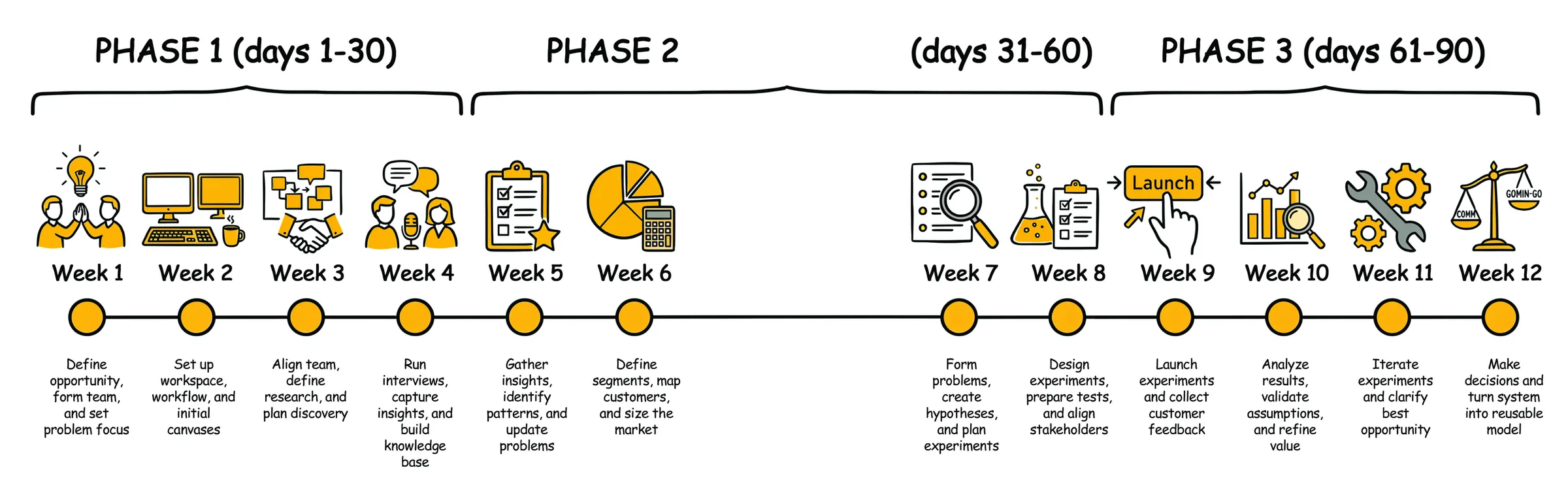
Installing the system in 90 days.
Installing a Collaborative Innovation Operating System does not require a large transformation program. In many cases the system can be installed inside a single business unit within 90 days.
The objective of the first 90 days is not to produce breakthrough ideas or launch new products. Instead, the expected outcome is the installation of infrastructure that allows innovation to happen continuously.
This infrastructure includes:
- A shared workflow rhythm
- A shared visual workspace
- A shared problem-solving language
- A reusable canvas library
- A rhythm of cross functional collaboration
- A decision system based on visible evidence
Once these elements exist, the organization possesses a system capable of generating learning and opportunities on an ongoing basis.
The installation takes place in three phases.
Phase 1: Align and architect (days 1–30)
The first phase focuses on establishing a structure that allows collaboration to function. Rather than beginning with brainstorming sessions, the process starts with selecting a pilot opportunity that represents a meaningful challenge for the business unit.
A cross-functional team is then formed around the opportunity, bringing together perspectives from product, commercial, customer experience, operations, and analytics. During this phase, the shared workspace is designed and the workflow is prepared.
Week 1
- Select the pilot opportunity connected to a strategic objective
- Identify the core cross functional team
- Define the problem domain that will be explored
Week 2
- Design the initial Miro workspace
- Install the workflow structure on the board
- Add the first set of canvases
Week 3
- Align the team on the workflow and collaboration rhythm
- Outline Discovery questions and research scope
- Prepare the customer discovery plan
Week 4
- Conduct the first customer interviews
- Capture insights in the Customer Problem canvas
- Begin building the knowledge base inside the workspace
By the end of the first month, the collaboration architecture is in place.
Phase 2: Run the first workflow (days 31–60)
During the second phase, the workflow is executed for the first time. Teams move through the Discover and Define stages while continuously documenting insights and assumptions.
Week 5
- Continue customer interviews and observations
- Cluster insights and patterns in the workspace
- Update the Customer Problem canvas
Week 6
- Identify recurring problems and affected segments
- Map customer situations using the Customer Journey canvas
- Estimate market potential using the TAM–SAM–SOM canvas
Week 7
- Formulate problem statements and opportunity hypotheses
- Identify critical assumptions that must be validated
- Create the initial experiment backlog
Week 8
- Design experiments using the Experiment canvas
- Prepare test prototypes, landing pages, or interview scripts
- Align stakeholders around experiment priorities
At this stage, the organization begins to experience a different way of working. Insights, assumptions, and experiments become visible to everyone involved.
Phase 3: Prove and scale (days 61–90)
The final phase demonstrates that the system works by generating real evidence through experimentation.
Week 9
- Launch the first experiments
- Collect behavioral feedback from customers
- Document results inside the workspace
Week 10
- Analyze experiment results and update canvases
- Validate or reject key assumptions
- Refine the Value Proposition
Week 11
- Run follow up experiments if necessary
- Clarify the most promising opportunity direction
- Prepare evidence for the decision checkpoint
Week 12
- Conduct the decision review inside the workspace
- Document the validated insights and opportunity logic
- Turn the workflow and board structure into a reusable template
By the end of 90 days, the most valuable outcome is not a finished product concept. It is a functioning Collaborative System that connects strategy, customer understanding, experimentation, and decision making into a coherent way of working.
Once that system exists, innovation becomes something the organization can do repeatedly rather than occasionally.