- CORE QUESTION
- How do we build and continuously improve the solution?
- PRIMARY OUTPUT
- Valuable, usable, feasible products
- LEAD
- Product + Engineering
- KEY COLLABORATORS
- Design, QA, Security, DevOps
This chapter follows five steps: turning a validated idea into a concrete plan, designing how it will work, building it, releasing it, and improving it based on what happens once customers touch it. Seven tools keep each step honest. Unlike the workshop tools of Customer Value Creation, these live inside the team's daily work, used continuously.
Translate to Requirements
Turn a validated value proposition into a plan the team can actually build against.
Tools and casesStory Mapping Impact Mapping Case Study
Open step 1 →2Design
Decide how it will look, feel, and work, and write down why.
Tools and casesArchitecture Decision Records Case Study
Open step 2 →3Build
Write, test, and integrate the code, with a shared bar for what "finished" means.
Tools and casesDefinition of Done Case Study
Open step 3 →4Release
Ship it gradually, and keep the ability to turn it back off.
Tools and casesFeature Flags Case Study
Open step 4 →5Improve
Learn from real usage and real teamwork, then feed both back into the plan.
Tools and casesNow-Next-Later Roadmap Retrospectives Case Study
Open step 5 →Product Development Workflow.
From requirements to improvement: a five-stage cycle for turning validated value propositions into shipped, improving software, with AI support mapped to each step
Translate to Requirements
Activity
Convert validated customer insights into buildable requirements: user stories, acceptance criteria, and a prioritized backlog that teams can act on.
Tools
- Story Mapping
- Impact Mapping
AI Support
- LLM-drafted requirements from research notes
- AI-generated user stories & acceptance criteria
- AI-assisted backlog prioritization scoring
Run user story mapping as a live board, breaking epics into stories against validated needs, then prioritize together so the backlog reflects shared judgment.
Design
Activity
Turn requirements into UX/ UI and technical design: wireframes, prototypes, and architecture decisions, validated with users before build starts.
Tools
- Architecture Decision Records
AI Support
- AI-generated wireframes & mockups
- AI design-system component generation
- AI-assisted usability test synthesis
Share early wireframes on a board for async comments and critique, so cheap versions absorb the disagreement before highfidelity work begins.
Build
Activity
Implement the design into working software through coding, review, and automated testing, in tight collaboration across engineering, QA, and design.
Tools
- Definition of Done
AI Support
- AI coding assistants & pair-programming
- AI-assisted code review & bug detection
- AI-generated tests & documentation
Keep a shared sprint board for cross-functional standups and a technical whiteboard for architecture, so decisions stay visible while the build moves.
Release
Activity
Ship the build through a controlled rollout: deployment, feature flags, monitoring, and release communication, so issues are caught early.
Tools
- Feature Flags
AI Support
- AI anomaly detection during rollout
- AI-generated release notes & changelogs
- Predictive risk / rollback scoring
Coordinate go-live on a shared launch-readiness checklist and timeline board, so every team sees status, blockers, and rollback criteria at a glance.
Improve
Activity
Monitor usage and feedback, diagnose issues and opportunities, and feed learnings into the next requirements round, closing the loop.
Tools
- Now-Next-Later Roadmap
- Retrospectives
AI Support
- AI usage analytics & anomaly detection
- AI feedback synthesis & theme clustering
- AI improvement recommendations
Run retrospectives on a shared board, clustering feedback and analytics there, so improvements are prioritized from evidence everyone has seen.
A product that learns, not a pipeline that ends.
Ask most organizations how they build product and they will describe a pipeline: requirements go in one end, a release comes out the other, and the team moves on to the next thing. A pipeline can answer "did we ship it?" It cannot answer the question that matters: did what we shipped change anything for the customer, and what should that teach us about what to build next?
That is what this workflow does, in five steps that form a single loop.
Five steps, one loop.
It starts where the previous workflow ended, with a validated proposition. Translate to Requirements turns customer evidence into user stories, acceptance criteria, and a prioritized backlog, mapped together as a team so the priorities carry shared judgment rather than one person's document. Design turns those requirements into wireframes, prototypes, and architecture decisions, tested with users while the versions are still cheap enough to change. Build turns the design into working software through coding, review, and automated testing, with the sprint and the architecture decisions visible to engineering, QA, and design at once. Release carries the build to production in stages, through feature flags, canary rollouts, and monitoring, so problems surface at one percent of users instead of all of them. And
Improve reads what actually happened, in usage, feedback, and experiments, and converts it into the input of the next cycle.
Notice what connects the steps, because the connections are the workflow. Every story traces back to a validated need. Every design absorbs its critique before the expensive version exists. Every build decision is made in the open. Every release is reversible while it is still small. And every learning visibly reshapes the backlog. Break any one of those links and the loop quietly degrades back into a pipeline: work still moves, releases still happen, and the product stops getting smarter.
AI accelerates every station on the loop. It drafts the requirements from research notes, generates the wireframes and components, pairs on the code and reviews it, watches the rollout for anomalies, and clusters the feedback into themes. What it does not carry are the connections themselves, because those are made of judgment: which need matters most, which design is right rather than merely plausible, which anomaly is noise and which is a warning. The faster AI makes the stations, the more the team's real work becomes the judgments between them.
The shift that matters.
Read the workflow as one movement and it runs from evidence to evidence. A validated promise enters at one end; a shipped, measured, improving product returns at the other, along with the data the portfolio needs to decide whether this bet has earned its next round of funding. Nothing in between travels on faith: not the backlog, not the design, not the release, not the roadmap.
The question this workflow retires is "did we ship it on time?", a question any project plan can answer. The question it installs is harder and worth everything: "is this product getting better, cycle after cycle, at changing something real for the customer?" Organizations that can answer that question do not just have good releases. They have a product that learns, and a product that learns is the only kind that stays worth owning.
Product development, turning a validated idea into a real, improving product.
Why this workflow is different from the one before it.
Customer Value Creation ends with a promise: a specific problem, tested with real customers, and a value proposition that answers it. Product Development is where that promise either becomes real or quietly falls apart in translation. The work here is more mechanical than the previous workflow, but mechanical does not mean simple. Most of what goes wrong in product teams is not misunderstanding the customer. It is a correct understanding getting lost between the value proposition and the shipped feature.
That distinction changes what this chapter needs to do. The previous workflow was about discovering the right thing. This one is about not losing it.
Every step between the validated promise and the customer's screen is a place where meaning can leak: a requirement written ambiguously, a design tradeoff made silently, a definition of finished that three people hold three versions of, a release that cannot be undone. The five steps of this workflow exist to seal those leaks, one by one.
This chapter follows five steps: turning a validated idea into a concrete plan, designing how it will actually work, building it, releasing it, and then improving it based on what happens once customers touch it. Seven tools do the work of keeping each step honest: Story Mapping, Impact Mapping, Architecture Decision Records, a shared Definition of Done, Feature Flags, a Now-Next-Later roadmap, and Retrospectives.
Unlike the tools in the Customer Value Creation chapter, most of these will already be familiar to anyone who has worked on a product or engineering team. Familiar tools get adopted halfway, hollowed out, or skipped under deadline pressure, because everyone assumes they already understand them. The point here is being deliberate about why each one earns its place, and what goes wrong when a team skips it.
One more difference matters. Customer Value Creation ran toward a decision: persevere, pivot, or kill. Product Development does not end. It is a loop that keeps running for as long as the product lives. Judge it by how quickly the loop turns.
Step 1
Translate to requirements.
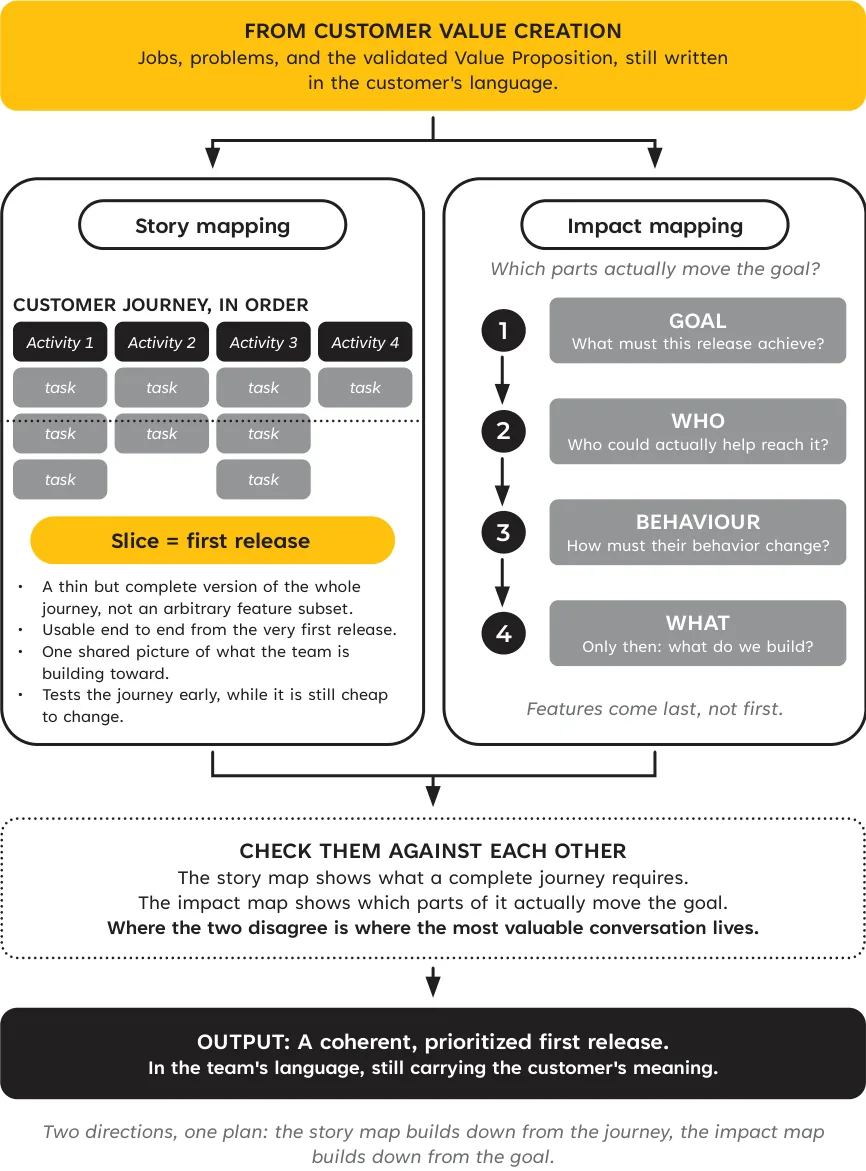
The jobs, problems, and value proposition from Customer Value Creation are not yet a plan a team can build against. They are still written from the customer's point of view, not the team's. Translating between those two languages is the first place meaning leaks, and two complementary techniques do the translation.
Story Mapping lays out everything a customer does, in order, as a horizontal backbone of activities, then stacks the specific things the product needs to do underneath each one. The advantage over a flat list of features is what it does to prioritization. Slicing a horizontal line across the map gives the team a coherent, minimal first release: a thin but complete version of the whole journey, instead of an arbitrary subset of a feature list that happens to fit a deadline. The customer gets something usable end to end from the very first release, and the team tests the whole journey early, while it is still cheap to change. The map also gives the whole team a shared picture of what they are building toward.
Impact Mapping works in the opposite direction, and is worth using alongside Story Mapping rather than instead of it. It starts from the business goal the release must achieve, then asks who could actually help reach that goal, how the team needs those people's behavior to change, and only then, as the last step rather than the first, what the team could build to cause that change. Teams that skip this and jump straight to features routinely end up with a well-built product that serves a goal nobody actually stated.
Run both and check them against each other. The story map shows what a complete journey requires. The impact map shows which parts of it actually move the goal. Where the two disagree is exactly where the most valuable conversation lives. Ten minutes of comparison can save weeks of building the wrong slice.
Step 2
Design, deciding how and writing down why.
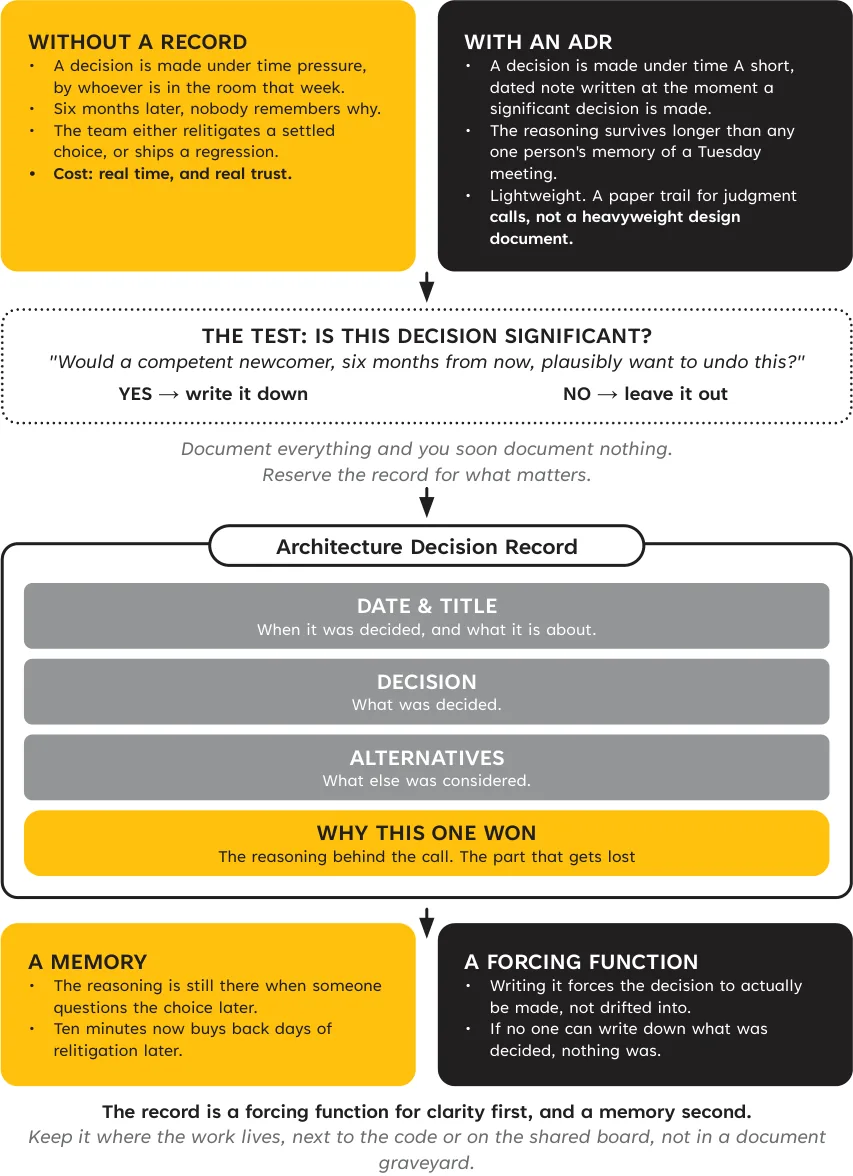
Design decisions, technical architecture as much as visual design, are made under time pressure, by whoever is in the room that week, and then forgotten. Six months later, a new engineer proposes simplifying something that was actually a deliberate tradeoff, and the team either relitigates a settled decision or ships a regression because nobody remembers why the original choice was made. Both cost real time and real trust when the bill finally arrives.
An Architecture Decision Record is the fix, and it is deliberately lightweight: a short, dated note written at the moment a significant technical decision is made, recording what was decided, what alternatives were considered, and why this one won. It is not a design document in the heavyweight, pre-Agile sense. It is closer to a paper trail for judgment calls, so a team's reasoning survives longer than any individual's memory of a Tuesday meeting.
The discipline is in the word significant. Not every choice deserves a record; a team that documents everything will soon document nothing. A good test: would a competent newcomer, six months from now, plausibly want to undo this? If yes, write it down. Ten minutes at the moment of decision buys back days of relitigation later.
There is a quieter benefit too. Writing the record forces the decision to actually be made. Plenty of architectural choices in product teams are never decided so much as drifted into, and the drift only becomes visible when someone has to write down what was decided and finds that nobody can say. The record is a forcing function for clarity first, and a memory second.
Step 3
Build, a shared bar for finished.
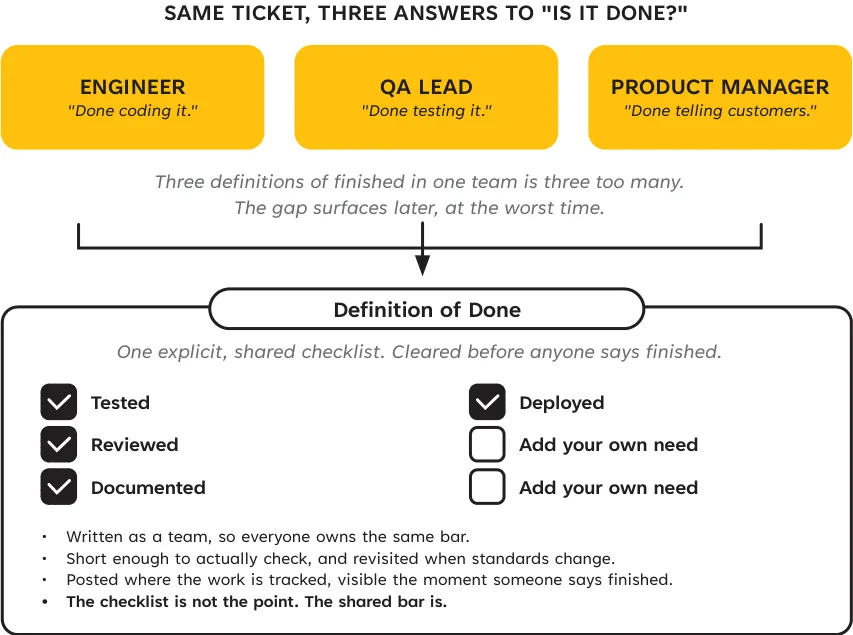
Ask an engineer, a QA lead, and a product manager what done means for the same ticket, and it is common to get three different answers: done coding it, done testing it, or done telling customers about it. Each person is describing the moment their own part of the work ends, and each is right from where they sit. But three definitions of finished in one team is three definitions too many. Work gets handed onward as complete when it is only complete by one person's measure, and the gap surfaces later, at the worst possible time.
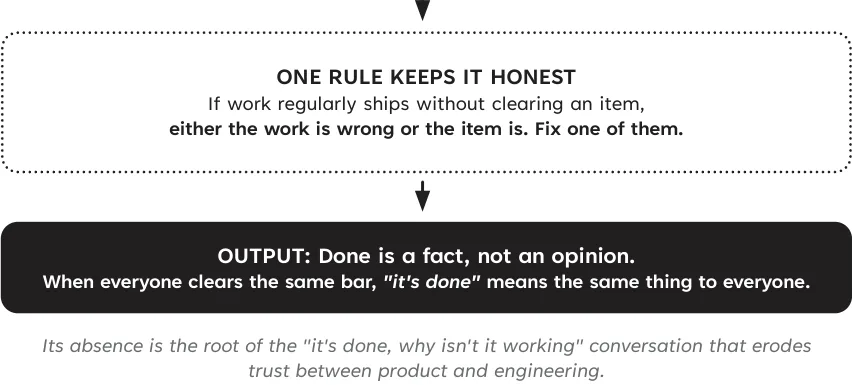
A Definition of Done closes that gap. It is an explicit, shared checklist that a piece of work has to clear before anyone calls it finished: tested, reviewed, documented, deployed, whatever the team actually needs. It sounds almost too simple to matter. But its absence is one of the most common sources of the "it's done, why isn't it working" conversation that quietly erodes trust between product and engineering.
Write it as a team, so everyone owns the same bar. Keep it short enough to actually check, and revisit it when the team's standards change. The checklist itself is not the point. The shared bar is. When everyone clears the same bar, done stops being an opinion and becomes a fact.
One rule keeps it honest: if work regularly ships without clearing an item, either the work is wrong or the item is. Fix one of them. And post the list where the work is tracked, so the bar is visible at the exact moment someone wants to call something finished.
Step 4
Release, without betting everything on one moment.
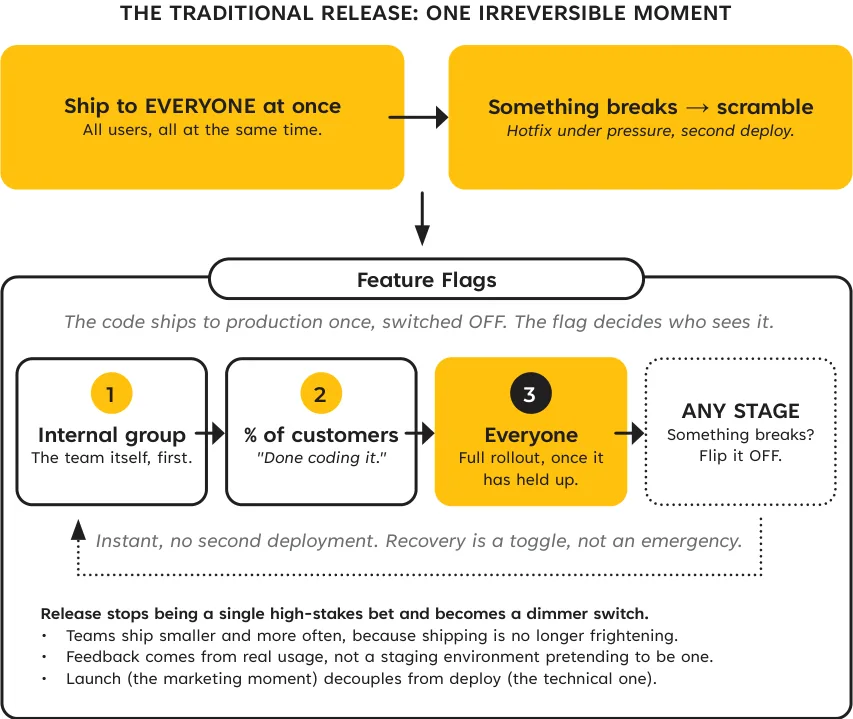
The traditional release is a single, irreversible event. Code goes out to everyone, all at once, and if something is wrong, the fix is a scramble: a hotfix written under pressure, a rushed second deployment, and a team watching dashboards at midnight hoping it holds. The release itself becomes the risk, so releases grow rare, large, and frightening, which only makes the next one riskier still.
Feature Flags change the shape of that risk. A flag lets the team ship code to production while keeping it switched off for most users, then turn it on gradually: a small internal group first, then a percentage of customers, then everyone. If something breaks, it can be switched back off instantly, without a second deployment. The code is already live; the flag simply decides who sees it. Recovery stops being an emergency and becomes a toggle.
Release stops being a single high-stakes bet and becomes something closer to a dimmer switch. That changes behavior, not just risk. Teams ship smaller and more often, because shipping is no longer frightening. Feedback arrives from real usage in production, not from a staging environment pretending to be one. And launch, the marketing moment, gets decoupled from deploy, the technical one, so each can happen when it is ready rather than being chained together on a single nervous date.
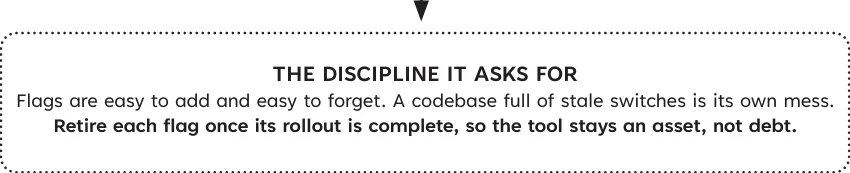
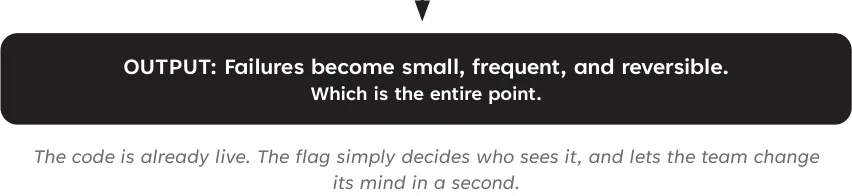
There is a discipline that comes with it. Flags are easy to add and easy to forget, and a codebase full of stale switches nobody dares touch is its own kind of mess. Retire each flag once its rollout is complete, so the tool stays an asset rather than becoming debt. Used with that care, small, frequent, reversible releases make failures small, frequent, and reversible, which is the entire point.
Step 5
Improve, closing the loop on the product and the team.
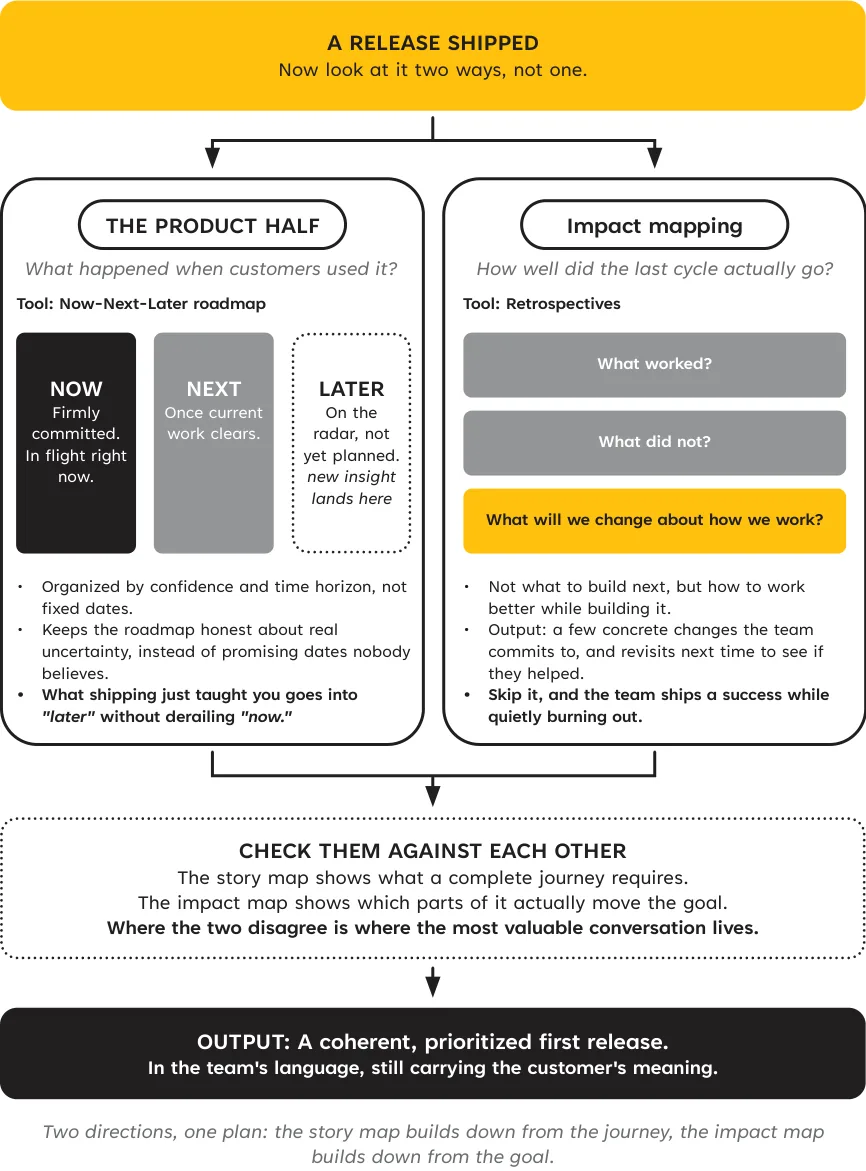
This step is where the workflow's real payoff shows up, and it has two halves that are easy to conflate. One is about the product: what actually happened once customers started using what shipped. The other is about the team: how well the last cycle of work went, independent of whether the feature itself succeeded. A feature can land beautifully while the team that built it is quietly falling apart, and both facts matter.
A Now-Next-Later roadmap handles the product half by organizing plans around confidence and time horizon instead of fixed dates: what the team is firmly committed to now, what comes next once current work clears, and what is on the radar later but not yet planned in detail. That keeps the roadmap honest about genuine uncertainty instead of promising dates nobody believes. It also absorbs what shipping just taught you, because "later" is where a fresh insight goes without derailing the work already in flight.
Retrospectives handle the team half: a regular, structured conversation about what worked, what did not, and what to change about how the team operates. Not what to build next, but how to work better while building it. Skipping this is how a team ships a successful release while quietly burning out, with the same friction resurfacing cycle after cycle because no one ever stopped to name it.
Do both halves, every cycle. The product half alone optimizes the output while exhausting the people who produce it. The team half alone improves morale while drifting from what customers need. Together they close the loop that makes this a workflow rather than a line.
task On the radar, not yet planned. new insight lands here
How these tools fit together.
Seven tools, one job. Not seven habits a team happens to keep, but a single thread that carries a validated idea safely from promise to shipped product, and hands it forward.
None of these seven tools is meant to operate alone. As with Customer Value Creation, they earn their value in combination, and it is worth seeing exactly how each one covers for the blind spot of another. Story Mapping and Impact Mapping without an Architecture Decision Record leave a team with a clear plan and no memory of the tradeoffs made while executing it, so the plan survives but the reasoning behind it evaporates. A Definition of Done without Feature Flags means every release is judged as finished-or-not, with no room for a gradual, reversible rollout, so the team's careful standard for "done" collides with an all-or-nothing way of shipping. And a Now-Next-Later roadmap without regular Retrospectives tracks what the team is building while staying silent on whether the way they are building it is actually working, so the plan improves while the people executing it quietly do not. Each gap is invisible until the tool that would have caught it is missing.
The coverage runs in the other direction too. Retrospectives without decision records tend to relitigate the past instead of learning from it, because nobody can check what was actually decided and why. Feature Flags without a roadmap make shipping safe but directionless, a stream of reversible releases with no shared picture of where they are heading. Even the humble Definition of Done depends on the retrospective to stay honest, because a bar nobody revisits slowly drifts away from what the team actually needs. Draw the connections out and a pattern appears: every tool is both a producer and a consumer, feeding one neighbour and checking another.
Used together, the seven tools trace one continuous thread. A validated idea becomes a sliced, prioritized plan. The plan becomes a documented set of decisions. The decisions become work everyone agrees is genuinely finished. The finished work becomes a release the team can control the risk of. And the release becomes a roadmap and a team practice that both keep improving. That thread is what turns Customer Value Creation's validated promise into something real.
The thread also has a rhythm, and knowing it stops the seven tools from feeling like seven ceremonies. Two of them are moment tools: Story Mapping and Impact Mapping come out at the start of a cycle, when a validated idea needs to become a plan, and then go back on the shelf. Two are event tools: an Architecture Decision Record is written the moment a significant choice is made, and Feature Flags are touched at the moment of release. Two are standing habits: the Definition of Done is checked continuously, on every piece of work, and the Now-Next-Later roadmap is glanced at whenever priorities are questioned. Only the Retrospective is a fixed appointment. A team that understands this spends remarkably little time on process, because six of the seven tools cost nothing except at the exact moment they earn their keep.
Notice what the thread protects at every point: not speed for its own sake, but meaning. Each tool exists to stop the validated idea from being quietly distorted at the moment it changes hands, from customer language to plan, from plan to architecture, from architecture to finished work, from finished work to live product, and from live product back into the plan. Skip a tool and the handover still happens, just without a witness. That is the quiet way good ideas die: not in a single bad decision, but in a series of small, unwatched translations, each one reasonable on its own.
This is not ideology, and it is worth saying so, because the thread makes a claim that sounds too good to be true: that discipline makes teams faster, not slower. The industry has measured this. A decade of DORA research across tens of thousands of teams keeps finding the same thing: the highest-performing teams deploy far more often than the lowest, in far smaller batches, and still fail less. In the most recent findings, elite teams deploy on demand, carry a change failure rate of around five percent, and recover from a failed release in under an hour, while deploying at frequencies their slower peers cannot approach. Speed and stability are not a tradeoff. They come from the same place: small, reversible, well-witnessed changes, which is precisely what this chapter's tools produce.
A practical note on adoption. Do not introduce all seven tools in the same week, because a team can only change so many habits at once, and seven new rituals arriving together feel like bureaucracy no matter how good each one is. Instead, listen for the symptom and adopt the tool that treats it. Decisions that keep getting reopened point to Architecture Decision Records. The recurring "it's done, why isn't it working" argument points to a Definition of Done. Releases that everyone quietly dreads point to Feature Flags. Roadmap dates that nobody believes point to Now-Next-Later. And a team that ships well but feels worse every cycle points to Retrospectives. Start where it hurts, prove the value, and let the next tool in when its gap becomes visible.
That thread does not end when the product ships. It ends by handing something forward. Because Product Development ends with a working, continuously improving product, not yet a viable business. The next question shifts from "can we build it well" to "can the organization make money from it sustainably": what pricing, channels, and cost structure turn a good product into a business that lasts? That is where Business Model Innovation picks up, and what it needs in order to ask whether that real thing can also become a sustainable business.
It does not start from a blank page. It carries forward the requirements, the usage data, and the product analytics this chapter's Improve step generated as its starting input. Nothing built here is thrown away at the boundary between workflows. The evidence compounds: each workflow inherits the validated output of the last and adds its own, so that by the time an idea reaches the business model, it arrives already tested as a customer need, already proven as a working product, and finally ready to be asked the one question left, whether it can pay for itself.