From gaps in the map to options worth testing.
Most organizations do not lack ideas. They lack a way of connecting ideas to anything, so exploration becomes theatre: workshops that generate post-its, post-its that become decks, decks that die in a drawer.
The chain this step follows exists to prevent exactly that. It starts from the outside, market and technology shifts that are actually happening, and refuses to let anything be called an option until it has passed through a customer problem and a job on its way to a business model.
The economics of exploration argue for this discipline. The most famous study of the innovation funnel, by Stevens and Burley, traced how many raw ideas it takes to produce one commercial success, across project literature, patent data, and venture capital experience, and arrived at the same brutal ratio from all three sources: roughly three thousand. Of those, about three hundred survive a first screen, 125 become small projects, nine become serious commitments, and fewer than two ever launch. Faced with numbers like that, most organizations respond by generating harder: more workshops, more post-its, more funnels. The chain responds differently. It does not try to beat the ratio with volume; it enters the funnel later, with candidates that have already survived the filters that kill most ideas: a real shift behind them, a real problem in front of them, and a job that names who will pay to have it done.
Run the chain in order. First name the shifts that matter for the attractive spaces step 2 identified: technology, regulation, behaviour, cost curves. Then ask what each shift does to customers: which workflows change, which problems appear or intensify, which existing solutions stop fitting. Sharpen those into Jobs-to-be-Done, stated the way this book has stated them since the Customer Value chapters. Only then design value propositions against the jobs, and wrap candidate business models around the propositions: how each would earn, through which channels, on which capabilities.
And aim the chain before running it. Step 2 already said where to look: the attractive spaces where the organization holds no position, and the Transform businesses whose models are wearing out. Exploration that starts from the map inherits its logic; exploration that starts from a blank wall inherits nothing, and produces the drawer-bound decks this step exists to prevent. A team that can say which gap each option addresses is having a portfolio conversation. A team that cannot is having a brainstorm.
Every link uses machinery this book has already built. The jobs work comes from the Customer Value workflow. The proposition design comes from the Value Proposition canvas. What is new here is the destination: options do not end as pitches. They end as experiments, and experiments need to know exactly what they are testing, which is where the Assumption Tracker takes over.
Business vs Innovation strategy.
Business strategy and innovation strategy converge in a Business Model portfolio through a structured process that begins with the innovation funnel and evolves toward the growth and maintenance of profitable Business Models. This integration ensures that innovation efforts are not isolated but strategically aligned with the organization's broader goals.
The journey starts with the innovation funnel, a structured pipeline that captures a broad range of ideas, from incremental improvements to disruptive concepts. These ideas are filtered and refined based on strategic alignment, feasibility, and market potential. Here, the innovation strategy plays a critical role by defining the criteria for selection and ensuring that new ideas support the company's long-term objectives.
Once promising ideas are identified, they are developed into early-stage Business Models using tools like the Business Model canvas. These models are tested through experiments and validated in the market. At this stage, innovation strategy is dominant, driving agility, learning, and customer discovery. However, business strategy starts to influence execution, risk management, and scalability.
This is usually where the Innovator's Dilemma sets in. The new Business Model is attractive, bold, and comes with a lot of potential. But unlocking this potential requires initial investment of financial means and time. Valuable resources that usually have to be reallocated from more mature Business Models. Organizations have to give up a healthy ROI from their core Business Models to risk investing in unproven alternatives which will take time to reach profitability, if they ever do.
But this innovation is essential. Without it your Business Model's lifecycle is also that of your organization. To enable innovation, organizations starkly benefit from a company culture which celebrates exploration and seeks to learn from mistakes, rather than avoiding them altogether.
When these Business Models prove viable, they move from the exploratory phase into the Business Model portfolio, which represents the mix of models the organization manages. This portfolio should be strategically balanced across different horizons: Core (optimizing current models), adjacent(expanding into related markets), and transformational (developing entirely new models). Business strategy should ensure this portfolio reflects market dynamics, competitive positioning, and financial targets.
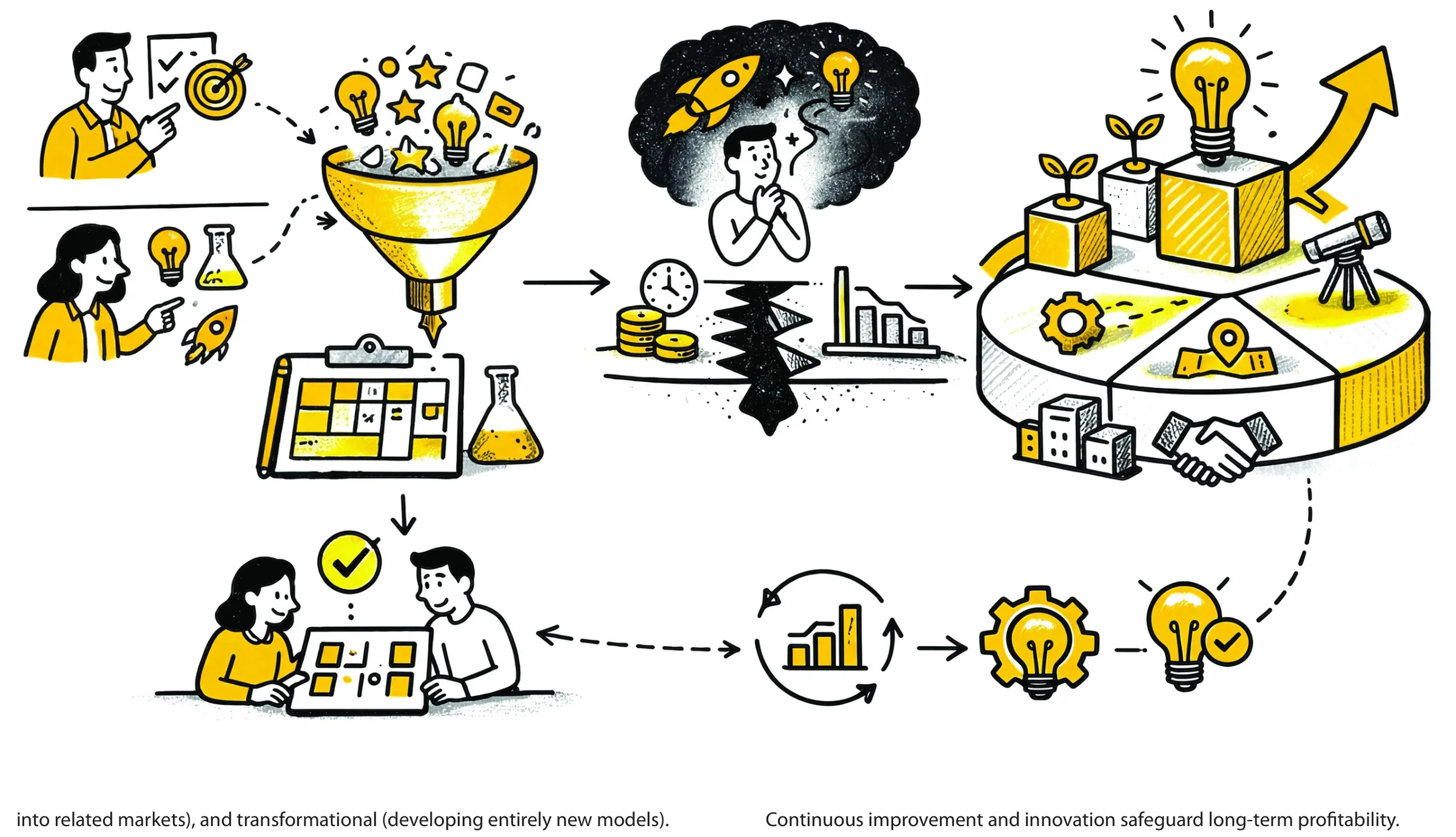
Innovation strategy remains essential in the growth phase, where models are scaled and adapted. Organizations need to invest in systems, partnerships, and talent to support scalability. Meanwhile, business strategy focuses on market entry, operational efficiency, and brand positioning. These approaches have to work together and support each other, understanding the strategic purpose of their counterpart. This is a requirement to setting up a sustainable Business Model portfolio.
Continuous improvement and innovation safeguard long-term profitability. Successful organizations embed a feedback loop, ensuring insights from the portfolio inform both innovation and business strategies. Truly future-proof organizations enable sustainable growth through a dynamic, strategically-aligned Business Model portfolio where experimentation and failure are celebrated, not feared.
Tool
Assumption mapping.
- PERSONAL
- test what must be true
- ± 90 MIN
- session
- 2-6
- people per group
Turning every candidate Business Model's riskiest claims into cheap evidence, before real money moves, is what separates exploration from gambling.
Every candidate Business Model that leaves the exploration chain looks convincing on paper, because paper does not push back. A model is a bundle of claims: customers will pay this, delivery will cost that, this channel will carry this volume. On the page, every claim looks equally solid. Most teams pick the claims they like and start building. And suddenly, real money is flowing toward assumptions nobody ever tested. That is where Assumption mapping comes in.
The evidence for this discipline is stark. CB Insights has run post-mortems on failed startups for a decade, and the same root cause has topped the list throughout: building something the market did not need, cited in 42 percent of the original analysis, and still leading the 2024 update, where 43 percent of 431 venture-backed failures died of poor product-market fit. Those companies did not fail from lack of effort. They failed from an untested desirability assumption, usually one that ten cheap conversations would have exposed.
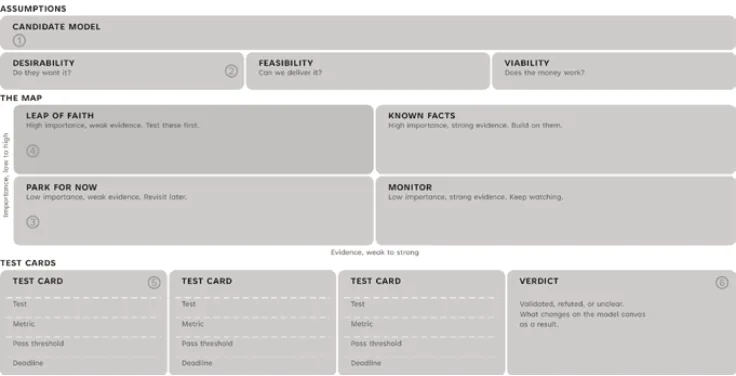
The method builds on assumptions mapping from Lean UX, refined by David Bland with Strategyzer: tag every claim with one of three questions, do they want it (desirability), can we deliver it (feasibility), does the money work (viability), then plot it by importance against evidence. The core purpose is derisking: find the claim that kills the model, and test it while testing is still cheap.
Benefits
- Answers: What must be true? Where is the biggest risk?
- Prevents over-investment in unproven models.
- Puts the dangerous assumptions first, not the easy ones.
- Creates shared language: leap of faith, known facts, parked, monitored.
- Enables small, cheap experiments in a deliberate sequence.
- Surfaces how little evidence the plan rests on.
Limitations and pitfalls
- Don't average placements; keep disagreements visible on the map.
- Avoid mixing models; one tracker per candidate.
- Weigh behaviour over opinions when judging evidence.
- Keep tests small and give every test a deadline.
- Revisit regularly; it's a snapshot, and evidence ages.
- Involve strategy, finance, operations, and customer-facing teams.
- How to use it: The 6-step process.
Name the candidate model.
One tracker per candidate, straight from the exploration chain. Open its Business Model canvas and list the claims block by block: who pays, what for, through which channel, at what cost.
Extract the assumptions.
Write each claim as a testable statement. Tag every one: desirability, do they want it? Feasibility, can we deliver it? Viability, does the money work?
Plot the map.
Score each assumption twice: importance, what breaks if it is false, and evidence, what you hold today. Place one claim at a time and leave disagreements visible on the map.
Find the leap of faith.
Look at the quadrant with high importance and weak evidence. The two or three claims there decide the model's fate, and the next experiment belongs to them.
Design the test cards.
Choose the cheapest credible test: ten customer conversations, a pricing page, a concierge pilot. Give every card a test, a metric, a pass threshold, and a deadline.
Record the verdict.
Mark each assumption validated, refuted, or unclear, and update the model canvas. Re-plot as evidence arrives, then decide: promote, redesign, or stop.
Find the shift, then shift the model.
New business models are not invented in a vacuum. They are found in the customer's workflow and unlocked with patterns.
The biggest mistake in business model innovation is starting with the question: "What new product could we sell?" Start instead with: "Where is the customer's workflow changing, and what new business model could we build around that change?"
That question turns innovation into a process rather than a brainstorm. It runs in one continuous line:
Customer workflow → Value opportunity → Value proposition → Business model patterns → New business models→ Experiments
Each step feeds the next. The workflow shows you where customer value is created or lost. That gap becomes a value opportunity. The opportunity is shaped into a value proposition. And only then do patterns come in, to challenge how that proposition is delivered and paid for.
Map the customer workflow. Where is value created, and where is it lost?
Don't map the customer's journey with your product. Map the entire workflow the customer goes through to accomplish a meaningful outcome.
So not: Search → Buy → Use our software.
But: Sense need → Define problem → Find options → Decide → Buy → Implement → Operate → Measure outcome → Improve.
Somewhere in that longer line, the customer is struggling, waiting, overpaying or working around you. Those moments are your value opportunities. Your product probably serves two or three steps. The workflow is where the other opportunities live.
You will recognise the opportunities by their symptoms. Look for the steps where the customer builds their own spreadsheet, hires a consultant, waits for another department, stitches three tools together or simply gives up. Every workaround is unpaid work the customer is doing to get to the outcome, and unpaid work is a business model waiting to be designed. Mark those moments on the map before moving on.
From customer value to value proposition.
A value opportunity is not yet a business. Before you touch the business model, shape the opportunity into a testable value proposition: which customer, which struggle in the workflow, and what you would offer to resolve it. This step matters because patterns applied to a vague opportunity produce vague models. Patterns applied to a sharp value proposition produce options you can actually test.
Now, and only now, are you ready to challenge the model itself.
Apply the business model patterns. From how it works today, to how it could work.
Every pattern is a shift, written the same way: from the logic you have, to a logic you could have. Take your value proposition and run it deliberately through each one.
| Business model pattern | Question to ask | |
|---|---|---|
| 1 | Product → Service | Could we sell the outcome instead of the product? |
| 2 | Service → Platform | Could we connect the actors in the workflow? |
| 3 | Transaction → Subscription | Could value be delivered continuously? |
| 4 | Ownership → Access | Does the customer really need to own it? |
| 5 | Selling → Usage | Could we charge based on consumption? |
| 6 | Input → Outcome | Could we charge for the result achieved? |
| 7 | Human → AI | Could part of the workflow become autonomous? |
| 8 | Single player → Ecosystem | Could partners create more value together? |
| 9 | B2B → Multi-sided | Could we create value for multiple customer groups? |
| 10 | One-off → Continuous | Could we stay involved throughout the customer's workflow? |
The critical point: you don't apply patterns randomly. You apply them to a specific value proposition, anchored in a specific moment of the customer's workflow.
Run the table as a discipline, not a discussion. For each pattern, spend a few minutes sketching what the shift would concretely mean for your proposition: who pays, for what, how often, and who does the work. Most patterns will not fit, and that is fine. The exercise is not to force ten new models into existence but to stop the team from defending the current one by default. Two or three patterns will make the room go quiet. Those are the ones worth keeping.
Then choose deliberately. Score the surviving options on three things: the customer value they unlock, the strategic fit with where you want to play, and how quickly the riskiest assumption can be tested. A brilliant model you cannot test for a year is worth less than a good model you can put in front of customers next month. The output of this step is not a decision to launch anything. It is a shortlist of new business models, each with its assumptions made explicit and an experiment attached.
The powerful combination
This gives you a simple strategic formula. The customer workflow tells you WHERE to innovate. The value proposition tells you WHAT to offer. The patterns tell you HOW to create and capture that value differently.
Each lens is weak on its own. Teams that only map the workflow end up with sharp insight into the customer's struggle but no new answer to it, so they ship another feature. Teams that only play with patterns end up bolting subscriptions and platforms onto propositions nobody asked for, which is how gimmicks get built. The value is in the sequence: the workflow disciplines the patterns, and the patterns give the workflow somewhere to go.
Or, more provocatively: don't invent business models in a vacuum. Find the shifts in the customer's workflow, then use patterns to turn those shifts into new sources of value and revenue.
And this is where it connects to Augmented Collaboration. AI can continuously sense changes in markets and customer workflows, identify opportunity spaces, search the pattern library, generate alternative business models, simulate their economics, challenge the assumptions and design the experiments. That turns business model innovation from an annual strategy workshop into a continuous workflow.
Freshwatching: steal the logic, not the company.
The best answers to your business model question are already running at full scale. They are just running in someone else's industry.
Freshwatching is the practice of deliberately looking outside your own industry, market and competitive set to discover business models that are already working somewhere else, and then asking: "What if we applied this logic to our customers, our market, our industry?"
It is a powerful ideation technique because of a habit almost every company shares. When teams look for inspiration, they benchmark against the usual suspects: direct competitors, adjacent players and familiar industry practice. That feels rigorous, but it guarantees incremental results, because everyone in the room is studying the same examples and arriving at the same conclusions. If your whole industry benchmarks against itself, the industry converges on one way of creating, delivering and capturing value, and nobody notices the assumptions they all share. Freshwatching breaks the pattern by hunting for business model logic in contexts where those assumptions never existed in the first place.
The name says what it is: watching, freshly. Not analysing your market harder, but looking sideways at markets you normally ignore, with one question in mind. Not "what do they sell?" but "how does the money and the value actually flow?"
How it works
Freshwatching has three steps, and the discipline is in keeping them separate.
Look sideways
Explore companies, markets and industries that have solved a value problem differently. Don't look for similar products. Look for interesting ways of creating, delivering and capturing value, wherever they live.
Netflix and Spotify shifted from ownership to access. Airbnb monetises capacity other people own. Amazon turned a shop into a marketplace and the marketplace into an ecosystem. Rolls-Royce sells power by the hour instead of engines. IKEA put the customer to work inside its own value chain. Salesforce turned software into a service. Uber orchestrates supply and demand it does not own.
None of these companies is in your industry. That is exactly the point. Each one is a working, proven answer to a question your industry may not have thought to ask yet.
Abstract the business model
This is the step most teams skip, and it is the one that makes the technique work. Don't copy the company. Extract the underlying logic, and write it the same way you write every pattern: from, to.
Rolls-Royce does not sell engines, it sells engine availability. Abstracted: from selling a product, to selling an outcome.
Airbnb does not own the assets, it orchestrates access to assets owned by others. Abstracted: from owning supply, to connecting fragmented supply with demand.
Once the logic is abstracted, the company that inspired it becomes irrelevant. You are no longer talking about hotels or jet engines. You are holding a transferable pattern, and a pattern travels across industries in a way a case study never does.
Reapply the pattern Bring the pattern back into your own customer context and ask: "Where could this work here?" You are not applying the pattern to your industry in general, but to a specific moment in your customer's workflow where value is created or lost.
An industrial equipment company might ask: what if we stopped selling machines and sold uptime? What if customers paid per unit produced? What if we created a marketplace for unused machine capacity? What if customers could configure and co-create products themselves? What if our installed base became a platform? The objective is not to find the answer. It is to generate strategic possibilities your industry's own benchmarks would never surface.
Freshwatching as an ideation loop
You can run this once, in a workshop, and get a wall full of options. But it works better as a repeatable loop:
Your customer problem → Look outside your industry → Spot an interesting business model → Abstract the pattern → Transfer the logic → Adapt to your customer → Design the new business model → Test the assumptions
The important shift is in the first question. Stop asking "who is doing something similar to us?" and start asking "who has solved a similar value problem in a completely different way?" The first question finds competitors. The second finds patterns.
A useful Freshwatching question set
When you explore another industry's business model, interrogate it systematically. Who pays? What exactly are they paying for? What is being sold: a product, a service, access, an outcome, an experience, data or a platform? Who creates the value? Who owns the assets? What role does the customer play, and what role does the company play? How is revenue generated? What recurring relationship is created? And finally, the transfer question: what would happen if we transplanted this logic into our industry?
Ten questions, and the last one is the only one that mentions you. That is deliberate. The longer you can stay inside the other industry's logic before jumping back to your own, the more you will actually learn from it.
The key principle
Freshwatching is not competitor analysis. It is business model pattern recognition. You are not asking "how can we become more like Airbnb?" You are asking "what is Airbnb doing differently, and where could that logic create value for our customers?"
That is why it belongs in this step, alongside the customer workflow and the pattern table. The workflow gives you an inside-out view: where your customer's world is shifting and where value is waiting. Freshwatching gives you the outsidein view: proven model logic from beyond your industry's line of sight. One without the other is half an exercise. Together they feed the same pattern step with better raw material, and they give AI something concrete to work with too: a library of abstracted patterns it can continuously match against the opportunity spaces it detects in your customer's workflow.