From products you sell to businesses you run.
Every organization already has a business model portfolio. That is worth saying plainly, because teams talk about "our business" in the singular while running three or four distinct models without noticing. A subscription product, a services arm that grew around it, a reseller channel with its own economics, a data by-product someone monetized: each creates, delivers, and captures value differently, and each has been accumulating decisions, about pricing, channels, partners, and costs, since its first sale. Together they form a system nobody has ever looked at in one piece.
That is the problem this step solves. A portfolio nobody can see is a portfolio nobody can manage. Costs that made sense at ten customers quietly become absurd at a thousand. A channel that was a stopgap becomes a dependency. Two models compete for the same customer without anyone deciding they should. None of these are decisions anyone made. They are drift, and drift is invisible until every model is on the table in front of the whole team.
So the first step of portfolio management is not strategy at all. It is inventory. Capture each business the same way, agree the pictures are accurate, and only then start asking which are strong, which are leaking, and which deserve more. Teams that skip straight to strategy end up allocating capital on a fiction, and the plan inherits every unexamined weakness of the map it never drew.
There is a second prize hidden in the exercise: a shared language. Finance thinks in cost structures, sales thinks in segments and channels, product thinks in value propositions, and in most organizations those vocabularies never meet. Capturing every business in the same blocks puts all of them on comparable pages, so that for the first time the head of sales and the head of engineering are pointing at the same picture when they disagree, about any business the company runs.
What to capture for every business.
Discovery is a disciplined inventory, not an essay. For each business or model in the organization, capture the same nine things, briefly and honestly:
- Customer. Who this business actually serves, not who the deck says it serves.
- Problem or job. The customer problem or Job-to-be-Done this model exists to solve.
- Value proposition. The promise, in the customer's language.
- Revenue model. How the business earns, and at what real prices.
- Key channels. How customers find it, buy it, and are served.
- Key capabilities and assets. What the model needs to be good at, and to own.
- Cost structure. The biggest costs, fixed and per customer.
- Geography and market. Where the model operates and genuinely wins.
- Strategic owner. The named person accountable for this model's future.
The output is a single portfolio map: every current business model, visible together, in the same language. That map is the raw material for everything that follows.
What we mean by a Business Model and why this matters.
Let's get one thing out of the way. If you have never heard of the term Business Model, or the Business Model canvas, there are only three possible explanations:
- You have been living under a rock
- You have been working in an organization where strategy is considered a dirty word
- You have heard the terms so often that they've become background noise
In all three cases, this short section is for you. Because while everyone uses the term “Business Model,” far fewer people agree on what it actually means, and even fewer use it deliberately.
The simplest definition (that actually works):
“A Business Model explains how an organization creates value, delivers value, and captures value”.
That's it. Not your product. Not your org chart. Not your mission statement.
Your Business Model is the logic behind your business: The set of assumptions that answers three brutally practical questions:
- Who is this really for?
- Why should they care?
- Why does this make economic sense for us?
If your strategy is your ambition, your Business Model is how you make that ambition work in the real world.
And here's the important part: A Business Model is not what you say you do. It is what your customers experience and what your financials prove.
Why we needed something visual
For years, Business Models lived in:
- PowerPoint decks
- Strategy documents
- The heads of a few senior leaders
Which made them:
- Hard to discuss
- Easy to misunderstand
- Almost impossible to change
Then someone had a radical idea: What if we made the Business Model visible, all on one page?
Enter the Business Model canvas.
Visualising Business Models: The Business Model canvas.
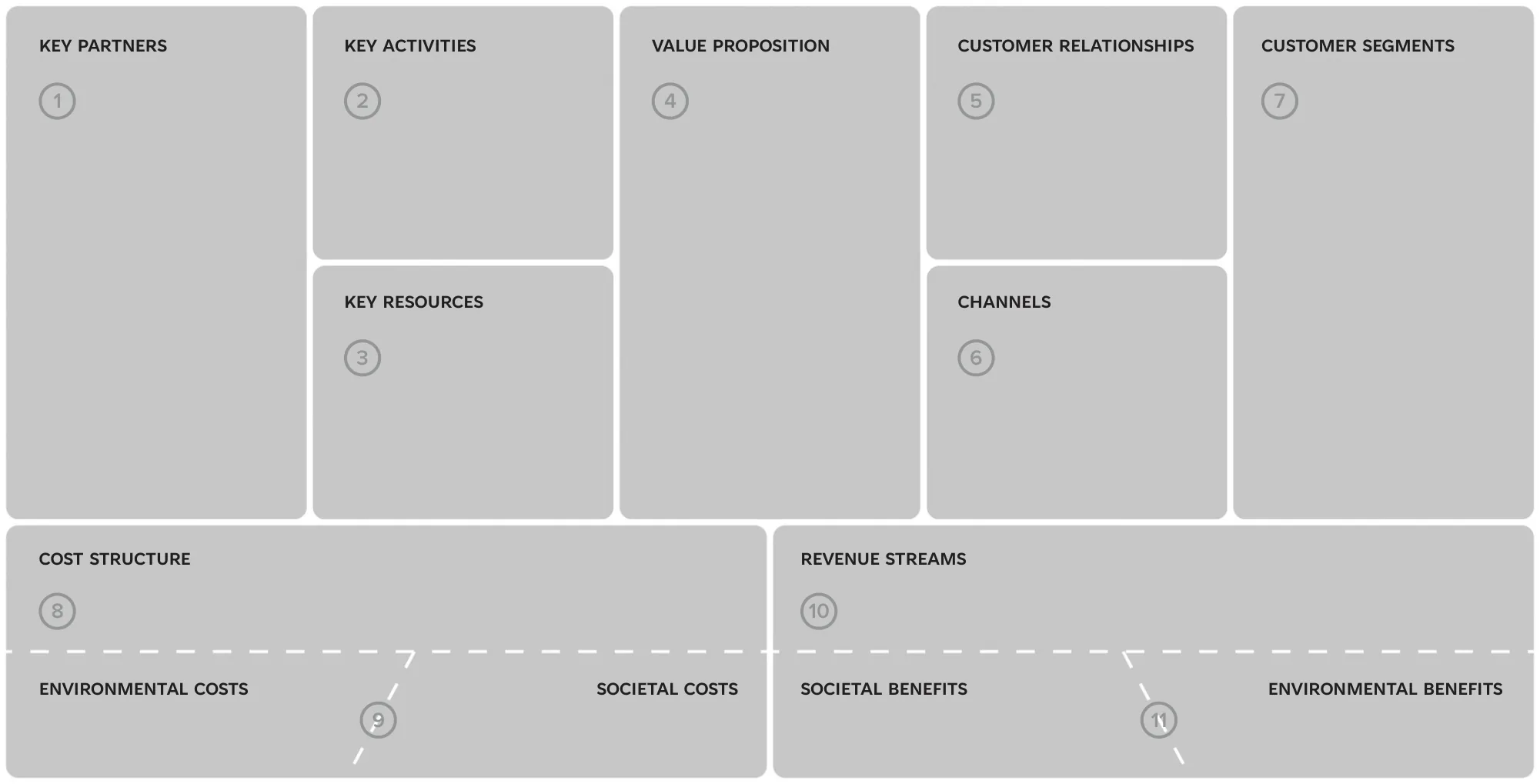
The Business Model canvas is a visual map of the key elements that together form a Business Model. It doesn't replace strategy. It makes the logic behind strategy explicit. It consists of nine building blocks, grouped into three simple questions: Why customers care? How it actually works? and Why it's sustainable?
Value creation: Why customers care
- Customer segments
- Value Propositions
- Channels
- Customer relationships
Value delivery: How it actually works
- Key activities
- Key resources
- Key partnerships
Value capture: Why it's sustainable
- Revenue streams
- Cost structure
Put together, these blocks tell a coherent story: Who you serve, what you offer, how you deliver it, and how you make money doing so.
However, its real power is not in the boxes themselves, but in the connections between them. Change one block, and others must follow. That's exactly why it's so useful when ideating Business Models.
Why this matters for the lifecycle you're about to read
The lifecycle of a Business Model is not about changing boxes on a canvas at random. It's about understanding which assumptions are being formed, tested, reinforced, stretched, or abandoned over time.
- In early stages, the canvas is fluid, more question marks than answers.
- In growth, it becomes sharper and more constrained.
- In maturity, it hardens.
- In decline, it resists change.
Seeing your Business Model on a canvas makes that evolution visible. And once something is visible, it can finally be discussed, challenged, and redesigned.
One last thought before we continue
If you feel slightly offended by the idea that you might not really understand your own Business Model: Good. That discomfort is exactly where insight starts. Now that we're all out from under the stone, we can move on.
In the next chapter, we'll look at how Business Models, like products, are born, grow, mature, and eventually need to be let go.
And why ignoring that lifecycle is one of the most expensive mistakes a company can make.
Tool
Business Model canvas.
- PERSONAL
- map Business Model insights
- ± 30 MIN
- session
- 2-6
- people per group
Organizations often get lost in their own complexity. Don't lose track of the essence of your Business Model and what makes it successful.
The Business Model canvas (BMC) is arguably the most well-known of them all. It is a tool to help you understand a Business Model in a straight forward, structured way. It is foundational to your understanding of what environment your business exists in. Using this canvas will lead to insights about the customers you serve, what Value Propositions are offered through what channels, and how your company makes money. You can use the Business Model canvas to analyze your own Business Model or that of a competitor!
First introduced through the Bestseller 'Business Model generation' in 2010 it has since established itself as a useful strategic framework for multinational companies and startups alike.
Originally it was made up of 9 building blocks: Key partners, Key activities, Key resources, Value Proposition, Customer relationships, Channels, Customer segments, Cost structure, and Revenue streams.
This enabled businesses to establish a shared, visual language for Business Models. Helping to make the underlying logic of it explicit and tangible. Many external and internal forces such as shifting customer expectations, technology, regulation, and competition, can now be mapped and their influence on a specific business measured.
In practice, the Business Model canvas is used not only to describe existing businesses but also to explore alternatives and test new ideas. Teams can prototype different Business Models, compare scenarios, and evaluate how changes in one area affect the system as a whole. This makes it especially useful in innovation, transformation, and growth contexts, where experimentation and learning are critical.
Compared to the traditional BMC, we have chosen to add two new blocks: Environmental/Societal costs, and Environmental/Societal benefits. These make up the foundation of the canvas as a Business Model can only be truly sustainable if it has a net positive influence on the world around it.
Building blocks Key partners
List the partners you can't do business without (not suppliers)
- Key activities
- What do you do every day to run your Business Model?
- Key resources
- The people, knowledge, means, and money you need to run your business.
- Value Proposition
- What is your offering? What is the job you get done for your customer?
- Customer relationships
- How does this show up and how do you maintain the relationship?
How do you communicate with your customer? How do you deliver the Value Proposition?
List your most important (future) segments. Look for the segments that provide the most revenue.
List your top costs by looking at activities and resources.
Environmental/Societal costs
What's the negative impact of your Business Model?
List your top three revenue streams. If you do things for free, add them here too.
Environmental/Societal benefits
What are you giving back to your community and planet?
The lifecycle of a Business Model.
Most leaders understand the lifecycle of a product. Fewer recognize that the Business Model enabling that product follows a lifecycle of its own. Slower, more systemic, and often more dangerous when ignored. While products can be replaced, iterated, or discontinued with relative ease, Business Models embed themselves deeply into organizational structures, incentives, and beliefs. This makes their evolution both essential and difficult.
A Business Model is not a static blueprint. It is a living system of assumptions about how value is created, delivered, and captured. Like any living system, it is born, it grows, it matures, and eventually it declines. Understanding this lifecycle is a prerequisite for long-term relevance.
This chapter explores the lifecycle of a Business Model across seven stages: Ideation, Problem validation, Solution design, Product–market fit, Amplify, Sustain, and Divest. While these stages may feel familiar to those used to product development, their meaning (and their risks) are fundamentally different when viewed from a Business Model perspective.
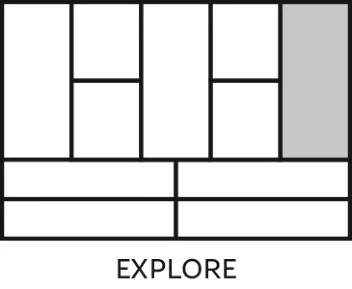
Ideation: Imagining a different value logic
Every Business Model begins as a hypothesis, not a plan. In the ideation stage, the organization explores new ways of creating value by questioning existing assumptions. This is not about generating product ideas, but about imagining alternative value logics: Who else could we serve? How else could value be captured?
At this stage, the Business Model is deliberately incomplete. It consists of loosely connected assumptions about customers, Value Propositions, revenue mechanisms, and logistics. The goal is to determine whether the initiative is possible. Ideation thrives on divergence, curiosity, and reframing.
Organizations often fail here by narrowing too quickly, forcing new ideas to fit existing Business Model constraints. When ideation is treated as an extension of current offerings rather than a rethink of value creation, truly new Business Models never get a chance to emerge.
The key risk in this stage is premature convergence: Deciding too early what the Business Model must look like.
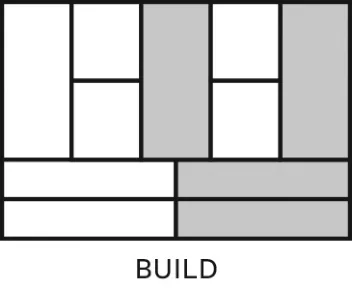
Problem validation: Testing whether the value really matters
In problem validation, the Business Model begins to encounter reality. The focus shifts from internal assumptions to external evidence. The core question becomes: Is this problem real, urgent, and worth solving at scale?
Unlike product validation, problem validation at the Business Model level examines whether the underlying Job-to-be-done justifies an entirely new value logic. It looks beyond feature desirability to structural pain points: Inefficiencies, risks, unmet outcomes, or misaligned incentives in the customer's world.
Here, the Business Model is still flexible, but its scope starts to narrow. Some assumptions fall away; others become sharper. Revenue logic is explored conceptually, partnerships are imagined, channels are considered. Crucially, no decision is irreversible.
The key risk in this stage is solution bias: Validating the problem only insofar as it supports a pre-existing idea. True problem validation often forces uncomfortable conclusions, including the possibility that the Business Model should not exist at all.
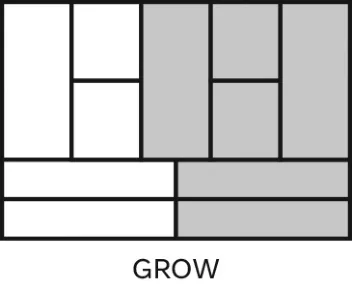
Solution design: Assembling a coherent system
Once a problem is validated, the Business Model enters solution design. This is where individual components, Value Proposition, Revenue Model, delivery system, partners, and cost structure, are deliberately designed to work as a coherent whole.
Unlike products, Business Models cannot be prototyped in isolation. Every design choice affects the others. Changing pricing affects partnerships; changing channels affects cost structures; changing the customer segment reshapes the entire logic.
At this stage, the Business Model becomes more explicit. Assumptions are articulated and prioritised. Trade-offs are acknowledged. Early design principles emerge: What the model will optimise for, and what it will deliberately not do.
The key risk here is internal alignment: Solution design often exposes tensions between the new Business Model and the existing organization. Incentives clash, capability is overestimated, and governance is diluted. Treating these as execution problems rather than design constraints is a common mistake.
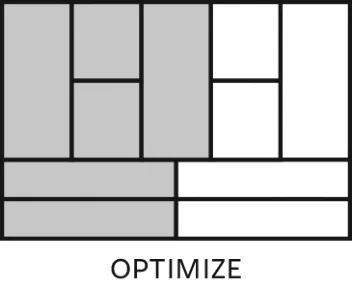
Product–market fit: Proving the Business Model works
Product–market fit is often misunderstood as a product milestone. In reality, it is a Business Model milestone. It is the moment when value creation, delivery, and capture align in a way that customers willingly sustain.
At this stage, the Business Model stops being theoretical. Customers pay, not once, but repeatedly. Value is not only perceived, but embedded in behavior. Revenue starts to show patterns and unit economics become visible.
Crucially, product–market fit does not mean the Business Model is finished. It means the core assumptions are no longer hypothetical. The model works, but only under specific conditions, with specific customers, and often at a limited scale.
The key risk here is false confirmation: Mistaking early traction or enthusiastic customers for a scalable Business Model. Without discipline, organizations lock in too early and harden a model that has not yet proven resilience.
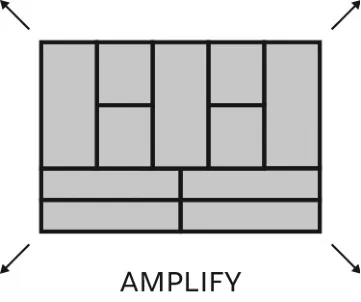
Amplify: Scaling the logic
In the amplify stage, the Business Model shifts from learning to leverage. The core logic is no longer questioned daily; instead, it is multiplied across markets, segments, or volumes. Systems are standardised, processes formalised, and governance tightened.
This is where the Business Model becomes visible in the organization's structure. Roles, incentives, KPIs, and investments begin to reflect the logic of the model. The organization learns how to execute efficiently.
Amplification is powerful and dangerous. The same mechanisms that enable scale also reduce flexibility. Assumptions become embedded in software, contracts, and culture. What once was a hypothesis turns into “the way we do things.”
The key risk in this stage is over-optimization: Confusing efficiency with future readiness. The better a Business Model works today, the harder it becomes to question tomorrow.
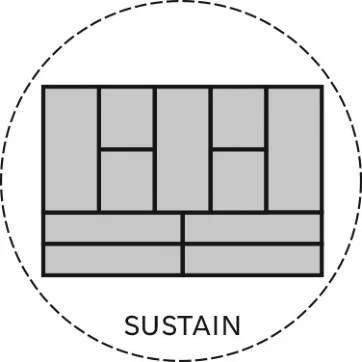
Sustain: Defending relevance
Sustainment is the longest and most underestimated phase of the Business Model lifecycle. The core logic remains viable, but the environment shifts around it. Customer expectations evolve, competitors adapt, regulations change, and new technologies emerge.
In this stage, the Business Model is less about growth and more about relevance. Margins are defended rather than expanded. Innovation becomes incremental. Complexity increases as exceptions, extensions, and workarounds accumulate.
A healthy sustainment phase requires conscious renewal: Simplifying where possible, updating assumptions, and investing in adjacent or exploratory models. Without this, sustainment quietly slides into extraction.
The key risk in this stage is denial: Mistaking stability for safety, and longevity for inevitability.
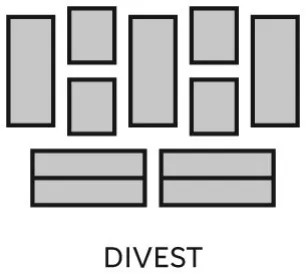
Divest: Letting go with intent
Every Business Model eventually reaches a point where sustaining it no longer creates future value. Divestment is not failure; it is a strategic act. It can take many forms: Spinning off, selling, harvesting, or deliberately winding down.
In this final stage, the organization acknowledges that the underlying value logic no longer fits the world as it is becoming. Resources are reallocated, talent is transitioned, and emotional attachment is confronted.
Divestment is difficult because Business Models are identity-shaping. They carry history, success, and pride. Yet organizations that avoid divestment often end up trapped, defending a past that limits their future.
Done well, divestment frees energy, capital, and attention for the next Business Model lifecycle to begin.
The key risk here is emotional attachment: Not being willing to let go of the Business Model which brought your company success in the past.
Closing reflection
Understanding the lifecycle of a Business Model allows organizations to move from reactive change to intentional evolution. It shifts innovation from isolated initiatives to systemic renewal. Most importantly, it reframes strategy as a continuous design challenge, not a one-time choice.
The question is no longer whether your Business Model will change, but whether you will recognize its lifecycle early enough to shape what comes next.
Putting the map to work.
Map what is, not what should be.
The strongest temptation is aspiration: "enterprise clients" because sales hopes to land some. Resist it: the map has one job, to be true; aspiration belongs in step 3, labelled as an option. Two rules keep it honest: one model per canvas, because averaging two produces a picture false for both, and every function in the room, because the people answering tickets and closing deals know what no deck contains.
Then put numbers on every page, actual price and churn, true delivery cost, so each canvas becomes a one-page profit and loss check. A map without numbers invites opinions; with numbers, decisions. Together the models reveal the value space, the territory of customer problems worth solving: the map marks where the organization stands, step 3 hunts in the open parts.
As Clayton Christensen demonstrated, actual strategy is not what documents declare but what resource allocation reveals: a deck can say "data is our future" while two percent of engineering time touches data; in that gap the timesheets are right. The honest map is how leadership confronts its real strategy, possibly for the first time.
A worked example.
The restaurant inventory company discovers it runs three businesses: the subscription tool, independent owners on a monthly fee; a services business grown around onboarding, restaurant groups paying for setup and training; and a data by-product, two suppliers buying anonymized demand reports. Three customers, three revenue models, three cost structures, one line in the plan. The map asks harder questions: services has no owner and no price list, the data business appears in no strategy document, the subscription carries onboarding costs that belong to services. The numbers sharpen it: the subscription margin is healthy but shrinking, services may not be profitable at all, never priced as a business, and the tiny data by-product runs at a margin the others can only dream of. Leadership is already asking: why is the best-margin business the one with no plan?
Common ways this step goes wrong.
Mapping aspiration instead of reality. One department filling it in alone, making a map sales and operations know is wrong. Counting products instead of models. Filing the map instead of working on it. And the stale map: step 5 makes it a quarterly rhythm, but only if step 1 ends with a date, an owner, and return visits.
What this step hands to the next.
One honest map: every business in the same language, each with a named owner, including models nobody had noticed. Step 2 asks which are strong and where the weight should go; step 3 treats the most dangerous claims as assumptions. It also arms the organization against allocation inertia: McKinsey's study of over 1,600 companies found the average firm shifts only about eight percent of its capital each year, yet the most active reallocators over fifteen years earned dramatically higher returns and were likelier to still exist. You cannot reallocate what you cannot see. The deliverable is deliberately small: one map, one date, one owner per model, and a leadership team that agrees the picture is true. Draw it honestly and the rest gets easier; draw it flatteringly and every following step inherits the flattery at compound interest.